- The battery stores energy; the inverter and grid controls help the installed system supply selected loads.
- kW describes power at a moment; kWh describes accumulated energy.
- A written load schedule and power assessment are separate from a duration calculation.
- Charge, operating conditions, winter generation and outside services can limit backup.
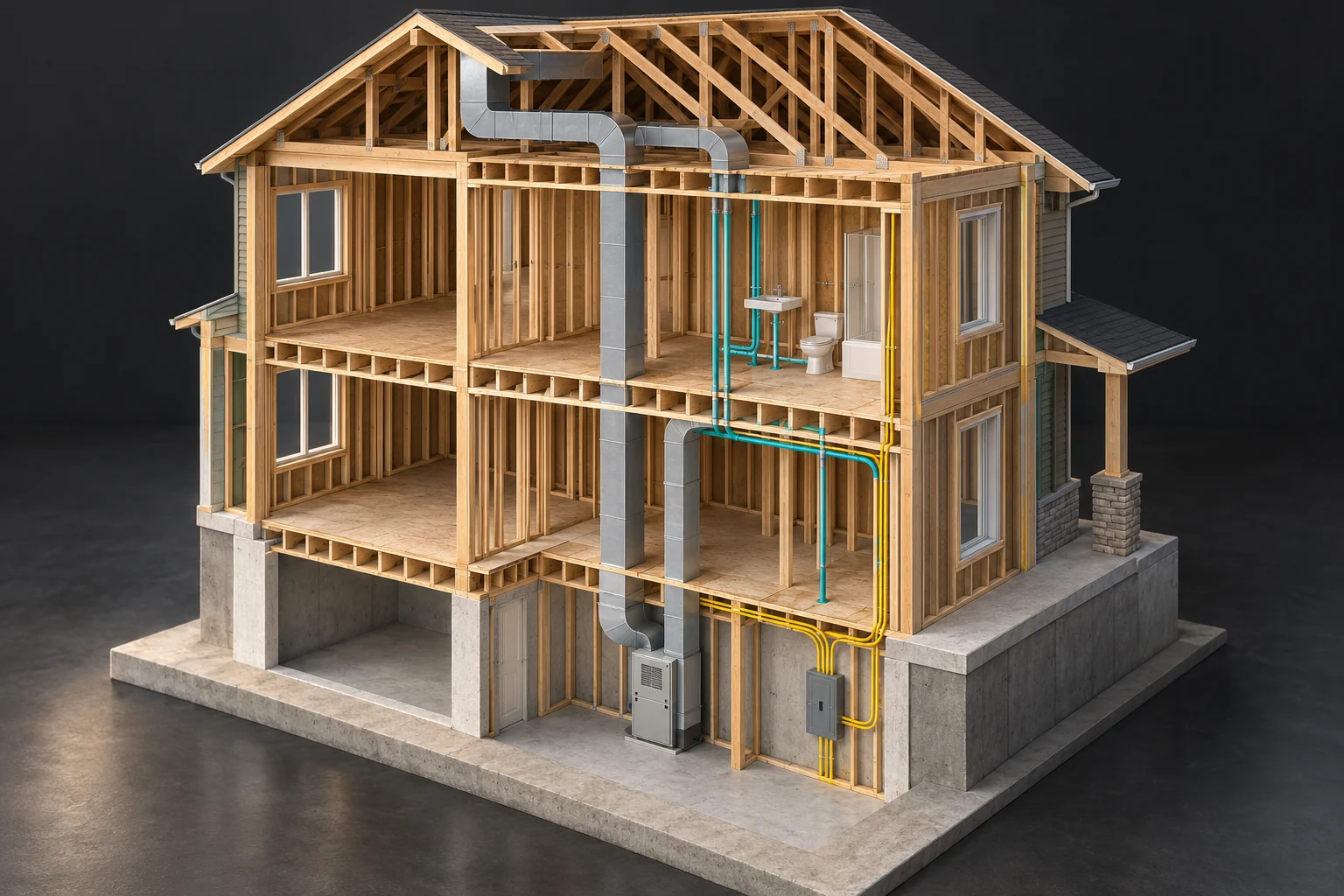
Conceptual architecture. Layout, sizes and routes are illustrative; the picture does not describe your home’s condition.
Explore this in the visual atlas ↗4 picture lessons appear beside the questions in this guide. Use them to understand the explanation, then consider what it means for your home.
What does a backup-battery proposal need to answer?
A home battery stores electrical energy. An inverter converts electricity into the form the connected household loads use. Controls manage the system and its connection to the grid. Those jobs may be combined in one cabinet or divided among several devices, depending on the product and installation.
During an outage, the installed backup arrangement must separate the home’s backup supply from the grid. The circuits selected in that arrangement determine what can receive power. A battery on the wall therefore tells you less than a drawing and a written list of the connected loads.
Start with three everyday questions: will the fridge stay powered, can the heating equipment operate, and what happens if the outage lasts longer than expected? Ask the installer to name the supported loads, power limits and assumed energy available. “Whole-home backup” needs that explanation; it does not promise that every appliance can run together indefinitely.
Tesla’s Canadian support pages illustrate battery, conversion and grid-control roles for its named product family. They are useful examples, rather than a design specification for every Canadian home. Obtain the documents for the actual equipment and proposed configuration.
Storage, power conversion and backup controls do different jobs
The tall cabinet represents energy storage, the middle one power conversion, and the smaller enclosure backup controls. They introduce the jobs to ask about in a proposal.
Numbers identify the parts explained below.
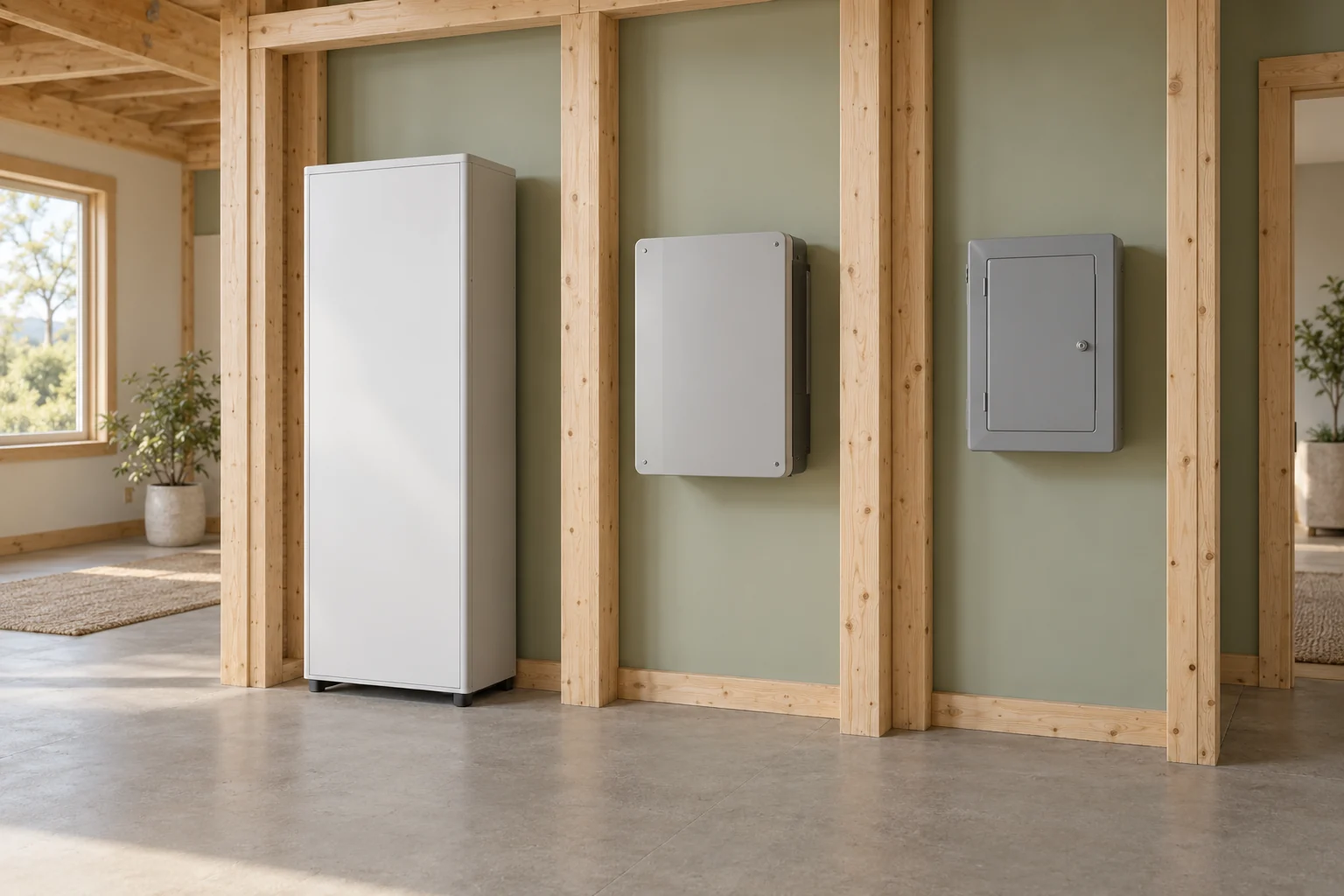
- Battery
Stores energy for later use. Its available energy needs a defined starting condition and measurement boundary.
- Power conversion
An inverter or integrated converter supplies the required form of electrical power. Its output and starting limits are separate from energy capacity.
- Backup controls
The actual equipment and configuration manage the permitted change between grid and backup operation. Ask what your installed design includes.
What does this illustration leave out?
These closed shapes are conceptual role markers, not identified products or a connected electrical system. Some products combine jobs. The picture supplies no ratings, protected circuits, verified transition or compliant installation. Ask the designer to explain the actual equipment and its limits. Use the installed model, current local authority and qualified provider for actual assessment. Keep electrical enclosures closed and stay clear of damaged equipment.
Which installed equipment stores energy, converts power and manages backup operation—and what does the proposal confirm about each job?
Explore this with HomeAI ↗Opens an editable question. Nothing is sent until you choose to send it.Why are kilowatts and kilowatt-hours different?
Kilowatts, written kW, describe how quickly energy is being used or supplied. Kilowatt-hours, written kWh, describe an accumulated amount of energy. A power limit answers “how much at once?”; an energy amount helps answer “for how long?”. Both matter.
For a fictional constant load, 1 kW used for 2 hours consumes 2 kWh. A 2 kW load used for 1 hour also consumes 2 kWh. The energy is equal, but the second load needs twice the power while it is running. These are teaching numbers, not appliance ratings.
NRCan’s 2020 solar-planning guide explains the relationship: constant power multiplied by elapsed hours gives energy. This historical publication supports the units and arithmetic here. Its older tariffs, code examples and installation details are not presented as current requirements.
Keep kW and kWh in separate fields when comparing proposals. More kWh can add energy storage without establishing a higher supported power output. A larger power rating, by itself, cannot establish a longer outage duration.
Power and energy answer different questions
- Power, in kWHow much can be supplied or used at once? Check running and starting requirements separately.
- Energy, in kWhHow much can accumulate or be delivered over time? Identify the stated conditions and point in the system.
- Duration, in hoursUnder the constant-load assumptions, energy divided by positive power gives arithmetic duration. Compatibility is a separate condition.
Why is advertised capacity different from energy available at the loads?
A capacity figure describes energy under stated conditions. “Nominal,” “usable” and “available now” can describe different things. Available energy also depends on the starting charge and the actual operating conditions. Ask which meaning the proposal uses before placing a number in the duration worksheet.
Follow the energy to the selected appliances. If the proposed amount is already the energy deliverable at those loads, the installer should explain which allowances it includes. Do not subtract an assumed conversion loss again. If the figure describes another point in the system, ask for a supported translation rather than choosing a generic efficiency percentage.
Tesla’s retained 2025 Powerwall 3 datasheet separates energy, output power and conversion paths and states test conditions. It is a named-model example, not a universal Canadian battery allowance. The actual model, edition and configuration need their own interpretation.
A proposal can be incomplete without the battery being defective. Missing charge assumptions, an unclear measurement point or an unspecified operating limit may explain the uncertainty. Mark the duration unknown until the useful input is established.
Which loads would actually stay powered?
A critical-load schedule is a list of the household jobs you want backup power to support and the equipment and circuits needed for them. Begin with jobs such as refrigeration, communication, lighting or water management. Then ask the installer to identify the actual connected devices.
A fridge needs its supplied circuit and enough power to operate. A router needs its own power, while outside communication service is a separate dependency. A water pump needs its supply and controls; its starting demand is another question. Keeping one device powered does not guarantee that the wider service remains available.
For a heating system, ask which blower, controls, pumps or other parts the proposed backup actually covers. The required parts vary with the equipment. Do not assume that a gas-fired system can provide heat solely because fuel is available.
The schedule should distinguish included loads, excluded loads and any managed loads that the system controls. Tesla’s owner manual describes loads selected during design for partial backup. BC Hydro likewise explains that the installed circuits determine which appliances receive backup power.
Use existing plans, handover records and safely available labels. Leave circuit tracing, panel access and power measurements to the appropriate professional. The diagram below is a planning example; it identifies no protected circuit in your home.
Turn three household priorities into installer questions
The three rows show a household job, its unanswered dependency questions and the record to request from the installer.
Numbers identify the parts explained below.
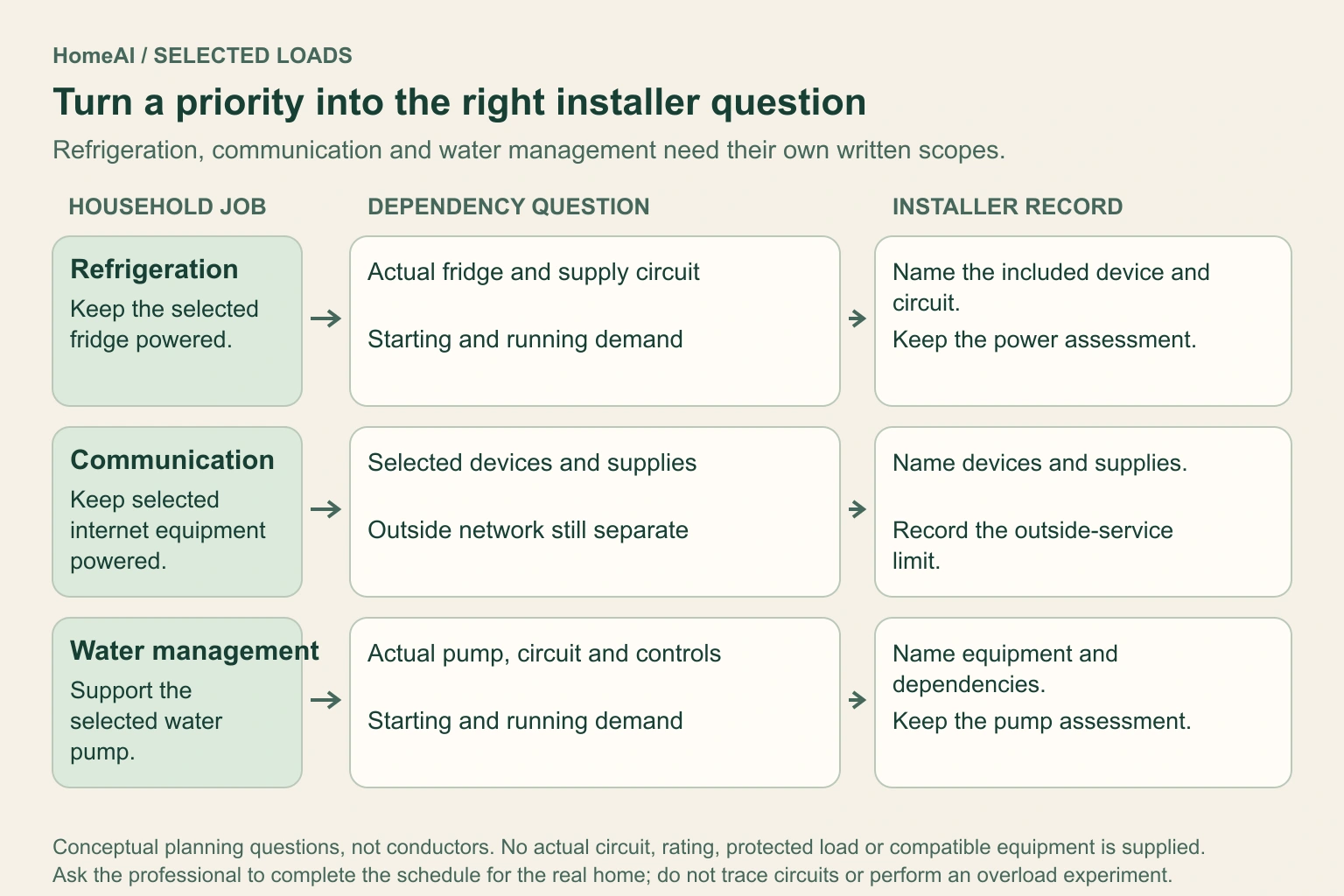
- Refrigeration
Keep the selected fridge powered. Which actual circuit supplies it, and what starting and running demand must the design support? Name the included device and circuit and the power assessment. No real circuit or rating is supplied here.
- Communication
Keep selected internet equipment powered. Which devices need power, and which outside network service remains a separate dependency? Name the included devices and supply. Battery power does not guarantee outside communication service.
- Water management
Support the selected water pump. Which pump, circuit and controls are involved, and what starting and running demand must be assessed? Name the equipment and dependency scope. No compatible pump or protected circuit is established here.
What does this illustration leave out?
No actual circuit, rating, protected load or compatible equipment is identified. Ask the professional to fill the schedule for the real home. This is a conceptual planning example, with no wiring design, appliance ratings or owner test.
Which actual devices, supplies, controls and outside dependencies does the backup plan cover?
Explore this with HomeAI ↗Opens an editable question. Nothing is sent until you choose to send it.List the job before assuming the circuit.
These three parallel examples turn a household priority into questions for the professional. The arrows in the picture connect planning questions; they do not draw wiring.
- Refrigeration
- Household job: Keep the selected fridge powered.
- Dependency question: Which actual circuit supplies it, and what starting and running demand must the design support?
- Requested record: Name the included device and circuit and the power assessment. No real circuit or rating is supplied here.
- Communication
- Household job: Keep selected internet equipment powered.
- Dependency question: Which devices need power, and which outside network service remains a separate dependency?
- Requested record: Name the included devices and supply. Battery power does not guarantee outside communication service.
- Water management
- Household job: Support the selected water pump.
- Dependency question: Which pump, circuit and controls are involved, and what starting and running demand must be assessed?
- Requested record: Name the equipment and dependency scope. No compatible pump or protected circuit is established here.
No actual device rating, protected circuit or compatible pump is supplied. Ask the installer to identify the included and excluded loads, required controls, power and transition assessment, and remaining outside-service dependencies for the real home. Do not trace circuits or perform an overload experiment.
Can the inverter start the loads as well as run them?
A motor’s demand while starting can differ from its steady running demand. Pumps and refrigeration equipment therefore raise two questions: can the backup supply start them, and can it support them while other connected loads are also operating?
The installer needs the actual equipment information, output limits and relevant starting characteristics. Voltage, simultaneous demand, any load management and the system’s transition to backup belong in that assessment. An energy calculation in kWh does not answer these power questions.
The Powerwall 3 datasheet lists output and motor-start information separately. Those named specifications cannot be substituted for a finding about a different battery or appliance. Ask how the proposed configuration meets the actual load requirement and which limits remain.
Do not create a deliberate overload, cycle equipment or operate breakers to find the limit. Request the professional design and commissioning scope, including what was checked and under which conditions. A successful moment of operation does not establish every future combination of loads.
What does a backup reserve or operating mode change?
A system’s operating mode describes how it uses stored energy. The current charge tells you how much remains at that time. The charge at a future outage may differ from the charge shown during a sales demonstration.
Ask the installer to explain any backup-reserve setting in the exact model’s current instructions: what it allocates, how normal operation uses energy, and how outage operation changes that use. Keep the setting, the observed charge and the scenario’s starting energy as separate facts.
Do not automatically subtract a reserve percentage from an energy amount that is already stated to be available to the selected loads. First ask what the input includes. Likewise, a chosen setting is not evidence that the battery will have reached a particular charge when an outage begins.
This guide recommends no universal reserve percentage or app-setting procedure. Obtain an explanation for the actual product and household priorities rather than treating a setting label as a runtime guarantee.
What can a constant-load scenario teach?
A simple energy account makes the relationship easier to see. Assume a known amount of energy deliverable at the selected loads, a constant positive load at that same point, and no recharge. Also assume that starting, running and backup-transition compatibility have been established separately. The arithmetic duration is energy in kWh divided by power in kW.
Fictional case A starts with 4 kWh and uses 0.5 kW constantly: 4 ÷ 0.5 = 8 hours. Case B starts with 2 kWh and uses 1 kW: 2 ÷ 1 = 2 hours. Both energy and load change between A and B, so this comparison does not isolate one variable or rank two products.
Case C keeps A’s 4 kWh but uses 1 kW: 4 ÷ 1 = 4 hours. Compared with A, the load has doubled while the starting energy is unchanged, so the arithmetic duration halves. The graph shows remaining energy as the starting amount minus power multiplied by elapsed hours, stopping each line at zero.
Real loads cycle, solar may vary and operating limits can intervene. Any energy allowances included in the assumed deliverable amount must be stated; the model does not invent them. Its straight lines teach a constant-load account, not a forecast of your next outage.
Unknown energy remains unknown. With zero power, this model has no finite depletion time; it does not establish unlimited real operation. Zero energy with a positive load gives zero arithmetic hours, without diagnosing a battery fault.
More power uses the assumed energy sooner
Three labelled lines show constant-load arithmetic, with each line ending at zero. The vertical axis is remaining deliverable energy in kWh; the horizontal axis is elapsed hours.
Numbers identify the parts explained below.
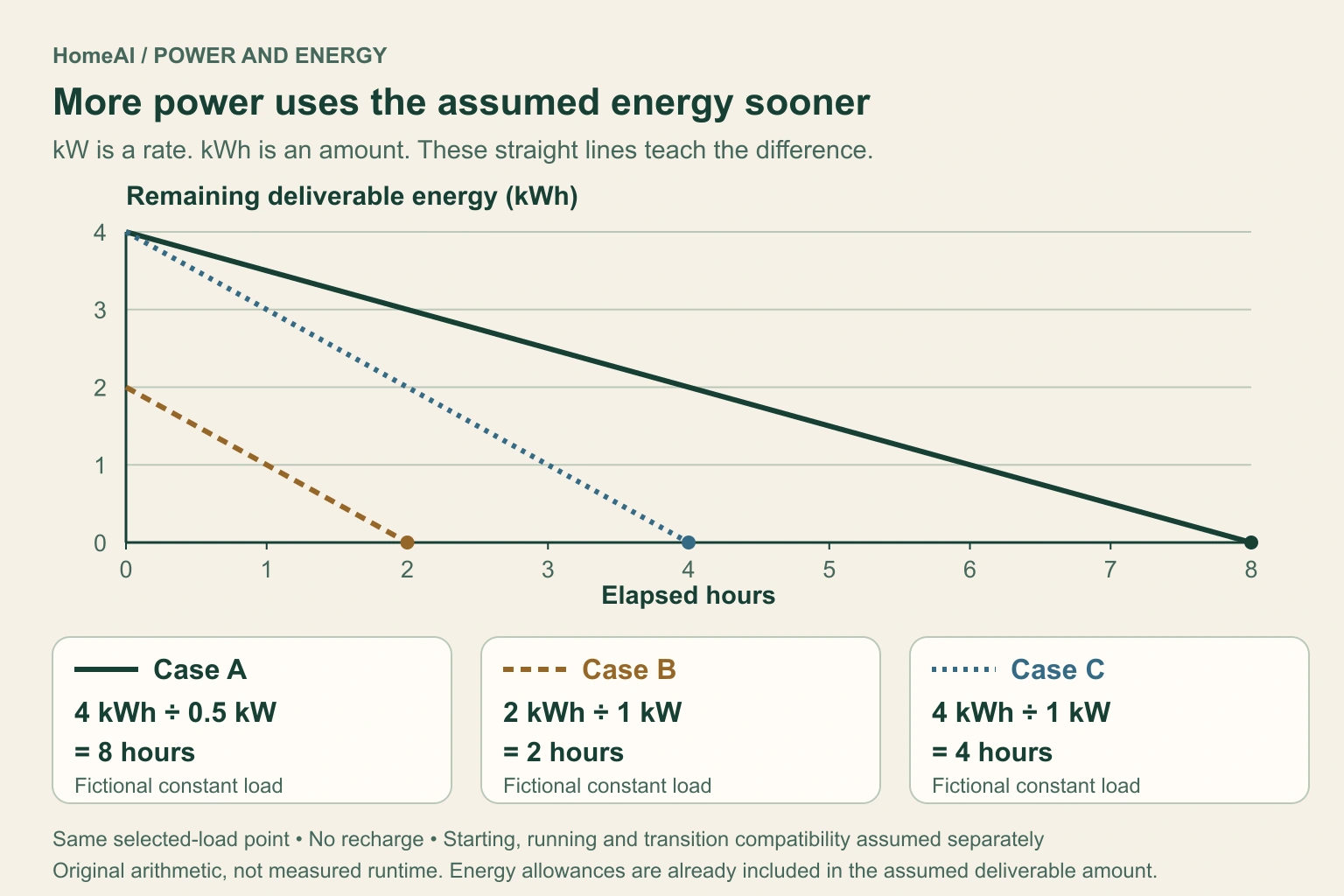
- Case A
4 kWh ÷ 0.5 kW = 8 hours in the stated fictional model.
- Case B
2 kWh ÷ 1 kW = 2 hours in the stated fictional model.
- Case C
4 kWh ÷ 1 kW = 4 hours in the stated fictional model.
What does this illustration leave out?
The inputs are fictional and apply at the same selected-load boundary with no recharge. Starting, running and backup-transition compatibility must be established separately. This is no measured battery or outage forecast. Original calculations: duration (hours)=deliverable energy (kWh)÷constant positive power (kW). Energy allowances are already included in the assumed deliverable amount.
Does the supplied energy describe the same point as the load, and which real operating assumptions remain unanswered?
Explore this with HomeAI ↗Opens an editable question. Nothing is sent until you choose to send it.Read the three constant-load cases.
Each case assumes known deliverable energy at the selected loads, constant positive power at that same point and no recharge. Starting, running and backup-transition compatibility are established separately as an assumption, not proved by the arithmetic.
Duration: deliverable energy (kWh) ÷ constant positive power (kW) = hours. Remaining energy: maximum of zero and starting energy minus power × elapsed hours.
- Case A
- 4 kWh ÷ 0.5 kW = 8 hours.
- All plotted points, elapsed hours → remaining kWh: 0 h → 4 kWh; 2 h → 3 kWh; 4 h → 2 kWh; 6 h → 1 kWh; 8 h → 0 kWh.
- Case B
- 2 kWh ÷ 1 kW = 2 hours.
- All plotted points, elapsed hours → remaining kWh: 0 h → 2 kWh; 1 h → 1 kWh; 2 h → 0 kWh.
- Case C
- 4 kWh ÷ 1 kW = 4 hours.
- All plotted points, elapsed hours → remaining kWh: 0 h → 4 kWh; 1 h → 3 kWh; 2 h → 2 kWh; 3 h → 1 kWh; 4 h → 0 kWh.
A and B change both energy and load, so they do not isolate one cause or rank products. A and C keep 4 kWh while C doubles the load from 0.5 to 1 kW; its calculated duration halves from 8 to 4 hours. Each line stops at zero.
All numbers are invented teaching inputs. Any energy allowances are already included in the assumed deliverable amount. Real demand, recharge and operating limits can differ; no measured runtime, equipment compatibility or outage guarantee is supplied. Unknown energy stays unknown. Zero power has no finite depletion time in this model, not unlimited real operation. Zero energy with positive power gives zero arithmetic hours without a fault diagnosis.
Does solar keep recharging the battery during an outage?
Solar panels produce electricity when conditions permit. Whether that electricity can operate the home or recharge storage during a grid outage depends on the installed system and its controls. The existence of rooftop panels does not establish that capability.
BC Hydro explains that most ordinary self-generation systems shut down during a grid outage. Its permitted battery-backup configurations depend on design, wiring and qualified commissioning. Automatic solar reconnection for battery charging must be part of the installed arrangement; recharge still depends on conditions.
Ask for the actual outage design and its commissioning record. Identify whether recharge is supported, which loads it serves and what happens when generation is insufficient. Keep an annual solar-production estimate separate from a claim about one winter outage.
BC Hydro’s explanation applies to its British Columbia service territory. Obtain the relevant utility requirements elsewhere. Do not bypass shutdown controls, energize equipment manually or climb onto a roof to clear panels for an outage experiment.
How do Canadian winter conditions change the evidence?
Begin with the actual installation location. A garage, outdoor wall and conditioned utility area can experience different temperatures, moisture and access conditions. Ask how the proposed equipment’s instructions address that location and the household’s expected winter loads.
A listed operating-temperature range and a promise of full output throughout that range are different statements. Tesla’s June 2025 owner manual describes temperature-related power limits for its named product. Use the applicable model documents and ask the installer to explain their effect on the proposed scenario.
Winter can change both sides of the energy account: heating-related loads may differ, while daylight, shading and weather affect solar production. Do not use an annual generation total as guaranteed recharge during a particular storm.
Review flooding, direct drainage, snow accumulation, service access and airflow with the professional. The picture explains location questions; it proves no compliant installation. Do not add heaters, covers or other modifications, obstruct ventilation or enter a hazardous area to inspect the cabinet.
The installation location matters in winter
The cabinet is in a garage beside outdoor winter conditions and a separate indoor room. Those surroundings help explain why an installer needs the actual location and exposure.
Numbers identify the parts explained below.
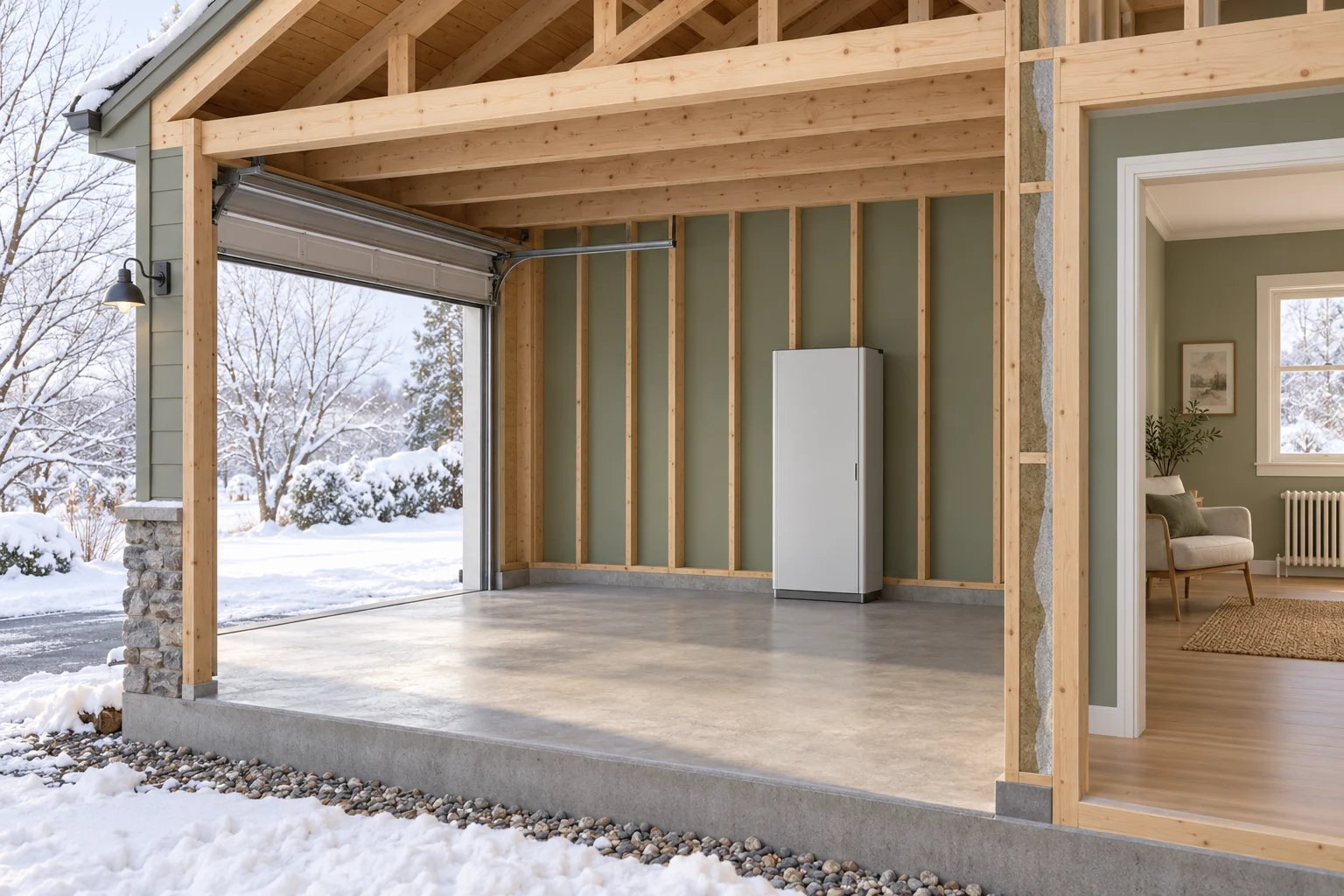
- Outside conditions
Snow introduces winter context. The picture gives no outdoor temperature or expected generation.
- Equipment location
Ask whether the installed model and location suit the actual conditions, including its stated charge and discharge limits.
- Household needs
Winter may change what the household needs powered. A room radiator here does not identify its heat source or prove backup coverage.
What does this illustration leave out?
The picture measures no cabinet or room temperature and proves no thermal separation, flood protection or installation clearance. It establishes no cold-weather capacity or operational finding. Follow model-matched owner instructions; ask the installer about conditions rather than adding a cover or heater. Use the installed model, current local authority and qualified provider for actual assessment. Keep electrical enclosures closed and stay clear of damaged equipment.
What conditions and operating limits apply at my battery’s actual location, and what alternative plan covers critical household needs?
Explore this with HomeAI ↗Opens an editable question. Nothing is sent until you choose to send it.Which installation and handover records resolve the limits?
Keep the actual models, design drawing, selected-load schedule, operating explanation and commissioning record together. Ask which power and energy assumptions support the proposal, how backup transition was assessed and which functions were left outside the scope.
Keep the applicable permits, inspection or acceptance records and utility correspondence as separate documents. Each has a stated job and date; one does not silently replace another or guarantee runtime. BC Hydro’s connection process and its closed battery-pilot page describe accepted applications for systems connected to its grid. The closed pilot is not a current offer.
In Ontario, ESA advises checking the contractor’s ECRA/ESA electrical-contracting licence and retaining the appropriate work records. Ontario’s licence category is not a national installer credential. Elsewhere, verify the requirements with the actual local authority and utility.
For a purchase, ask whether the property file contains the documents for the equipment now installed. A seller’s recollection, an equipment brochure and a property-specific commissioning finding answer different questions. Missing paperwork calls for a scoped assessment rather than an invented approval.
Give each backup-system record its own job
- Design and selected-load scheduleName the proposed equipment, included and excluded loads, dependencies and assumptions.
- Commissioning recordRead which installed functions were assessed, by whom, when and with what limits.
- Local work and utility recordsKeep the actual permit, inspection or acceptance scope and utility correspondence; processes vary by jurisdiction.
- Operating and outage planKeep the applicable instructions, support contact and plan when backup or another dependency is unavailable.
How does a fictional owner turn a whole-home promise into a scoped plan?
Maya is a fictional owner reviewing a proposal described as whole-home backup. She wants refrigeration, communication and water management during an outage. The first document lists cabinet capacity but leaves the pump circuit and starting demand unanswered.
She asks the installer for the included and excluded loads, the relevant controls, the power assessment and the starting-energy assumptions. The constant-load lesson’s 4 kWh and 0.5 kW are invented teaching inputs; Maya does not treat them as figures for her proposed installation.
The useful outcome is a written scope with the outstanding pump question still visible. An energy calculation cannot answer it. Winter solar recharge, the external communication network and a longer outage also remain separate planning questions.
This fictional case supplies no actual inspection, approval, measured runtime or compatible pump. It shows how to turn a broad promise into questions the responsible designer and installer can answer.
How should the household prepare for a limit or failure?
Keep an outage plan even when the home has a battery. Know the documented backup scope, the support contact and the plan for essential needs when energy or another dependency is unavailable. Discuss medical-equipment and refrigerated-medication needs with the appropriate healthcare and support providers before an outage.
BC Hydro warns against using household battery storage as the sole source of life-sustaining power. Its current outage guidance also explains that storage does not replace emergency preparation. This guide supplies no medical-device power clearance or guaranteed continuity.
For smoke, fire or an immediate threat, leave the affected area and contact emergency services. Stay out of water near battery equipment or wiring. Do not open, repair or modify battery cabinets, disconnect equipment or use an improvised reset sequence to investigate.
Use the applicable manufacturer instructions and qualified support for a non-emergency operating concern. Record the ordinary symptom and time from a safe position. Never use fuel-burning generators indoors or in enclosed spaces; an outage does not remove the carbon-monoxide hazard.
Keep learning about the connected parts
Practice the distinction.
Maya asks what the backup promise covers
Fictional learning scenario: a whole-home proposal names capacity but does not yet answer the priority-load questions.
Reported observations
- Maya wants refrigeration, communication and water management.
- The pump’s circuit and starting requirement are unanswered.
- The lesson’s 4 kWh and 0.5 kW are invented inputs, not figures for Maya’s equipment.
Compare the explanations
Expand each possibility to see the evidence needed to distinguish it. Similar symptoms can have different mechanisms.
The scope needs a selected-load plan
A capacity figure alone does not identify connected circuits, required controls or power compatibility.
The property-specific design, load schedule and professional assessment with stated limits.
A longer outage still needs another plan
Energy, winter generation and outside service dependencies can limit the outcome.
Explicit scenario assumptions and a household plan for essential needs when the supported service is unavailable.
A useful next question
Ask the responsible installer for the actual design and outstanding pump assessment, then keep the remaining outage questions in the household plan.
No real installation approval, compatible pump, medical clearance, measured runtime or guaranteed solar recharge is supplied.
Know what the words mean.
- Backup power capability
- The actual installed arrangement’s ability to supply stated loads during an outage, subject to its power, energy, operating and connection limits.
- Deliverable scenario energy
- The assumed energy available to the selected loads for a scenario, with the measurement point and any included allowances explained.
- Critical-load schedule
- A written list of priority jobs, their actual devices and circuits, and the dependencies the backup design must address.
- Backup reserve
- A model-specific allocation for backup operation. Obtain the actual manufacturer explanation; a setting alone does not establish charge at an outage.
- Islanding arrangement
- The installed controls and connection arrangement that separate the backup supply from the grid during an outage.
- Constant-load scenario
- An arithmetic example with known deliverable energy, constant power and no recharge; starting, running and transition compatibility are separate assumptions.
Questions to bring
to the conversation.
- Which jobs, devices and circuits are included or excluded?
- Which starting, running and transition conditions were assessed?
- What energy is assumed at the loads, and which allowances does it include?
- How do the actual operating mode, starting charge and location affect the scenario?
- Which local work, utility, commissioning and handover records exist?
- What is the household plan when backup or another dependency is unavailable?
Separate a showing observation, an existing record and a new professional assessment. Unknown means a question remains; it does not automatically mean a defect.
Use the evidence planner ↗Go to the source.
Original HomeAI explanation informed by these public references. Sources support the underlying guidance; they have not reviewed or endorsed HomeAI. Diagrams are conceptual, and calculator outputs depend on your inputs.
Chapter references reviewed for this refresh on October 5, 2026. The NRCan solar-planning guide is a 2020 edition. Tesla documents describe named products, not every battery. BC Hydro utility processes apply locally; Ontario ECRA/ESA licensing is regional. Fictional constant-load arithmetic establishes no installed duration or critical-power guarantee. The retained Backup Reserve support page and 2011 Public Safety Canada publication could not be read in full during this refresh and supplied no new technical claims.
Publication & source review
First published .
Sources reviewed .
- Natural Resources Canada · Planning and Decision Guide for Solar PV Systems (2020)
- Tesla Canada · How Powerwall works
- Tesla Canada · Powerwall system design
- Tesla Canada · Backup reserve
- Tesla Canada · Best practices during power outages
- Tesla · Powerwall 3 datasheet, 2025 edition (linked from Canadian owner documents)
- Tesla · Powerwall 3 owner manual and safety instructions, published June 2025 (Canadian-index linked)
- BC Hydro · Self-generation and power outages
- BC Hydro · Self-generation
- BC Hydro · Battery-storage pilot information (applications closed)
- Electrical Safety Authority · Hire a Licensed Electrical Contractor
- Public Safety Canada · Power outages: what to do (2011 publication, current public reading)
- Health Canada · Carbon monoxide: preventing exposure
Where this reference applies
Jurisdiction: Canada
Modified November 12, 2024. CO-alarm evacuation, emergency call from outside, professional re-entry boundary and seasonal exhaust-obstruction context. No owner combustion testing or exhaustive provincial alarm-law claim.
Have a question about your home?
Start with the symptom, timing and what you have observed.
Ask HomeAI