Jump to a question in this guide
- Follow the child, the object and the consequence
- Understand why furniture and televisions can tip
- Treat windows as openings with several functions
- Find accessible cords beyond the obvious side loop
- Connect gates to their intended location and use
- Make chemical storage a controlled household route
- Account for button batteries inside ordinary devices
- Plan supervision around water and changing routines
- Include portable belongings and temporary products
- Review the home when abilities and rooms change
- Agree responsibilities across caregivers and shared rooms
- Carry the child’s access questions into household work
- A fictional family separates three different questions
- Keep a record that supports action and handover
- Changing abilities and room layouts can change access.
- Tip-over, windows, cords, gates, chemicals and batteries need distinct answers.
- Product identity and matching instructions matter alongside caregiver routines.
- Child-resistant packaging is not childproof.
- Suspected harmful exposure needs urgent appropriate help before documentation.
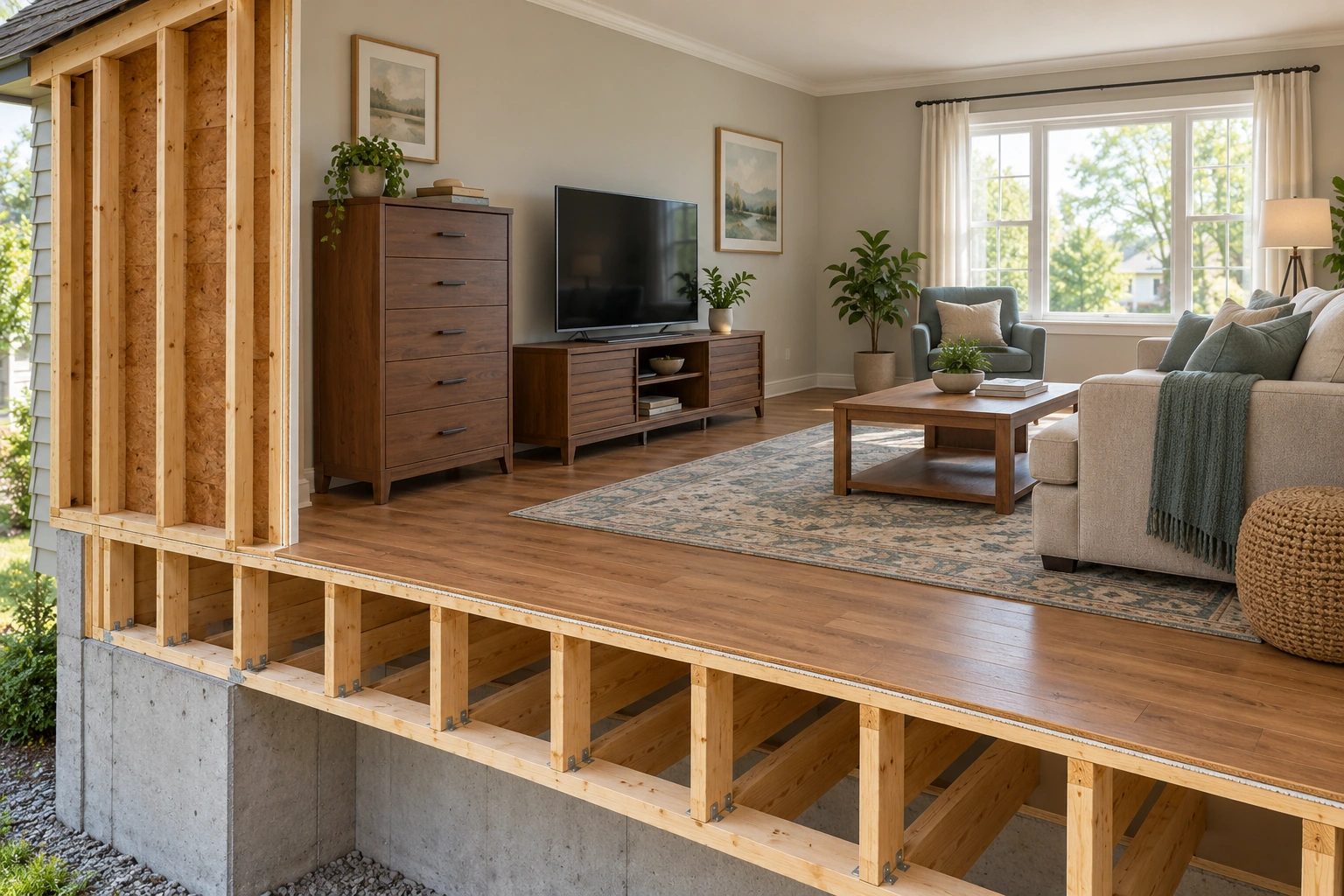
A television sits on a low cabinet beside a tall closed drawer unit; the wall behind remains opaque.
About this illustration
No verified anchoring, product suitability, stability, recall result or owner pull test. This is a conceptual teaching model, not an assessment of your home.
7 picture lessons appear beside the questions in this guide. Use them to understand the explanation, then consider what it means for your home.
Follow the child, the object and the consequence
Child safety in a home concerns the interaction between a child’s changing abilities and the things they can reach, move, climb or open. A room that worked for one stage can present different questions later. Start with ordinary household routines and the actual items present. A general checklist helps organize attention, but it cannot certify a home or replace supervision and product-specific instructions.
Different hazards need different responses. Furniture may tip, a window may permit a fall, a cord may form an accessible loop and a small battery may be swallowed. Calling all of them “things to put out of reach” misses their mechanisms. The useful record names the object, how access occurs and the relevant protection or professional question. This guide explains those relationships without asking a child to demonstrate a hazard.
Health Canada’s current furniture, cord, chemical and button-battery pages supply distinct primary guidance here. Their dates and scopes are retained with the sources. A PHAC general home-safety publication dated March 5, 2018 adds context about changing abilities, while its older cord-cutting advice is deliberately not adopted. Current specific guidance takes precedence over an old household shortcut.
Consider all places the child actually uses, including shared rooms and another caregiver’s arrangements. A safety product in one room does not address the same object elsewhere. Visitors may also bring devices, bags or products into reach. Discuss routines with the adults responsible without assuming that a written rule alone prevents access or that one person has checked every new item.
For an immediate injury or suspected harmful exposure, obtain the appropriate emergency or poison-centre medical help promptly. The later record and design review should not delay that response. This guide gives no treatment recipe, medical assessment or test to decide whether an exposure is harmless. Its purpose is to connect everyday household arrangements to the correct product, technical and health advice.
Follow access and the actual mechanism
Original native teaching figure: Follow access and the actual mechanism. Complete labels distinguish the conceptual functions; no actual property finding.
Numbers identify the parts explained below.
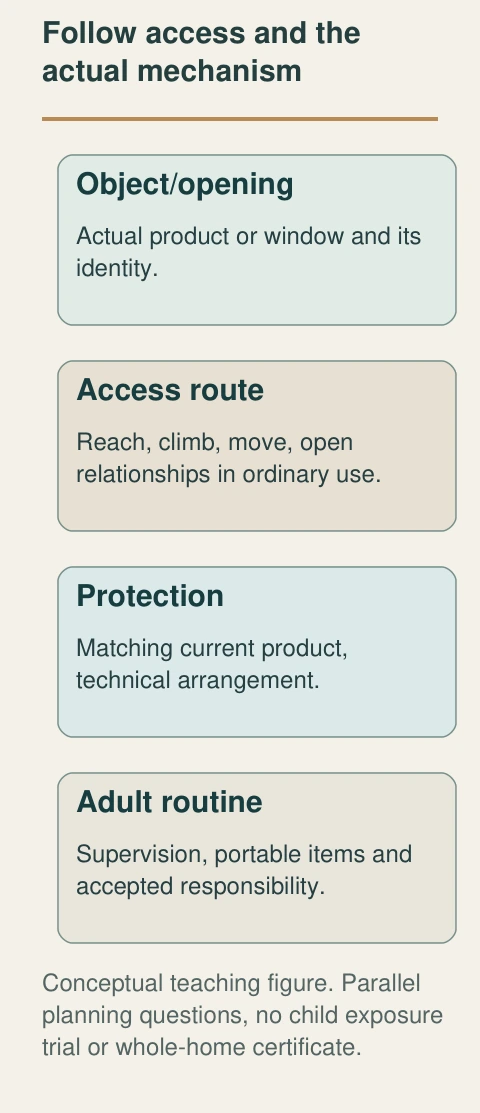
- Object/opening
Actual product or window and its identity.
- Access route
Reach, climb, move, open relationships in ordinary use.
- Protection
Matching current product, technical arrangement.
- Adult routine
Supervision, portable items and accepted responsibility.
What does this illustration leave out?
Parallel planning questions, no child exposure trial or whole-home certificate. This illustration explains an idea. It is not an installation guide.
What changed in this object, layout or routine?
Explore this with HomeAI ↗Opens an editable question. Nothing is sent until you choose to send it.Different mechanisms, different questions
- Tip-overActual item stability/intended use and matching anchoring requirements.
- WindowOpening access, screen limits and local device/exit coordination.
- CordAccessible side/back/internal cords and current matching protection.
- Chemical/batteryControlled access and urgent appropriate exposure response.
No whole-home certificate, owner exposure test or treatment recipe.
Further reading: Health Canada · Furniture, appliance and television tip-overs; Health Canada · Blind cord safety; PHAC · Make your home safe for your child: Nobody’s Perfect; Health Canada · Household chemical safety; Health Canada · Button battery safety; Health Canada · Safety gates; Alberta Health Services · Keep children safe around windows.
Read the complete figure
Follow access and the actual mechanism
Original native teaching figure: Follow access and the actual mechanism. Complete labels distinguish the conceptual functions; no actual property finding.
- Object/opening
- Actual product or window and its identity.
- Access route
- Reach, climb, move, open relationships in ordinary use.
- Protection
- Matching current product, technical arrangement.
- Adult routine
- Supervision, portable items and accepted responsibility.
What remains unknown: Parallel planning questions, no child exposure trial or whole-home certificate.
A useful question: What changed in this object, layout or routine?
Understand why furniture and televisions can tip
A piece of furniture or an appliance can become unstable when the forces acting on it change. Health Canada describes children climbing or pulling on furniture and opened drawers contributing to tip-over hazards. The object’s familiar weight or the fact that it has stood for years does not establish that it will remain stable in those circumstances. A television and the furniture beneath it also need their intended-use arrangements considered together.
Treat the actual item and its matching instructions as the starting point. The current Health Canada page addresses anchoring and appropriate use; it does not make every generic strap or fixing suitable for every item and wall. Ask the manufacturer and appropriate installer about the required arrangement. This guide supplies no anchor selection, fastener specification, wall-opening procedure or owner load test.
Room layout can encourage a climbing route. An attractive item high on furniture or a television placed on unsuitable furniture can connect a child’s interest with an unstable object. Consider what the child can see and reach in normal routines, without placing them near the item to observe what they do. Keep the intended storage and display arrangement consistent with the product guidance.
An anchoring kit in a drawer is different from an installed arrangement, and an installed-looking fitting is different from a verified match to the item and building. Keep the product identity and relevant installation record where the household can find them. If the object is moved, replaced or reassembled, return to its matching requirements instead of assuming that the previous arrangement still applies.
Product recalls are another distinct question. An owner should identify the actual model and seek the relevant current manufacturer or recall information when required. A familiar brand name alone cannot establish recall status. Do not pull, rock or climb an item to prove stability; a qualified assessment should determine the relevant technical questions without reproducing the child’s potential exposure.
Furniture and television need their actual arrangements
A television sits on a low cabinet beside a tall closed drawer unit; the wall behind remains opaque.
Numbers identify the parts explained below.
- Television
Actual intended-use requirements.
- Drawer unit
Tip-over questions are separate.
- Opaque wall
Concealed fixing is not shown.
What does this illustration leave out?
No verified anchoring, product suitability, stability, recall result or owner pull test. This illustration explains an idea. It is not an installation guide.
What matching instructions and installation evidence address each actual item?
Explore this with HomeAI ↗Opens an editable question. Nothing is sent until you choose to send it.Treat windows as openings with several functions
A window admits light and may provide ventilation, while its opening can also create a fall hazard. A screen has a different purpose from a fall barrier. The Alberta Health Services Edmonton notice of June 18, 2024 specifically warns that screens do not prevent children from falling through windows. A screen that looks intact should therefore not be used as evidence that an open window is protected.
Furniture changes access to an opening. A bed, chair or other climbable object can form part of a route to a window even when the sill seems high from the floor. Review the arrangement from the child’s developing abilities and the household’s ordinary use, without staging a climb. Moving one item may also change another route, so consider the room rather than only the object beside the window.
A protective device must be considered with the actual window and other required functions, including emergency exit arrangements where applicable. Ask the appropriate local building or fire adviser and product provider about the relevant requirements. This guide gives no universal opening limit, guard spacing, floor-height rule, release design or installation method. The Alberta notice is local public-health guidance, not a complete national window specification.
Supervision remains part of the household plan. A fitted device does not establish that every opening or every future situation has been addressed. Explain the agreed window-use arrangement to adults responsible for the child, including in rooms used less often. If furnishings, windows or devices change, revisit the arrangement using current matching instructions and local advice.
Record an already noticed concern without reproducing it. A description of the opening, the actual device and the room arrangement can support the relevant inquiry. A photograph from a safe ordinary position may show context but cannot prove concealed fixing, release operation or compliance. Preserve those limits rather than labelling a window child-safe because one visible feature is present.
Room layout changes access to an opening
A closed bedroom window and a bed on a different wall show the furniture-to-window relationship in a house cutaway.
Numbers identify the parts explained below.

- Window
Closed appearance is not a protection assessment.
- Bed
Furniture relationship matters.
- Room
Review changes without staging a climb.
What does this illustration leave out?
No universal distance, guard/egress design, verified fall protection or supervision substitute. This illustration explains an idea. It is not an installation guide.
How does the actual layout affect access to the window?
Explore this with HomeAI ↗Opens an editable question. Nothing is sent until you choose to send it.Find accessible cords beyond the obvious side loop
A window-covering cord can be accessible at the side, back or within the covering. Health Canada’s September 17, 2025 guidance explains that the hazard is not limited to a conspicuous hanging loop. A covering that appears tidy from across the room may still have accessible cords. Identify the actual product and its intended protective components rather than judging only its front appearance.
The current guidance recommends replacing coverings with long accessible cords with safer alternatives. Product choice and the matching installation matter together. A new covering supplied with protective components still needs its actual instructions followed. This guide gives no cord-cutting, cleat placement, knot, tensioning or removal method, and it does not adopt the older PHAC suggestion to cut cords.
Furniture and other climbable objects can change access to the covering. Consider beds, seating and storage in relation to the window rather than assuming that a cord is unreachable from the floor. Do not ask a child to reach it or reproduce a climb. An adult’s ability to tuck a cord away temporarily is not evidence that the product’s protective arrangement is complete.
Keep product identification, instructions and installation responsibilities together. Where a landlord, building manager or contractor controls the covering, make the concern and needed response explicit through the actual arrangement. Ownership and responsibility require their own confirmation; this guide does not assign legal liability or decide which party must pay for a replacement.
Review coverings when a room’s use changes or a child spends time in a new area. The visible product can remain the same while the route to it changes. A household record should state what was identified and what protection or replacement remains unresolved. It should not convert a one-time visual check into a guarantee against access or injury.
Connect gates to their intended location and use
A safety gate controls passage through a particular opening when it is used as intended. It does not remove every hazard beyond that opening or replace adult supervision. Health Canada’s January 11, 2021 guidance distinguishes actual safety-gate use and product instructions. Begin with the location, the actual model and the child’s circumstances rather than choosing solely because a gate fits visually between two surfaces.
Product identity matters. A gate intended for a pet is not automatically a child safety gate, and a model suitable for one location may have different requirements elsewhere. Ask the manufacturer or appropriate installer about the intended arrangement and current matching instructions. This guide supplies no universal age cutoff, fastening method, mounting location specification or pressure test.
Opening and closing the gate is part of its ordinary function. Adults responsible for the child need to understand the intended latch and use arrangement. A gate left open does not provide its intended barrier; a visibly closed gate still does not establish that the installation and product match. Keep those questions separate so a convenient daily routine does not conceal an unresolved technical concern.
The surrounding layout can change access and use. Nearby furniture, stored items and another route to the same area may matter to the household plan. Review the whole passage and destination without encouraging a child to climb or push the gate. If the child’s abilities or the room arrangement change, revisit the actual product guidance and relevant professional advice.
Retain the model identity and matching instructions, particularly when a gate is moved between locations or supplied second-hand. Missing parts or uncertain history require their own product inquiry. Do not improvise a repair or treat a substitute fitting as equivalent without the relevant guidance. The objective is a known intended arrangement, with unresolved questions recorded and addressed rather than hidden behind the word “installed.”
Make chemical storage a controlled household route
Household chemicals have a path from purchase to storage, use and return. Child access can occur during any part of that path. Health Canada’s page dated October 2, 2026 advises keeping products tightly closed in original containers, out of children’s sight and reach. Original identification matters because a familiar drink container or an unlabelled bottle can hide what the substance actually is.
Child-resistant packaging is not childproof. The closure and storage arrangement have different jobs: one impedes access to the contents, while the other limits access to the product itself. A child-resistant cap does not make an accessible storage location appropriate. Likewise, a locked cupboard does not make an unlabelled decanted substance identifiable to the adults who may later handle it.
Include products temporarily in use and items brought by visitors or contractors. A routine that returns a product to storage after use needs an actual responsible adult and an understood place. Discuss the arrangement with caregivers rather than relying on a reminder that is disconnected from ordinary household activity. Keep the child away from the product without asking them to demonstrate whether the closure can be opened.
The current source also warns against mixing household chemicals. This guide gives no bleach dilution, ventilation, protective-equipment or cleaning recipe. Read and follow the actual product label and obtain appropriate advice for the task. Chemical selection and use remain separate from the child-storage plan; a storage improvement does not authorize a hazardous mixture or an unfamiliar handling procedure.
For possible poisoning or harmful exposure, seek poison-centre or medical advice promptly and use emergency services where needed. Preserve the actual product identification for the responding professional when it is safe to do so. Do not wait to complete a household checklist or use this guide to judge symptoms. It supplies no treatment method or reassurance that a child-resistant closure rules out exposure.
Closed storage and packaging have separate jobs
The cutaway shows two opaque closed cupboard doors with lock exteriors and no keys visible; contents remain concealed.
Numbers identify the parts explained below.
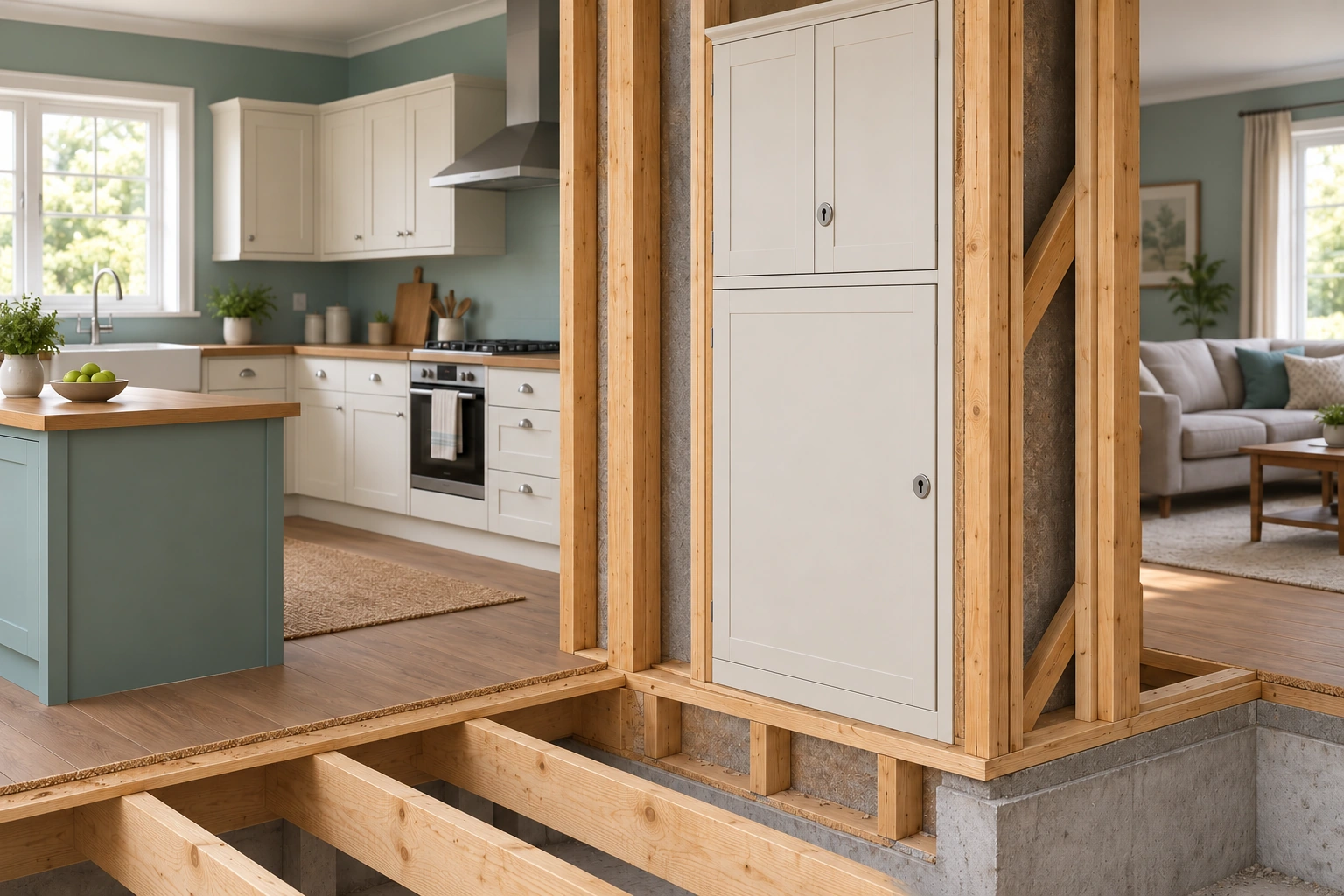
- Closed doors
Visible storage boundary only.
- Lock exteriors
Actual function/key control remains unverified.
- Concealed contents
Original containers need their own arrangements.
What does this illustration leave out?
No actual locked-state verification, key-control plan, product identity or childproof guarantee. This illustration explains an idea. It is not an installation guide.
What actual storage and adult routine control product access?
Explore this with HomeAI ↗Opens an editable question. Nothing is sent until you choose to send it.Packaging and storage do different jobs
Original native teaching figure: Packaging and storage do different jobs. Complete labels distinguish the conceptual functions; no actual property finding.
Numbers identify the parts explained below.
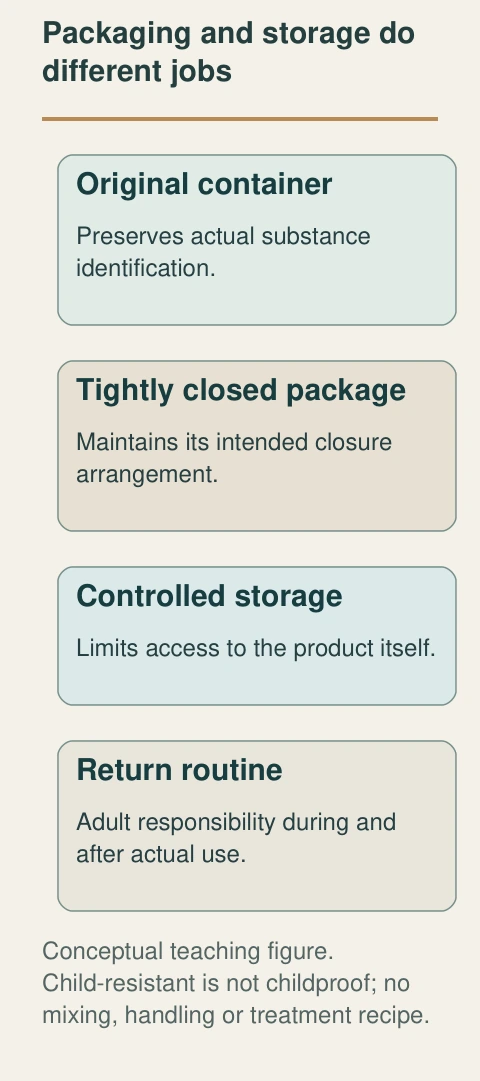
- Original container
Preserves actual substance identification.
- Tightly closed package
Maintains its intended closure arrangement.
- Controlled storage
Limits access to the product itself.
- Return routine
Adult responsibility during and after actual use.
What does this illustration leave out?
Child-resistant is not childproof; no mixing, handling or treatment recipe. This illustration explains an idea. It is not an installation guide.
Where can access occur during the actual household routine?
Explore this with HomeAI ↗Opens an editable question. Nothing is sent until you choose to send it.Closure and storage have different jobs
- Original containerPreserves actual substance identification.
- Tightly closed packagingKeeps its intended closure arrangement.
- Controlled storageLimits child access to the product itself.
- Adult routineConnects use, temporary location and return.
Child-resistant is not childproof; no chemical handling/mixing/treatment instructions.
Further reading: Health Canada · Household chemical safety.
Read the complete figure
Packaging and storage do different jobs
Original native teaching figure: Packaging and storage do different jobs. Complete labels distinguish the conceptual functions; no actual property finding.
- Original container
- Preserves actual substance identification.
- Tightly closed package
- Maintains its intended closure arrangement.
- Controlled storage
- Limits access to the product itself.
- Return routine
- Adult responsibility during and after actual use.
What remains unknown: Child-resistant is not childproof; no mixing, handling or treatment recipe.
A useful question: Where can access occur during the actual household routine?
Account for button batteries inside ordinary devices
Button batteries can be present in small everyday devices, so the household inventory should follow the devices as well as spare batteries. Health Canada’s September 29, 2026 page describes their serious swallowing hazard and the importance of secure battery compartments. A remote control or small electronic item may appear to be an ordinary household object while containing a battery a child must not access.
Identify the actual devices the child can reach or that are carried between rooms. The battery compartment and its matching requirements need attention; an exterior that looks intact does not independently verify the compartment. Ask the manufacturer or appropriate provider about a loose, damaged or uncertain compartment. This guide gives no fastening modification, improvised tape repair or instruction to let a child handle the device as a test.
Spare and used batteries also need a controlled route. Health Canada warns that used button batteries can remain hazardous. A battery no longer powering a device should therefore not be treated as harmless play material. Follow current local disposal and product guidance; this guide does not reproduce a taping, packaging or disposal method or assume that every municipal collection programme accepts the same materials.
Visitor belongings and items supplied for a temporary activity can change the household inventory. Discuss who keeps them out of a child’s access and returns them to the appropriate storage. A check of permanent fixtures alone misses a device that arrives in a bag or is left beside a chair. Record product concerns without converting the record into a claim that all devices in the home have been assessed.
If a child may have swallowed a button battery, Health Canada directs immediate medical attention and warns not to wait for symptoms. Follow urgent professional advice. This guide deliberately gives no honey recipe, injury timetable, size threshold or home treatment. The emergency action is separate from the later task of identifying how access occurred and improving the household arrangement.
Portable devices carry their own battery questions
A remote control lies on a living-room table while a closed box is shown on a wall shelf. No battery compartment or loose battery is exposed.
Numbers identify the parts explained below.

- Remote
Actual contents/compartment need identity.
- Closed box
Storage route needs an agreed purpose.
- Room
Portable items can change access.
What does this illustration leave out?
No actual battery identification, secure-compartment verification, inaccessible-height promise or storage certification. This illustration explains an idea. It is not an installation guide.
Which actual devices and battery compartments need matching guidance?
Explore this with HomeAI ↗Opens an editable question. Nothing is sent until you choose to send it.Device, battery and urgent response differ
Original native teaching figure: Device, battery and urgent response differ. Complete labels distinguish the conceptual functions; no actual property finding.
Numbers identify the parts explained below.
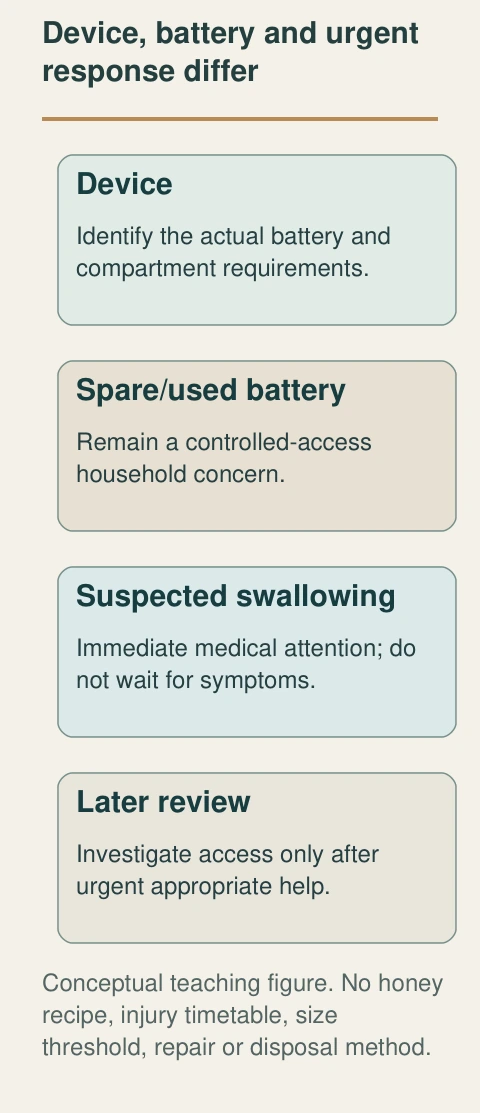
- Device
Identify the actual battery and compartment requirements.
- Spare/used battery
Remain a controlled-access household concern.
- Suspected swallowing
Immediate medical attention; do not wait for symptoms.
- Later review
Investigate access only after urgent appropriate help.
What does this illustration leave out?
No honey recipe, injury timetable, size threshold, repair or disposal method. This illustration explains an idea. It is not an installation guide.
Which actual device and access arrangement need resolution?
Explore this with HomeAI ↗Opens an editable question. Nothing is sent until you choose to send it.Read the complete figure
Device, battery and urgent response differ
Original native teaching figure: Device, battery and urgent response differ. Complete labels distinguish the conceptual functions; no actual property finding.
- Device
- Identify the actual battery and compartment requirements.
- Spare/used battery
- Remain a controlled-access household concern.
- Suspected swallowing
- Immediate medical attention; do not wait for symptoms.
- Later review
- Investigate access only after urgent appropriate help.
What remains unknown: No honey recipe, injury timetable, size threshold, repair or disposal method.
A useful question: Which actual device and access arrangement need resolution?
Plan supervision around water and changing routines
Water-related household arrangements need direct adult attention appropriate to the child and activity. The PHAC general home-safety publication includes supervision around water among its considerations. Its March 2018 page is a general overview, not a complete current bathing, swimming or clinical manual. Use it to identify the household responsibility question, then obtain current activity-specific guidance where needed.
A bathroom, laundry area or temporary container may be used differently from day to day. The relevant plan concerns what is present, who is responsible and how the child’s access is managed during the actual routine. A door, gate or storage rule does not independently establish that an adult is attending to the activity. Avoid treating equipment presence as a substitute for an explicit supervision arrangement.
Caregiver handoffs deserve clear words. If responsibility changes during a household task, adults need to understand who is attending to the child. This is particularly relevant when an ordinary routine is interrupted by a visitor, delivery or another child needing help. Discuss the practical arrangement in advance rather than assuming that someone nearby has taken over.
This guide gives no bathing sequence, water-temperature setting, swimming technique, rescue procedure or assessment of a child’s abilities. Those topics need current appropriate health, safety and emergency guidance. Product-specific equipment also retains its own intended-use instructions. A general home-safety article cannot establish that a particular product, room or activity is suitable for an individual child.
After a concerning event, obtain appropriate urgent help first. The later review can identify the activity, access route and responsibility that need attention without recreating the event. Record what was actually known and keep uncertainty explicit. A fictional example or a household discussion should never be presented as evidence that an injury was prevented or that a supervision arrangement has been professionally assessed.
Include portable belongings and temporary products
A household safety review can miss objects that do not have a permanent place. Visitor bags, a device carried between rooms, cleaning products brought for a task and spare batteries can create new access questions. The relevant mechanism remains the same as for a permanent item, but the responsible person and storage route may be less obvious. Include those temporary arrivals in the ordinary household arrangement.
Ask adults to agree where their belongings and products will remain while children are present. The location should reflect the actual contents and current product guidance. A high-looking surface or a zipped bag should not automatically be described as controlled chemical or battery storage. The household needs a known arrangement, not an assumption that a visitor has checked the home’s usual routines.
Products borrowed, inherited or bought second-hand need identification and matching instructions just as newly purchased items do. A missing label, uncertain model or incomplete protective component is an unresolved question. Ask the relevant manufacturer or provider before treating a familiar-looking object as equivalent to the identified product. This guide does not certify a second-hand item or supply a universal acceptance test.
When an object moves, its relationship to furniture and children can change. A remote control on a low table may be accessible even though its usual storage is controlled. A gate moved to a different opening may have a different intended-use question. Returning to the actual mechanism helps the adults see why a previous arrangement cannot simply be assumed to travel with the object.
Keep the discussion practical and proportionate to the items present. Name the concern, responsible adult and current product question. Do not invent a medical or legal finding from a visitor’s belongings. If an exposure or injury is suspected, obtain appropriate urgent help; sorting ownership, storage and future routines is a later task that must not delay the response.
Review the home when abilities and rooms change
A child’s developing ability to reach, climb, open or move an object changes how the same room is used. PHAC’s general publication identifies changing household hazards as children grow. The useful response is a new look at ordinary routines and actual objects, not an age-based promise that a particular hazard begins or ends on a birthday. Individual development and product limits require their own consideration.
Changes to the room can be equally important. A new bed beside a window, a storage unit near furniture or a different covering may create a new relationship. The child’s abilities may be unchanged while access changes. Review furniture, openings, cords and stored products together when the room is rearranged rather than checking each new item in isolation.
Do not stage a hazard to see whether the child can reach it. Adults can identify a plausible access route from ordinary observation and product information, then seek the relevant advice. A lack of a previous incident is not evidence that a child cannot climb, open or encounter the item later. Keep the arrangement preventive without turning the child into a test subject.
Use actual product instructions to identify when an item’s intended-use limits need review. Safety gates, furniture arrangements and protective components retain their own requirements. A household milestone is a reason to ask the question, not a replacement for the product information. If an instruction or identity is missing, record that uncertainty and resolve it through the appropriate provider.
Make the review part of a real change rather than an unsupported universal interval. Moving house, changing caregivers, rearranging a bedroom and introducing a new device are concrete occasions to revisit the relevant arrangements. This guide supplies no claim that a periodic checklist guarantees safety. The record should describe what changed and what was addressed, with any remaining product or professional questions visible.
Agree responsibilities across caregivers and shared rooms
Several adults may use the same room and care for the same child at different times. A protective arrangement works within that shared routine: the gate must be used as intended, a product returned to storage and a newly arrived device accounted for. Discuss responsibilities in ordinary language so an adult does not have to infer the home’s arrangement from a fitting or a sign.
A useful handoff states who is attending to the child and identifies any current concern. “The covering is being replaced; this room’s arrangement is unresolved” conveys different information from “we checked the windows.” Be precise about the object and limit. Avoid a broad child-safe label that encourages another adult to assume that every mechanism and room has been assessed.
Shared housing and visits create another coordination question. The adult caring for the child may not control every fixture or stored product. Identify the actual concern and the person able to address it, while arranging an appropriate immediate household response. This guide does not determine legal responsibility, tenancy rights or the allocation of replacement costs.
Caregiver agreement does not replace the matching technical work. A furniture anchor, window device or gate still needs the correct product and installation arrangement. Likewise, a technical installation does not define who supervises an activity. Keep the two responsibilities connected in the plan, with the relevant provider answering the technical question and the adults agreeing their ordinary use.
If a caregiver reports a concern, preserve what was already observed without asking them or the child to reproduce it. A clear account can identify which product guidance or professional assessment is needed. For suspected injury, poisoning or battery swallowing, urgent medical action comes first. The household record should support later learning, never become a prerequisite for obtaining help.
Carry the child’s access questions into household work
Repairs, deliveries and room changes can temporarily alter the child’s surroundings. Products may arrive, furniture may move and usual storage may be unavailable. Treat that change as a household planning task before it begins. Identify which established arrangements will be affected and who will maintain an appropriate alternative while the work takes place.
A contractor’s materials and devices retain their own handling and storage requirements. The child-access question should be explicit in the work and occupancy discussion, rather than assuming that the household’s usual cupboard can absorb every temporary product. This guide gives no construction barrier design, chemical-handling recipe, electrical procedure or assurance that a room remains suitable for occupancy.
Moving furniture can change both tip-over protection and the route to a window or cord. A furnishing returned to approximately its former place may still need its actual matching arrangement checked. Keep this requirement with the scope of the move instead of treating it as an optional task after the room looks finished. The appropriate installer or manufacturer should address product-specific uncertainties.
The renovation-occupancy guide owns construction separation and the wider living-through-work plan. The repair-contractor guide owns proposals, changes and completion evidence. This guide contributes the child’s access routes, actual products and caregiver responsibilities to those plans. When the scopes meet, name who coordinates the result rather than expecting three separate conversations to agree automatically.
At completion, review the changed household arrangement and the actual items returned to use. Keep matching instructions and relevant installation records, and identify anything still unresolved. A finished repair is not a whole-home safety certificate. The purpose of the review is to connect the specific changes to the household’s current routines and the appropriate technical or product advice.
A fictional family separates three different questions
This invented example illustrates decisions, not an actual incident or verified safety result. Mateo and Erin rearrange a shared living room before a young relative begins spending afternoons there. They notice a television on a storage unit, a corded window covering and a small remote control. Rather than treating these as one general clutter problem, they identify the different mechanism associated with each item.
For the television and furniture, they need actual product identities and the appropriate intended-use and anchoring guidance. For the covering, they need to address accessible cords using current specific guidance, rather than cutting or temporarily tucking a loop away. For the remote, they need to establish its battery type and compartment arrangement. No child is asked to climb, pull or open anything as a trial.
The adults also review the new furniture positions. Moving the storage unit may change access to the window, while leaving the remote on a different table changes where the device can be reached. Those relationships matter alongside the individual products. The family records the unresolved questions and the appropriate provider for each rather than marking the entire room safe because it looks less crowded.
A caregiver discussion addresses ordinary use: who returns portable items to the agreed place, what visiting adults need to know and which arrangement remains unresolved. Technical questions stay with the relevant manufacturer or installer. The example provides no actual anchor, window device, battery-compartment assessment, recall result or completed replacement.
The useful outcome is a clearer set of next decisions with distinct responsibilities. It is not evidence that the family prevented an injury or received professional approval. If a harmful exposure were suspected, they would seek urgent appropriate medical help first; their product notes would support that response where safe and useful, rather than delaying it while they complete the household review.
Keep a record that supports action and handover
A useful child-safety record identifies the actual item, its location, the concern and what happened next. Product model information and matching instructions help distinguish a specific arrangement from a generic recommendation. Keep the relevant dates so another caregiver can see whether the note describes the current room or a previous arrangement.
Separate observation from assessment. “The drawer unit was moved beside the window” is an observation about the layout. A statement about its anchoring or a window device’s suitability requires the relevant evidence and provider scope. A photograph may show position and appearance, but cannot establish concealed fixing or compliance. Preserve that limit in the record instead of turning a photograph into an approval.
Record actions precisely. A replacement ordered is different from a product installed, and a product installed is different from an unresolved matching-instruction question. Name the person responsible for the remaining step. This helps caregivers understand what is actually in place without assuming that a purchase receipt or an intended plan proves the completed arrangement.
Keep urgent response separate from routine documentation. For suspected button-battery swallowing, the current Health Canada guidance requires immediate medical attention without waiting for symptoms. For possible poisoning or injury, obtain appropriate urgent advice and emergency help as needed. This guide supplies no treatment method or symptom threshold, and a record should never be completed before help is sought.
Revisit the relevant notes when a product, room, caregiver routine or child’s abilities change. Retain useful history while making the current arrangement clear. The record supports communication and appropriate next steps; it does not certify that every hazard has been found or that future access is impossible. A well-described unresolved question is more actionable than an unsupported whole-home safety claim.
Describe the actual stage
- ObservedKnown item/location or already reported concern.
- PlannedIntended replacement or provider inquiry.
- InstalledActual product and relevant matching records.
- UnresolvedSpecific question and responsible next step.
Recordkeeping never delays urgent medical help or proves concealed fixing.
Further reading: Health Canada · Furniture, appliance and television tip-overs; Health Canada · Blind cord safety; PHAC · Make your home safe for your child: Nobody’s Perfect; Health Canada · Household chemical safety; Health Canada · Button battery safety; Health Canada · Safety gates; Alberta Health Services · Keep children safe around windows.
Keep learning about the connected parts
- A sticking window: understand the parts before replacement
- Stairs, handrails and guards: what buyers should understand
- Build a home-care record that the next person can understand
- Hiring a repair contractor: carry evidence into scope, changes and completion
Canadian context and authorities · Visual atlas · Learning labs
Practice the distinction.
Mateo and Erin separate three questions
Fictional shared living-room rearrangement before a young relative visits.
Reported observations
- Furniture and TV need actual identity and intended-use/anchoring guidance.
- A covering has a separate accessible-cord question.
- A remote needs battery and compartment identity.
Compare the explanations
Expand each possibility to see the evidence needed to distinguish it. Similar symptoms can have different mechanisms.
Product arrangement unresolved
A neat appearance does not verify matching protection.
Actual model/instructions and relevant provider response.
Room layout changes access
Moving an item changes its relationship to windows and portable devices.
Current arrangement and caregiver responsibilities.
A useful next question
Resolve each mechanism and responsibility without staging a child’s exposure.
No actual injury, installed protection, recall result, medical finding or verified safety outcome.
Know what the words mean.
- Access route
- The ordinary sequence by which a child may reach an object or opening.
- Tip-over
- An object becoming unstable, distinct from whether it previously stood without incident.
- Child-resistant
- Packaging intended to impede access, not a claim that a child cannot open it.
- Matching instructions
- Current guidance for the actual identified product and intended arrangement.
- Caregiver handoff
- An explicit agreement about responsibility and current unresolved household concerns.
Questions to bring
to the conversation.
- Which actual item and access route are identified?
- What current matching protection or product question remains?
- Who controls portable belongings and returns products to storage?
- What changed in the room, child’s abilities or caregiver routine?
- Which technical evidence supports the installed arrangement and what remains unresolved?
Separate a showing observation, an existing record and a new professional assessment. Unknown means a question remains; it does not automatically mean a defect.
Use the evidence planner ↗Go to the source.
Original HomeAI explanation informed by these public references. Sources support the underlying guidance; they have not reviewed or endorsed HomeAI. Diagrams are conceptual, and calculator outputs depend on your inputs.
Full seven primary bodies read; dates/current-specific versus historical/local scope retained. OlderPHACcord-cutting specifically withheld in favour ofHC2025. No universal numeric rules, installation/medical recipes, owner tests, actual recall finding or safety guarantee. FictionalMateo/Erin case only; related destinations checked against current canonical intent owners.
Publication & source review
First published .
Sources reviewed .
- Health Canada · Furniture, appliance and television tip-overs
- Health Canada · Blind cord safety
- PHAC · Make your home safe for your child: Nobody’s Perfect
- Health Canada · Household chemical safety
- Health Canada · Button battery safety
- Health Canada · Safety gates
- Alberta Health Services · Keep children safe around windows
Have a question about your home?
Start with the symptom, timing and what you have observed.
Ask HomeAI