- A wet-pad humidifier uses water, passing air and heat to support evaporation. Liquid left over follows a different route.
- Steam, mist and pad equipment add moisture in different ways and need their own matching care instructions.
- A control target, an air reading and visible water describe different things. Use dated, scoped records and qualified advice to connect them.
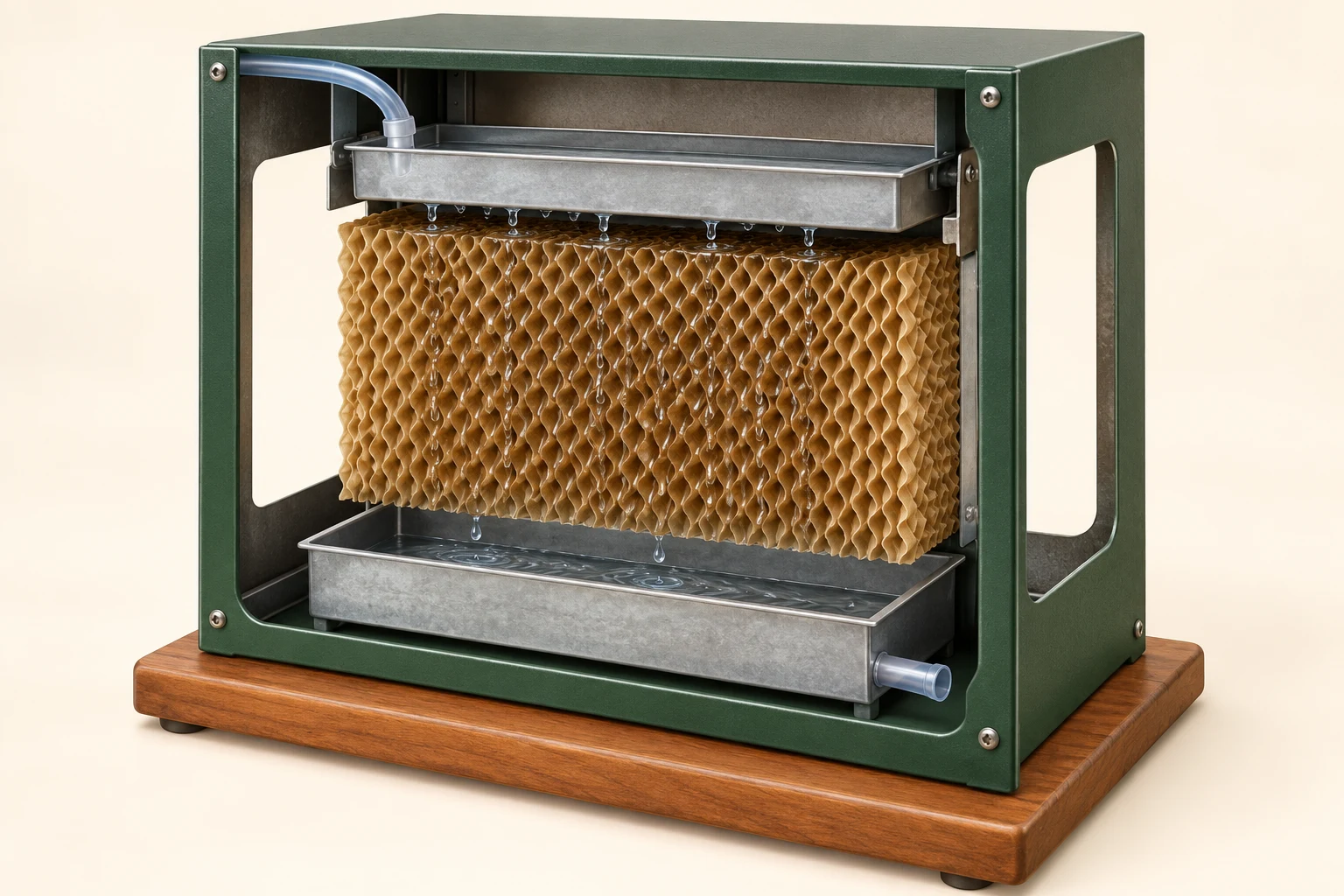
The trough represents water spread across the pad. The pad provides a wet surface for evaporation into passing air. Liquid that remains can collect in the pan and leave through a drain; visible droplets illustrate liquid, not invisible vapour.
About this illustration
The picture supplies no measured evaporation, actual airflow direction, connected furnace, material identity, installed drainage destination or safe operating result. This is a conceptual teaching model, not an assessment of your home.
7 picture lessons appear beside the questions in this guide. Use them to understand the explanation, then consider what it means for your home.
What does a humidifier actually add to the air?
A humidifier adds moisture to air. Some devices let water evaporate from a wet surface; others make steam or disperse tiny liquid droplets. Water vapour is the gaseous form of water. Understanding which process your appliance uses explains why its water supply, air movement, control and care requirements matter.
For the furnace-linked example in this guide, picture three connected jobs: water wets a pad, household air passes that pad, and heat supports evaporation. Some water becomes vapour in the passing air. Liquid left over follows a separate drain route. The humidifier needs those jobs to work together; a cabinet beside a furnace tells you little about their actual condition.
A furnace blower moves household air. A humidifier adds moisture to the air its arrangement serves. Those jobs can depend on each other without being the same service task. A heating invoice therefore needs to say whether it also covered the humidifier, its control, water delivery and drain.
The detailed pad example comes from a Canadian GeneralAire manual. Its cover and body use different model names; fuller document limits are in the references. Match your appliance and control to applicable instructions before care decisions. The explanation below helps you prepare questions without opening equipment or forcing a cycle.
How does a wet pad add invisible water vapour to air?
A distributor trough spreads water over the top of the evaporator pad. The pad is a porous surface with many small passages, giving water and passing air a large area to meet. In the named furnace-linked example, heat from the furnace supports evaporation: liquid water at the pad becomes water vapour in the air.
The manufacturer calls its pad a Vapor Pad. It does not heat the water itself or spray a visible cloud into the duct. Its useful job is to hold and spread water where air can pass. The lower pan collects liquid that remains, so droplets at the pan and vapour carried by air have different destinations.
Water delivery, air movement and heat each matter. A blower sound cannot show that the pad received water. A water supply cannot show how much evaporated. This is why a useful assessment describes the connected process instead of reporting only that the furnace fan ran or a component was replaced.
The cutaway shows the trough, wet pad and lower pan together. It leaves the building connections and actual air movement unmeasured. Use it to understand the jobs, then ask which functions the provider checked on your identified installation. It is a conceptual lesson, not an instruction to expose the pad.
Water wets the pad; passing air can gain vapour
The trough represents water spread across the pad. The pad provides a wet surface for evaporation into passing air. Liquid that remains can collect in the pan and leave through a drain; visible droplets illustrate liquid, not invisible vapour.
Numbers identify the parts explained below.
- Feed and trough
Bring water to the top and spread it across the pad in this conceptual wet-pad example.
- Wet pad
Provides a surface from which passing air can gain invisible water vapour; evaporation itself is not visible here.
- Pan and outlet
Collect remaining liquid and represent its separate drainage job; no actual receiving drain is shown.
What does this illustration leave out?
The picture supplies no measured evaporation, actual airflow direction, connected furnace, material identity, installed drainage destination or safe operating result. Read the part names and their jobs below the picture.
Which exact model and installed air and water arrangement does the provider identify?
Explore this with HomeAI ↗Opens an editable question. Nothing is sent until you choose to send it.Which parts bring water in, and which carry liquid away?
The named manual identifies a strainer, a metering orifice, a solenoid valve and a distributor. A strainer is a small screen in the incoming-water route. The orifice is an opening that meters delivery. The solenoid is an electrically controlled water valve. The distributor then spreads water across the pad.
Those parts support incoming water delivery. The pan and drain handle liquid remaining after evaporation. The supply tube and drain therefore answer different questions even when they are close together. A tube disappearing behind equipment does not identify its destination or establish that it is connected correctly.
The manual describes minerals remaining at the pad or leaving with waste water. That is different from a droplet-making appliance carrying mineral-containing droplets into room air. It does not mean a residue photograph identifies the chemistry, the water source or the amount of moisture delivered.
Ask the provider to identify the actual supply, water-control parts and outgoing drain, and say what the visit verified. Water beside the unit could involve its drain, a supply connection or another source. Keep clear of wet electrical areas; do not operate valves, clear openings, disconnect tubes or stage a water test.
Water delivery, evaporation and drainage do different jobs
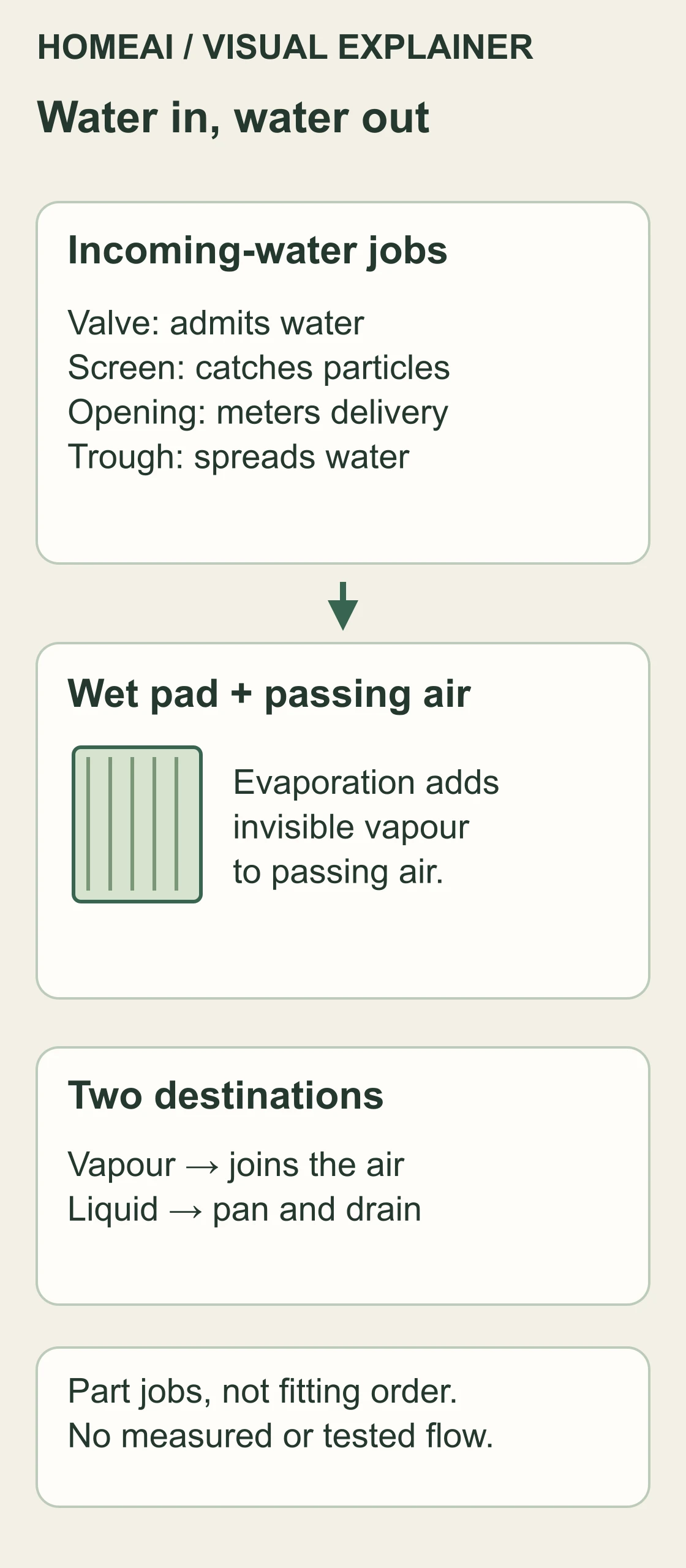
The controlled valve admits water; a screen catches particles and a small opening meters delivery in the named GeneralAire example. The trough spreads water. Some can evaporate from the pad into passing air; remaining liquid has a separate pan and drain job.
Numbers identify the parts explained below.
- Incoming-water jobs
The named manual lists a controlled valve, strainer screen and metering opening. This grouping is not a piping or repair diagram.
- Wet-pad job
A wet surface lets passing air gain vapour through evaporation. Liquid drops and vapour are different forms of water.
- Separate destinations
Vapour joins air; remaining liquid collects in a pan and follows the installed drain route.
What does this illustration leave out?
No amount, valve sequence, fitting order, owner access, full installed route, correct flow or successful drainage is established. Read the complete water-job explanation below.
Does the service report explain delivery, pad wetting and drainage separately?
Explore this with HomeAI ↗Opens an editable question. Nothing is sent until you choose to send it.Read the complete diagram
Read the water-delivery, evaporation and drainage jobs
- Controlled water valve
- In the named GeneralAire manual, an electrically controlled valve admits water when the equipment calls for it. This explains a job, not the actual wiring or a valve test.
- Strainer and metering opening
- The manual identifies a small screen that catches particles and an opening that meters water delivery. Their positions, dimensions, access and replacement belong to the exact model and qualified work.
- Distributor trough
- Spreads water across the top of the pad in the wet-pad arrangement. A parts list alone does not show that distribution works in an installed unit.
- Wet pad and passing air
- The pad gives water a surface for evaporation. Some liquid becomes invisible vapour in passing air; visible droplets in a drawing depict liquid.
- Liquid collection and drain
- Remaining liquid collects in a pan and follows the applicable installed drain route. Neither this diagram nor an invoice naming a pad establishes that receiving route or a successful drain check.
The upper boxes group part functions rather than prescribe a physical fitting order. No quantities, owner disassembly, live water test, wiring, maintenance interval or completed service finding is supplied.
What remains unknown: No amount, valve sequence, fitting order, owner access, full installed route, correct flow or successful drainage is established.
A useful question: Does the service report explain delivery, pad wetting and drainage separately?
Water delivery, evaporation and drainage answer different questions
The named pad example connects these jobs, but one observation cannot verify all three.
- Water deliveryUseful record or observation: Record identifying the supply, valve and distributorQuestion still to answer: Did the assessment verify delivery to the pad?
- Evaporation into airUseful record or observation: Identified pad process and scoped operation findingQuestion still to answer: What air and heat served the wet surface?
- Liquid drainageUseful record or observation: Record naming the pan, outlet and destinationQuestion still to answer: What actual connection and drainage function were assessed?
Conceptual roles from the named Canadian manual. No flow quantity, connection approval or owner test.
Where does the air come from in a bypass humidifier?
In the documented bypass arrangement, a branch connects the furnace’s warm-air side and its return-air side through the humidifier. The warm-air side carries heated household air away from the furnace. The return side brings household air back toward it. Passing air meets the wet pad along this branch.
The furnace’s household-air operation supplies the air movement described by the manual. The humidifier is using a branch of that system; it is not a separate fan moving fresh outdoor air into every room. Seeing a duct beside the box does not reveal the real connections or direction of movement.
A fan-powered pad humidifier has an additional fan within the appliance. GeneralAire’s family explanation says that fan draws heated air through the pad. It changes how air is moved, while water, a wetted surface and suitable control conditions still matter. A fan sound alone does not show moisture delivery.
Ask which family you have, where its air enters and leaves, and how it coordinates with the heating system. For room supply and return questions, continue to the heating-airflow guide. A generic branch picture cannot establish the served rooms, airflow quantity or suitability of this installation.
A bypass branch gives air another route
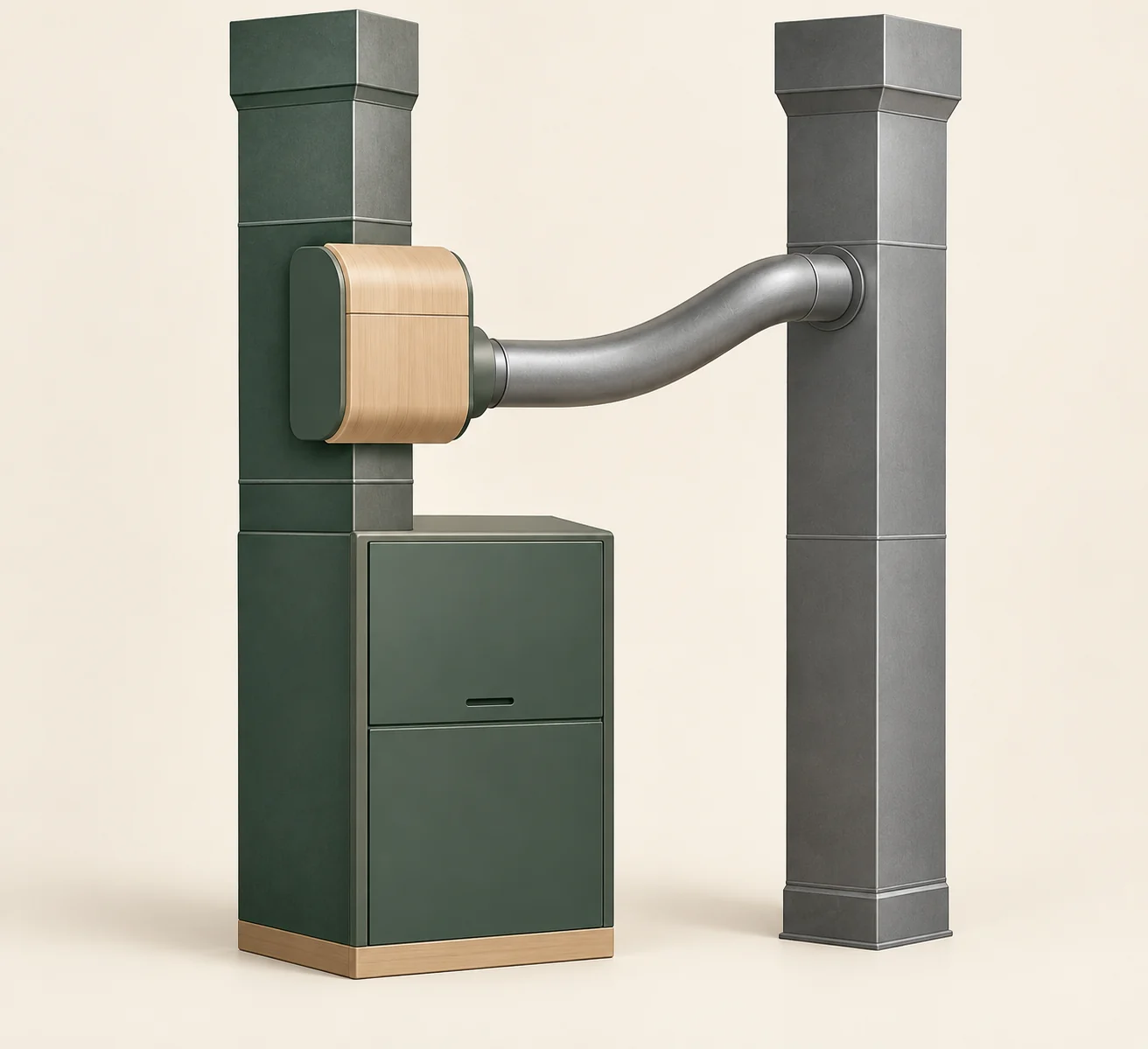
In a bypass humidifier, a side branch allows air through a humidifying surface and back into the heating-air arrangement. The pictured branch helps explain that side-route job; the closed box hides its internal parts.
Numbers identify the parts explained below.
- Side-mounted box
Represents a humidifier housing; the pad and its actual condition are hidden.
- Branch duct
Illustrates the side-route concept. The actual connections and intended airflow need model-matched identification.
- Closed heating cabinet
In the documented example, the furnace supplies heat and air movement. This closed view does not show a running blower or the temperature of either duct.
What does this illustration leave out?
The artwork does not identify the real supply and return ducts, show direction or amount of airflow, confirm a damper position or establish a functioning installed branch. Read the part names and their jobs below the picture.
Which duct connections and ordinary operating conditions serve this actual humidifier?
Explore this with HomeAI ↗Opens an editable question. Nothing is sent until you choose to send it.How are steam and cool mist different from a wet pad?
GeneralAire’s electrode-steam family passes electrical current through water in a cylinder to produce steam. The cylinder is the water-heating part in that explanation. It differs from the pad example, where furnace heat supports evaporation. This family description does not identify an installed steam model or its electrical and water requirements.
Health Canada describes portable vaporizers that boil water, ultrasonic devices that use vibration to make a fine mist, and motor-driven cool-mist devices that disperse droplets. These are different ways to add moisture. A visible plume does not mean every humidifier has the same internal parts or needs the same care.
The distinction matters because liquid droplets can carry materials from their water. Health Canada describes mineral-containing particles from some cool-mist devices and warns that microorganisms can multiply in standing water. A plume that looks clean does not establish the condition of the reservoir or a health clearance.
Use the identified device’s care instructions rather than borrowing a pad, steam-cylinder or portable-reservoir procedure. This guide supplies no cleaning mixture, water-treatment choice or refill recipe. Discuss suspected respiratory effects with an appropriate healthcare professional; appearance or device category cannot diagnose a health problem.
What is the difference between a setting and a humidity reading?
A humidistat is a humidity control. Its target is the result the control requests. A sensor reading describes the air sampled at that location and time. Relative humidity, commonly displayed as RH and a percentage, is a humidity measure interpreted with the air’s temperature. A target and a reading are different records.
A photograph may show the selected target, a current reading or an unidentified dial. Preserve the label and context with the number. An appliance control and a separate room device may represent different air; agreement between them alone does not establish accuracy or conditions throughout the house.
The retained main manual and the separate MHX3C quicknote give different turning-direction advice. Neither is adopted here. The useful first question is which control is installed and which instructions apply. Do not infer adjustment direction from a similar-looking dial or turn it to complete a learning exercise.
A humidity reading also differs from moisture inside a wall. Air sampling, appliance operation and material condition need their own methods and scope. Use the home-air-sensor guide for interpreting an existing reading, and ask the provider how the identified humidistat’s sensing location and control arrangement relate to the rooms you are concerned about.
A setting, an air reading and window water are separate notes
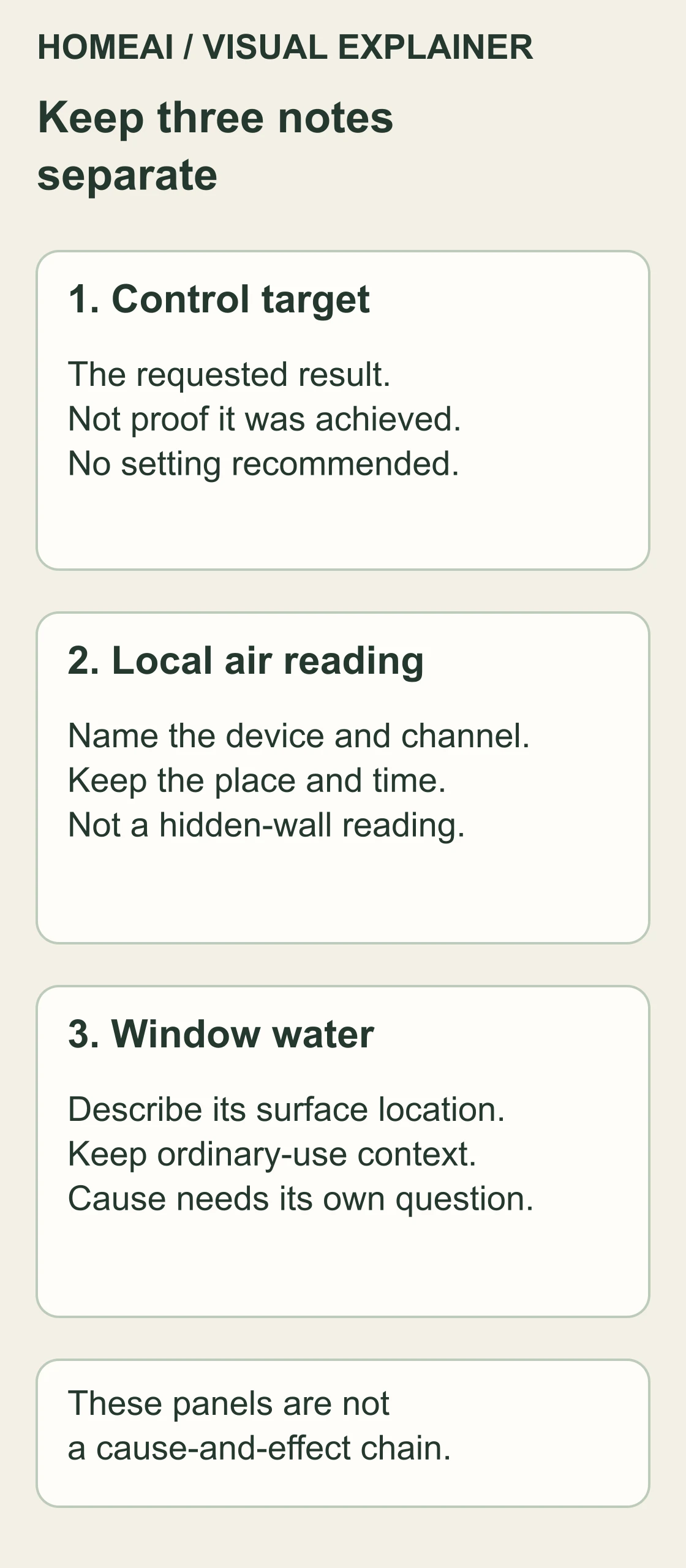
The control target is the requested result. An air reading describes the sensor’s location and time. Window water describes a surface and location. Keeping those labels separate makes the next question clearer.
Numbers identify the parts explained below.
- Control target
A selected request, not proof the room achieved it. The correct interpretation belongs to the actual control.
- Air reading
Keep the already-known sensor, location and time. It does not measure concealed materials or every room.
- Window observation
Record the already-visible location separately. Glass water alone cannot explain the cause.
What does this illustration leave out?
No target is recommended; no sensor accuracy, whole-home humidity, cold-surface temperature, failed window seal or moisture cause is established. Read each separate observation and its question below.
Which information is actually recorded, and which meaning still needs explanation?
Explore this with HomeAI ↗Opens an editable question. Nothing is sent until you choose to send it.Read the complete diagram
Read each observation with its own meaning
- Humidity target
- The control’s requested result. It does not prove the result was reached. No target or change is recommended here.
- Local air reading
- A value has meaning with its already-known device, channel, location, time and ordinary context. It is not automatically a reading of the whole home.
- Window-surface water
- Describe where the water was already observed. Room-side glass, an apparent between-pane change and exterior weather water ask different questions.
- Material or source question
- An air value cannot establish concealed-material dryness or explain recurring water. Ask what qualified assessment can address the source, location and affected extent.
The panels are separate notes, not a causal chain or a new measurement exercise. Matching control instructions help interpret the target; the moisture assessment must address its own question.
What remains unknown: No target is recommended; no sensor accuracy, whole-home humidity, cold-surface temperature, failed window seal or moisture cause is established.
A useful question: Which information is actually recorded, and which meaning still needs explanation?
A target, a reading and a wet surface are different information
Keep the label and location with each existing observation.
- Control targetWhat it describes: The requested resultWhat it leaves open: Actual delivered moisture and room conditions
- Humidity readingWhat it describes: Sampled air at a known place and timeWhat it leaves open: Unmeasured rooms and water in materials
- Window waterWhat it describes: Liquid at a described glass locationWhat it leaves open: Cause, concealed wetness and appliance contribution
No target number, adjustment direction, new measurement or health clearance is prescribed.
Why can a dry-feeling room still have a wet window?
Feeling dry is a comfort account. Water on a window is a surface observation. Health Canada identifies condensation on cold surfaces as one source of indoor moisture problems: moist air meets a sufficiently cold surface and liquid forms. That can be a different question from how a person experiences the room.
Record where the water is already visible: room side of the glass, between panes, or outside in a weather-related setting. Those locations guide different enquiries. The window picture organizes locations; it does not diagnose a seal, a leak or the humidifier’s contribution.
NRCan includes added humidifier moisture among things to review when windows are wet. That is a useful question, not proof that the appliance caused every mark. Plumbing leaks, exterior water and other indoor moisture sources remain possible. Turning a control cannot substitute for investigating recurring wet materials.
Canadian climates and buildings differ. Ask for advice tied to the actual room, surface conditions, appliance and building rather than copying a nationwide winter setting. Follow the window-condensation guide for glass and room-air questions, and the moisture guide when materials stay damp or mould keeps returning.
The location of window water changes the question
Room-side water, an apparent between-pane change and outside weather water concern different locations. Describe the visible surface first; then ask what assessment can explain it.
Numbers identify the parts explained below.
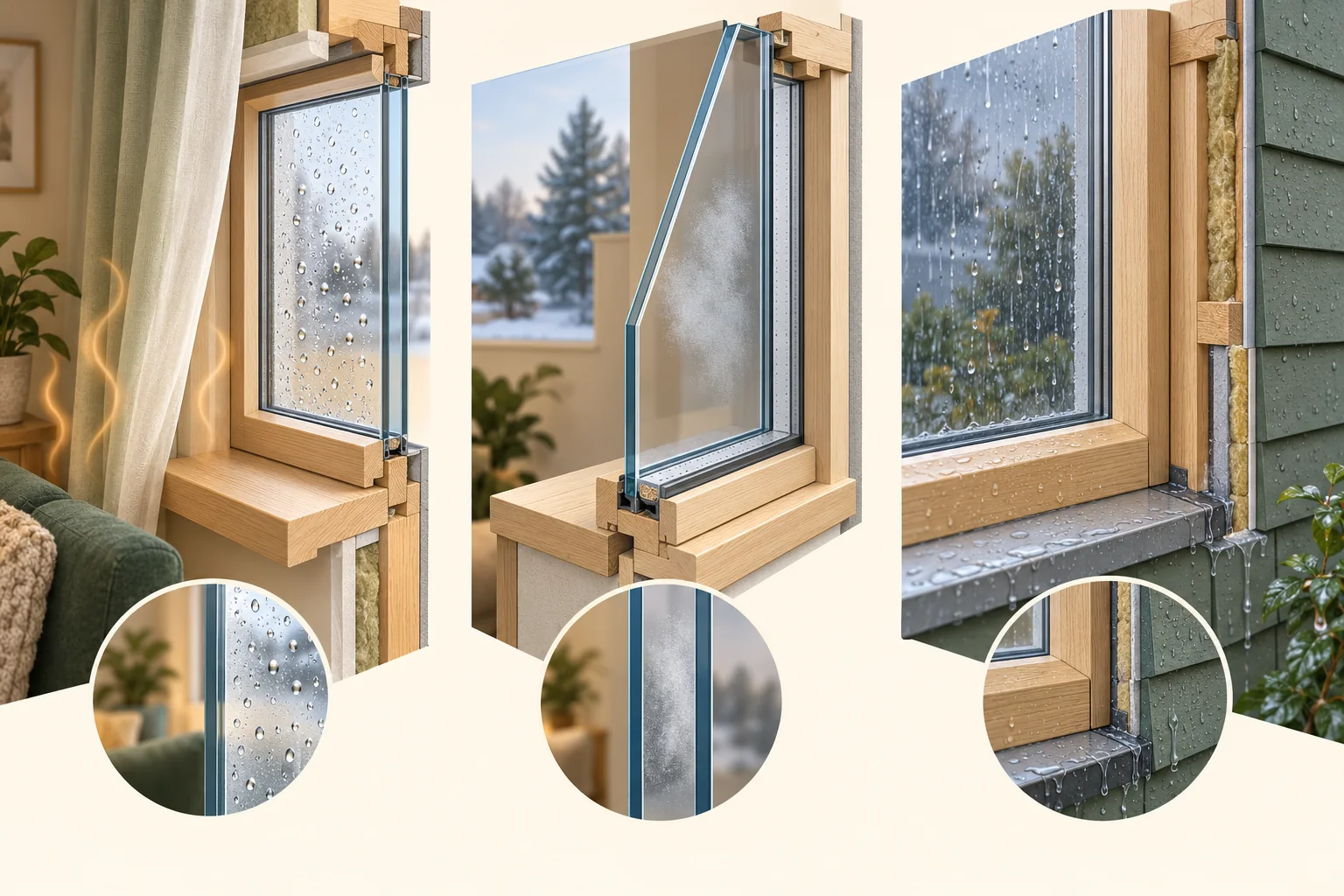
- Room-side glass
The left example illustrates water on the room-facing glass; no indoor humidity or surface temperature is supplied.
- Between-layer study
The centre illustrates a different location; the image cannot establish a real seal failure.
- Exterior weather
The right example shows outside water; it is not evidence of a humidifier’s indoor result.
What does this illustration leave out?
These conceptual studies diagnose no window, indoor humidity, seal, leak route or hidden material condition. The actual location may itself need qualified identification. Read the part names and their jobs below the picture.
Is the observed water actually on the room side, between layers or outside?
Explore this with HomeAI ↗Opens an editable question. Nothing is sent until you choose to send it.How can mineral buildup affect a pad or steam cylinder?
The pad manual explains that mineral accumulation can reduce the pad’s ability to absorb water and obstruct air movement through it. That affects the wet surface and passing-air jobs together. A fresh-looking cover cannot establish the condition of the pad inside it.
GeneralAire’s steam-family FAQ describes minerals remaining within a steam cylinder, including on its electrodes. The electrodes are the parts involved in heating the water electrically in that family. Mineral-related care therefore concerns a different component and mechanism from the pad example.
A record saying “pad replaced” identifies one task. It does not automatically show that water was distributed, air passed through or liquid drained correctly. Ask whether the provider assessed those functions and recorded findings, or whether the visit was limited to a replacement.
Use the exact component and applicable instructions for care planning. The retained pad manual gives differing replacement intervals in different places; this guide adopts no generic calendar. Do not scrape, soak or treat a component based on a picture. Its appearance alone cannot determine a suitable cleaning method or remaining output.
What should a humidifier service record include?
A useful record names the appliance and control, the applicable manual, the date, the work done and the findings. It should distinguish a task from a verified function. “Heating service” is broad; “humidifier pad replaced” is narrower; a finding about delivery or drainage needs its own recorded scope.
Ask whether the visit addressed the water supply and valve, distribution across the pad, the served air, control coordination and the liquid outlet. Not every visit must cover everything, but the record should make exclusions clear. A photograph preserves appearance; it is not a substitute for the provider’s method and findings.
These distinctions help sellers transfer care records honestly and buyers understand responsibility for the system. A buyer can ask whether the humidifier was included in an inspection and whether a specialist assessment is needed. Neither a listing description nor a service invoice guarantees future performance.
An HVAC or appliance provider can address the identified unit. A separate building-moisture specialist may be needed for recurring wet surfaces or concealed materials. Ask about actual qualifications, licensing where required, availability and the proposed assessment. HAUSE coordination does not itself establish a credential, an appointment or a completed result.
A pad, trough and pan each need their own care record
The trough spreads water, the pad offers a surface for evaporation and the pan collects liquid in a wet-pad example. Naming each job helps distinguish what a provider actually examined, cleaned or replaced.
Numbers identify the parts explained below.
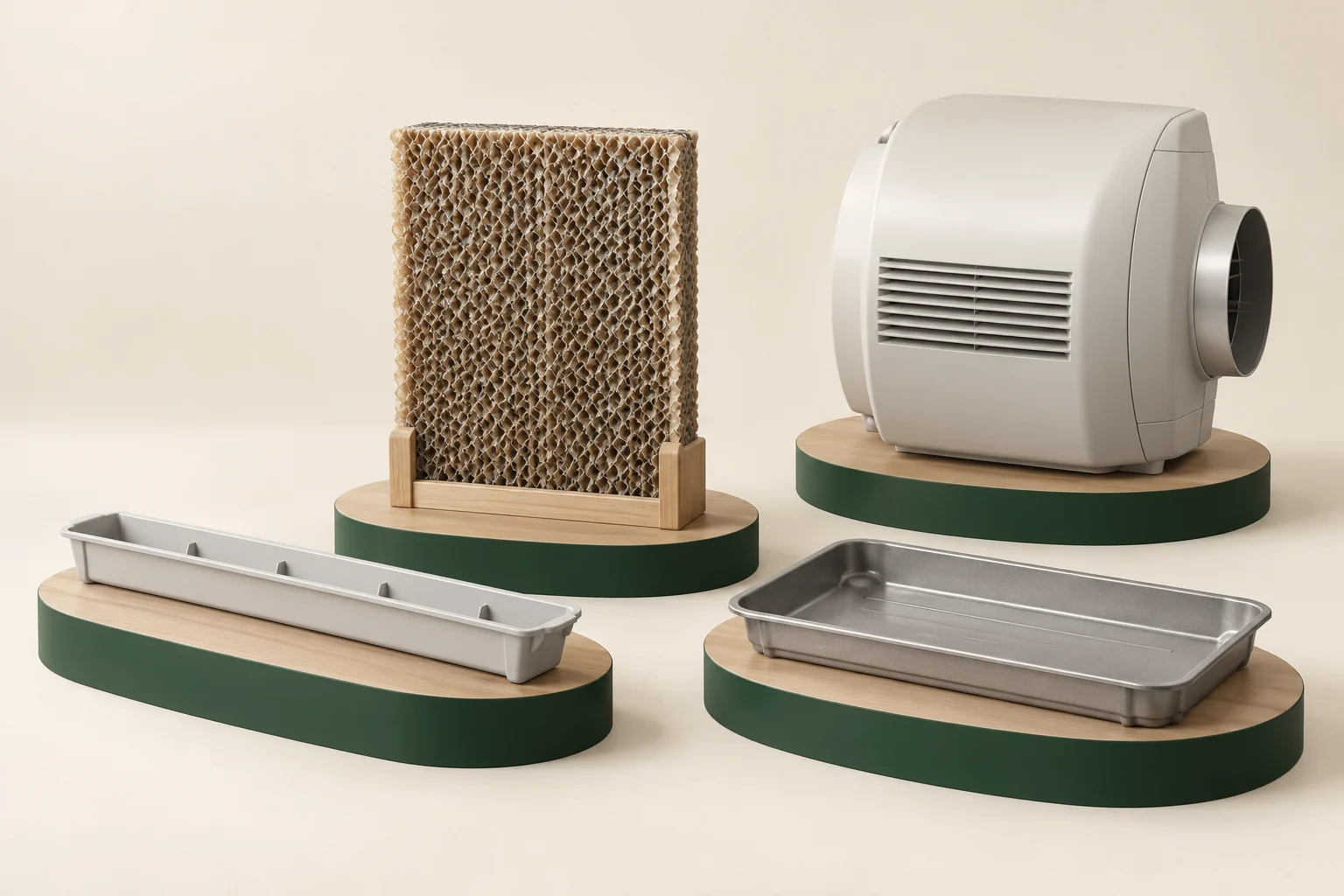
- Trough
Its intended job is spreading water across the pad; the illustration shows no live feed.
- Pad
Provides surface area for the wet-pad process. Its appearance cannot identify a real replacement part or current condition.
- Pan
Has a liquid-collection job. The receiving drain and successful installed drainage remain unknown.
What does this illustration leave out?
The separated forms establish no working route, actual material, mineral buildup, correct replacement part, completed service or safe condition. Read the part names and their jobs below the picture.
Which exact parts and drain checks are included in the service record?
Explore this with HomeAI ↗Opens an editable question. Nothing is sent until you choose to send it.A service task is different from an assessed finding
A useful invoice identifies its work and its boundaries.
- Pad replacementUseful meaning: A named component was addressedLimit: Does not automatically verify supply, air or drain
- Heating serviceUseful meaning: A visit concerned heating equipmentLimit: Humidifier work may be outside its scope
- Scoped humidifier assessmentUseful meaning: Documented methods and actual findingsLimit: Only the identified functions and conditions are covered
Illustrative record categories; no real invoice, professional credential or completed outcome is invented.
What can you safely note before asking for help?
Use information already available from normal, safe observation: a model in existing records, a closed exterior photograph, the label beside an already-visible number, the location of visible water and a dated care invoice. Missing information can stay missing. You do not need an induced operating cycle to prepare a useful question.
Keep the notes separate. “Room feels dry” describes comfort. “Dial photographed beside the cabinet” describes a control record. “Water on room-side glass” describes location. “Invoice names pad replacement” describes a task. The worksheet should not silently turn these into a humidity measurement, a failed valve or proven leakage.
Stay away from exposed hot or moving parts and wet electrical areas. Do not open the unit, bypass controls, alter settings, operate valves or disconnect water and drain routes for this guide. Where water may have contacted electrical equipment, keep clear and seek the appropriate utility or qualified electrical help.
Send the responsible provider a focused question: which mechanism and control apply, what air the unit serves, and what the proposed assessment can establish about water delivery, evaporation and drainage. Send recurring wall or window concerns through the separate building-moisture enquiry rather than treating an appliance visit as a whole-home clearance.
A fictional owner has a dry room, wet glass and an unclear invoice
Explicitly fictional Canadian example: an owner describes a dry-feeling room after the heating season begins. Existing photographs show a dial beside a duct-mounted cabinet and water on the room side of one window. A previous invoice says “heating service.” No humidity measurement, failed component or professional result is invented.
The owner prepares five fields: appliance and control identity; display label and context; water location; dated work and exclusions; and the next question. The blank model field remains blank. The window observation does not become proof that the humidifier needs a higher or lower setting.
The equipment enquiry asks the provider to identify the process and explain the served air, water control, pad or cylinder, and drainage. The building enquiry asks what accounts for the window water and whether nearby materials need assessment. Both investigations can be useful without assuming their findings in advance.
A replacement invoice could answer which part was supplied while leaving connected operation unverified. A scoped assessment could address more, but only its actual findings support a conclusion. The fictional owner learns how to ask better questions; the example ends without a diagnosis, a recommended setting, a health clearance or an invented repair outcome.
Room comfort, a device and a window raise different questions
This room setting accompanies a fictional owner’s separate comfort, window-water and service-record questions. If the real room has a device, identify what it measures before interpreting a number.
Numbers identify the parts explained below.

- Room account
Describe which room and ordinary circumstances the owner already reported, without inventing a reading.
- Blank device
Its type, channel and accuracy are unknown. Ask which actual measurement the existing record names.
- Window
A separate surface observation needs its own location and assessment; outside scenery is illustrative.
What does this illustration leave out?
The blank device is not identified as a hygrometer. The artwork supplies no humidity, temperature, sensor accuracy, outdoor reading, cause of discomfort or humidifier result. Read the part names and their jobs below the picture.
What existing information can clarify each question without creating an owner test?
Explore this with HomeAI ↗Opens an editable question. Nothing is sent until you choose to send it.Which answers should you seek before buying, selling or changing equipment?
Before a change, establish what is installed and the question you are trying to solve. Adding moisture for a comfort concern, addressing recurring window water and investigating a leaking appliance are different tasks. A product-family page cannot decide among them or prove that a new appliance is suitable.
For a buyer, request identity, installation and care records, then connect the inspection scope with any unresolved appliance or building concern. For a seller, describe dated work accurately and disclose its exclusions. Avoid presenting an ordinary comfort account as a measured whole-home result.
Ask the proposed provider to explain the identified mechanism, actual air and water routes, controls and evidence behind any recommendation. Keep local installation, electrical and receiving-drain requirements tied to the property and responsible authority. The named Canadian examples supply mechanisms, not a universal installation or professional licence rule.
Continue with the dehumidifier guide to understand moisture removal, the heating-airflow guide for room distribution, and the moisture and sensor guides for their separate questions. A clear explanation should leave you able to name the part and its job, the observation you have, and the qualified question that remains.
Practice the distinction.
A dry room, wet glass and an unclear invoice
Explicitly fictional Canadian owner with existing observations; no measured humidity or diagnosed fault.
Reported observations
- A room feels dry.
- An existing photograph shows an unidentified dial beside a cabinet.
- Water is already photographed on the room side of one window.
- An invoice says heating service without naming humidifier work.
Compare the explanations
Expand each possibility to see the evidence needed to distinguish it. Similar symptoms can have different mechanisms.
Equipment identity and care may be unclear
The existing records do not identify every component or verified function.
Matched model/control/manual and a scoped appliance assessment.
The window needs a separate moisture enquiry
Location helps organize a question without establishing the source or concealed condition.
An appropriate surface/source assessment with findings and limits.
A useful next question
Prepare identity, display context, water location, care scope and provider-question fields; keep appliance and building enquiries distinct.
Fictional only: no new test, setting, defect, licence, appointment, health clearance or repair result.
Know what the words mean.
- Water vapour
- Water in its gaseous form, distinct from liquid droplets.
- Evaporation
- Liquid water becoming water vapour, as at the named wetted pad.
- Evaporator pad
- A porous wet surface where passing air can gain water vapour.
- Distributor trough
- The upper part spreading incoming water across the pad.
- Strainer
- A small screen in the named incoming-water route.
- Metering orifice
- An opening that meters water delivery in the named example.
- Solenoid valve
- An electrically controlled water valve.
- Drain pan
- The part collecting liquid left over from the pad process.
- Bypass humidifier air route
- The documented branch through the humidifier between warm-air and return-air sides.
- Humidistat
- A humidity control whose target requests a result; a sensor reading describes sampled air.
- Humidification
- Adding moisture to air through an identified appliance process.
- Electrode-steam family
- The manufacturer-described family that passes electrical current through water to produce steam.
- Cool-mist droplets
- Tiny liquid droplets dispersed into air, distinct from gaseous water vapour.
- Humidistat target
- The result requested by the humidity control, separate from a sensor reading.
- Humidifier care scope
- The named components, tasks, assessed functions and exclusions recorded for a care visit.
Questions to bring
to the conversation.
- Which appliance, control and manual apply?
- Which parts bring water in, expose it to air and carry remaining liquid away?
- What air does the actual arrangement serve?
- Is a known number a target or a reading, and what location does it represent?
- Which task, assessment and exclusions are recorded?
- Does recurring surface moisture need a separate building enquiry?
Separate a showing observation, an existing record and a new professional assessment. Unknown means a question remains; it does not automatically mean a defect.
Use the evidence planner ↗Go to the source.
Original HomeAI explanation informed by these public references. Sources support the underlying guidance; they have not reviewed or endorsed HomeAI. Diagrams are conceptual, and calculator outputs depend on your inputs.
Publication & source review
First published .
Sources reviewed .
- Canadian General Filters / GeneralAire Canada · Humidifiers
Where this reference applies
Jurisdiction: Canadian manufacturer/distributor product portal
Edition: No publication/update date established in substantive body. HTTP last-modified and copyright are not publication dates.
Source reviewed: 2026-10-05 · UTC
Reading scope: Complete substantive current English product-list body.
Canadian product-family context and GF1042DMM/DMD naming; no current stock, installed identity or suitability claim.
- GeneralAire Canada · GF-1042DMM / 1042LH humidifier manual
Where this reference applies
Jurisdiction: Canadian manufacturer/distributor manual, Toronto address; exact applicability must be established for the installed appliance
Edition: Cover says GF-1042DMM, Last Updated 10-2023; repeated body headers say Model 1042LH. Canadian product listing uses GF1042DMM/DMD. These identities remain separate. October 2024 upload/HTTP date is not the printed edition.
Source reviewed: 2026-10-05 · UTC
Reading scope: Entire 10-page PDF body personally read, including safety, installation, workings, specification table, maintenance and troubleshooting/FAQ. Actual figures on PDF pages 3,7,8 personally viewed.
Named wetted-pad evaporation, bypass household-air route, distributor/pad/pan and water delivery/drain roles; no installation, adjustment, access, cleaning, interval or specification prescription.
- GeneralAire Canada · Frequently Asked Questions — humidifier section
Where this reference applies
Jurisdiction: Canadian manufacturer/distributor family-level explanation; not an exact installed steam or fan-powered manual
Edition: No publication/update date established in substantive body.
Source reviewed: 2026-10-05 · UTC
Reading scope: Complete applicable Humidifier section, from why install a humidifier through whether a Vapor Pad can simply be cleaned. Other air-cleaner/dehumidifier sections retained but not claimed personally read.
Wetted-pad, fan-powered and electrode-steam family mechanisms and mineral/care distinction. Clinical, savings, sizing, universal ideal-humidity, water-treatment and repair advice excluded.
- GeneralAire Canada · Properly using the MHX3 quicknote
Where this reference applies
Jurisdiction: Canadian manufacturer/distributor; note identifies MHX3C, not every installed humidistat
Edition: No printed publication/update date established. November 2024 URL and February 2026 file metadata separately retained, not substituted as publication dates.
Source reviewed: 2026-10-05 · UTC
Reading scope: Complete one-page actual pixels personally read; text extraction contains only the title.
Control-identity and source-conflict boundary. Note and manual differ on turning direction; all adjustment directions, timings, humidity prescriptions and cold-weather table values excluded.
- Health Canada · Cool-mist humidifiers
Where this reference applies
Jurisdiction: Canadian national household-product public-health guidance
Edition: Page details dated 2016-12-06; historical guidance read at its current official URL.
Source reviewed: 2026-10-05 · UTC
Reading scope: Complete substantive English HTML body: device types, water-related risks, safe use and care.
Steam/ultrasonic/motor-driven mist distinctions, standing-water care and mineral-containing droplets. No universal target, clinical assurance or cleaning recipe.
- Health Canada · Guide to addressing moisture and mould indoors
Where this reference applies
Jurisdiction: Canadian national public-health guidance
Edition: Body says published January 2023; page-details field says 2020-04-09. Both retained without silent substitution.
Source reviewed: 2026-10-05 · UTC
Reading scope: Complete substantive English body, including moisture sources, identification, safety/cleanup, professional assessment, air-testing limits, Appendix A and references.
Moisture-source, surface/material and professional-scope boundaries. No remediation instructions, medical diagnosis or concealed-material clearance.
- Natural Resources Canada · Humidity levels
Where this reference applies
Jurisdiction: Canadian national consumer energy guidance
Edition: Date modified 2025-03-21 displayed.
Source reviewed: 2026-10-05 · UTC
Reading scope: Complete substantive English humidity body obtained by direct official HTTP GET; browser research route returned 403 and is not claimed to have supplied the body.
Added humidifier moisture and wet-window context; no climate-independent setting, product selection or performance guarantee.
- Electrical Safety Authority · Flood Safety
Where this reference applies
Jurisdiction: Ontario electrical safety regulator; regional safety example, not a national code rule
Edition: No publication or update date established in captured body.
Source reviewed: 2026-10-04 · UTC
Reading scope: Entire substantive English HTML flood-safety body and homeowner/business/contractor headings.
Immediate wet-electrical priority and professional/utility escalation; Ontario credentials scoped.
Have a question about your home?
Start with the symptom, timing and what you have observed.
Ask HomeAI