Jump to a question in this guide
- What can a portable extinguisher add to a home’s fire plan?
- What must be interrupted for a fire to stop burning?
- What do the letters on the label tell you?
- What is stored inside a dry-chemical extinguisher?
- How do the handle, lever, pin, hose and nozzle differ?
- What does a green pressure gauge leave unanswered?
- Why is a quick practice discharge the wrong readiness check?
- How does placement relate to leaving the room?
- What should an ordinary household observation record contain?
- What changes after use, damage or an uncertain history?
- What does a service report prove, and what belongs with another specialist?
- Does a garage, shed or kitchen provide the right storage conditions?
- What should the next household receive at handover?
- How would a fictional household resolve a green gauge and a reported puff?
- Warning, escape, automatic sprinklers and portable extinguishing agent have different jobs.
- The fire class and agent must match; an ABC marking is not a K marking.
- A green gauge is one observation, and any use changes the service or replacement question.
- Do not stage a discharge to prove readiness; use the exact model’s instructions and suitable training.
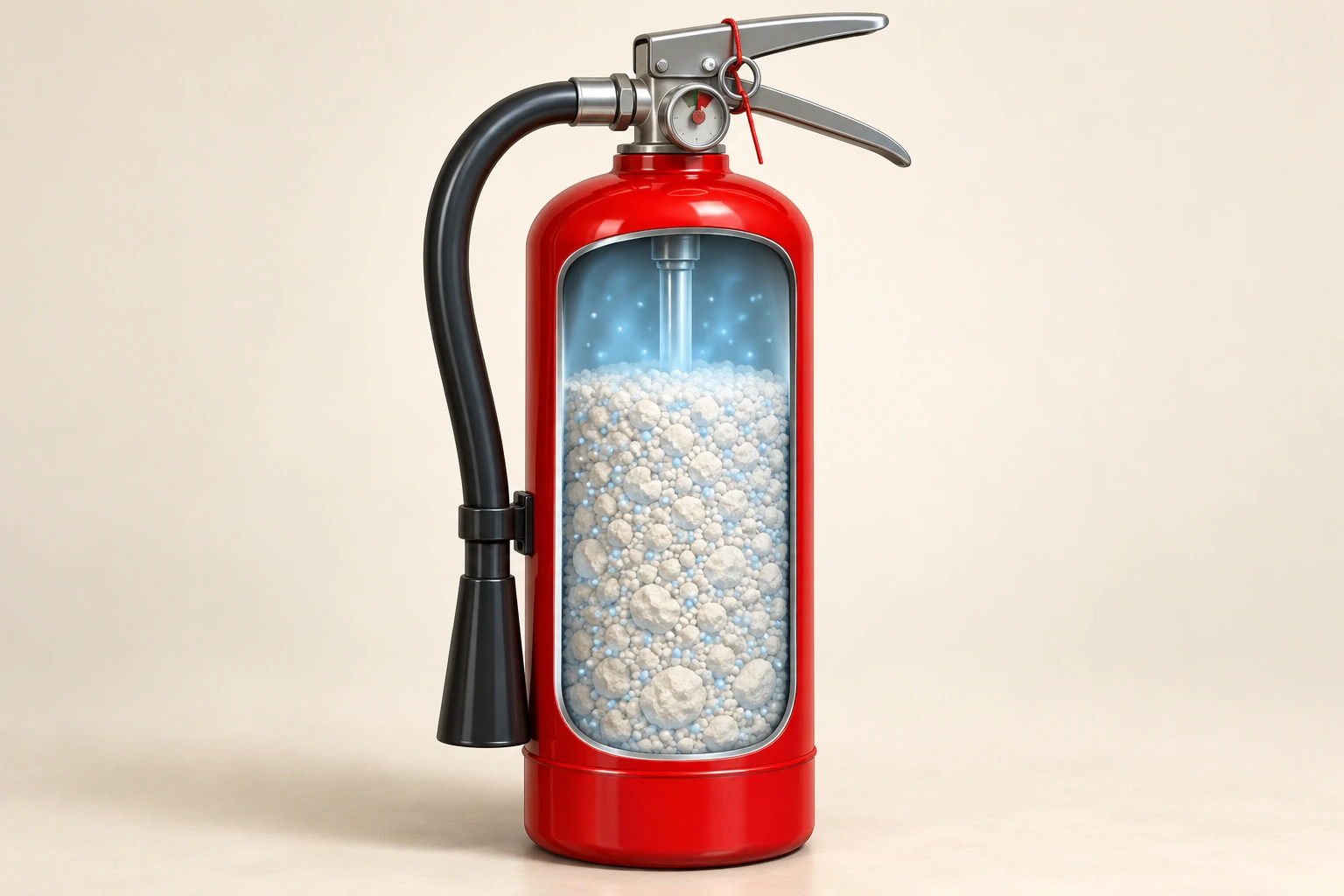
The powder is the extinguishing agent; stored gas provides discharge energy when the intended valve operates. The enlarged particles and blue gas marks explain that relationship inside a conceptual see-through vessel.
About this illustration
Particle size and fill level are illustrative. The pickup tube disappears into powder, so the complete internal outlet route is not shown. No actual unit, charge or readiness is established. This is a conceptual teaching model, not an assessment of your home.
8 picture lessons appear beside the questions in this guide. Use them to understand the explanation, then consider what it means for your home.
What can a portable extinguisher add to a home’s fire plan?
A portable extinguisher stores a limited supply of extinguishing agent that a person may discharge onto a suitable small fire. It does not detect smoke, wake a sleeping household or provide an escape route. Those are different jobs. Understanding the container is useful preparation, but keeping people able to leave remains the first purpose of the household plan.
If there is a fire, smoke or an uncertain dangerous situation, leave, alert others and call emergency services from a safe location. Do not stay to read this guide, retrieve a hidden extinguisher or decide whether a growing fire still fits an illustration. CCOHS says not to fight a fire when the material, correct equipment, training or ability to handle the situation is uncertain.
This guide explains the familiar parts, the meaning of the label and the difference between an ordinary observation and professional servicing. It supplies no permission to attack a fire and no substitute for practical instruction from an appropriate fire-safety provider. An unused red cylinder and a green gauge are useful things to identify; neither answers every question about readiness.
The smoke-alarm and escape guide owns warning and the household exit plan. The sprinkler guide owns an installed automatic water system. Here the distinct question is how a portable stored agent, its discharge controls, its intended fire classes and its service history fit together before an emergency. The pictures are conceptual examples, not a finding that this home has suitable equipment.
What must be interrupted for a fire to stop burning?
A fire needs fuel, sufficient heat, oxygen and a continuing chemical reaction. CCOHS uses these four elements to explain why different agents work differently. Cooling a burning material addresses heat. Separating fuel from oxygen addresses a different part of the relationship. Interrupting the combustion reaction is another mechanism. An extinguisher’s contents are selected for an intended kind of fire, not simply for producing a visible cloud.
Water removes heat from suitable ordinary combustible materials. Carbon dioxide can displace oxygen around the fuel surface. Dry chemical acts on the fuel–oxygen relationship and the continuing reaction. These descriptions explain agent functions; they do not make agents interchangeable. Water can spread burning liquids and creates an electrical hazard on energized equipment. Carbon dioxide can create a breathing hazard in an enclosed space.
An extinguished-looking flame also does not establish that heat has disappeared, that concealed material has stopped smouldering or that a room is safe to enter. The missing visible flame and the remaining conditions are different observations. Emergency responders determine the appropriate fire response and re-entry direction. Do not turn a basic combustion diagram into a reason to re-enter or investigate.
Use the mechanism to ask better preparation questions: which hazard was considered, which agent is intended for it and which limitations accompany that agent? This is more useful than buying the largest-looking cylinder or treating a familiar brand as a guarantee. The four-element native figure is deliberately conceptual; it gives no household extinguishing capacity or prediction about a real fire.
Different agents interrupt different fire relationships
Cooling, oxygen separation and interruption of the continuing reaction address different parts of combustion. The four elements organize the explanation; they are not instructions to fight a fire.
Numbers identify the parts explained below.
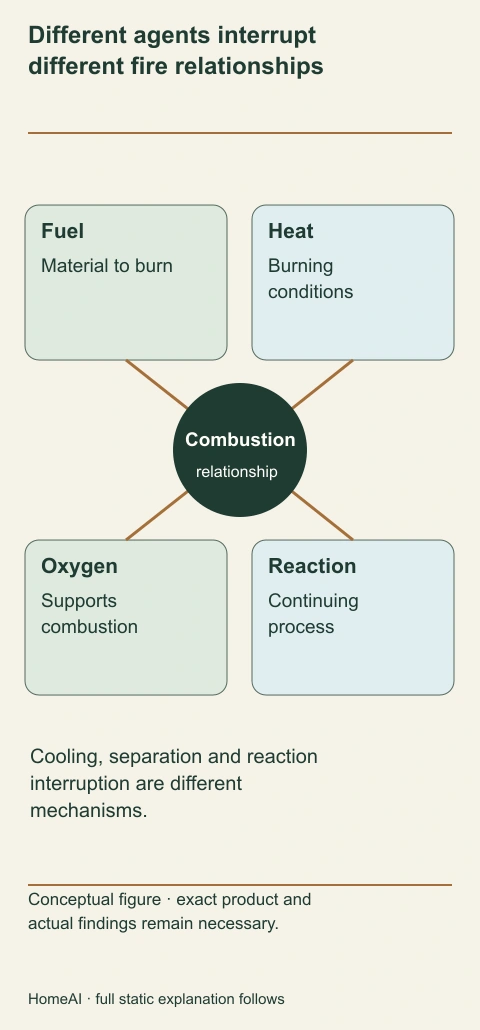
- Fuel
The material that can burn.
- Heat
Energy bringing material to burning conditions.
- Oxygen
Supports the continuing combustion.
- Reaction
The continuing chemical process of burning.
What does this illustration leave out?
Conceptual combustion model, not an agent-selection permission or a fire-capacity estimate. This illustration explains an idea. It is not an installation guide.
Which actual hazard and product limitations does the fire-safety provider identify?
Explore this with HomeAI ↗Opens an editable question. Nothing is sent until you choose to send it.Different agents interrupt different fire relationships
Cooling, oxygen separation and interruption of the continuing reaction address different parts of combustion. The four elements organize the explanation; they are not instructions to fight a fire.
- Fuel
- The material that can burn.
- Heat
- Energy bringing material to burning conditions.
- Oxygen
- Supports the continuing combustion.
- Reaction
- The continuing chemical process of burning.
Figure scope: Conceptual combustion model, not an agent-selection permission or a fire-capacity estimate.
A useful question: Which actual hazard and product limitations does the fire-safety provider identify?
Full wording shown in this figure
- Different agents interrupt
- different fire relationships
- Fuel
- Material to burn
- Heat
- Burning
- conditions
- Oxygen
- Supports
- combustion
- Reaction
- Continuing
- process
- Combustion
- relationship
- Cooling, separation and reaction
- interruption are different
- mechanisms.
- Conceptual figure · exact product and
- actual findings remain necessary.
- HomeAI · full static explanation follows
- Cooling, oxygen separation and interruption of the continuing reaction address different parts of combustion. The four elements organize the explanation; they are not instructions to fight a fire.
- Conceptual combustion model, not an agent-selection permission or a fire-capacity estimate.
- Which actual hazard and product limitations does the fire-safety provider identify?
What do the letters on the label tell you?
A fire class describes the burning material or relevant electrical condition. In the Canadian CCOHS explanation, Class A covers ordinary combustibles such as wood, paper and cloth. Class B concerns flammable liquids and gases. Class C concerns energized electrical equipment. Class D concerns combustible metals, and Class K concerns combustible cooking oils or fats in cooking appliances.
An extinguisher marked for several classes is intended for those identified classes; the letters do not mean every fire in that room. In particular, an ABC marking is not a K marking. A general household picture cannot resolve the suitability of a product for the actual cooking-oil hazard, a specialist metal hazard or a specific battery incident. Ask the appropriate fire-safety provider about the actual use and read the product label.
Class C does not mean that electricity is itself an extinguishing agent or an ordinary fuel. It flags energized equipment as a condition relevant to the suitable extinguisher. The surrounding materials and the electrical state still matter. Do not touch an appliance, open a panel or try to change that state to reclassify a fire. The class lesson is preparation vocabulary, not an emergency electrical procedure.
Keep the label’s complete rating and manufacturer identity together. The named First Alert manual includes numerical ratings as well as letters, but this guide does not translate a number into a safe room size, attack distance or guaranteed fire capacity. The native classification matrix uses words rather than colour alone, so a reader can distinguish classes without treating colour as product identification.
Read the class, not just the cylinder colour
The letters identify different burning materials or an energized-electrical condition. A product marked ABC does not acquire a K marking because it is kept near a kitchen.
Numbers identify the parts explained below.
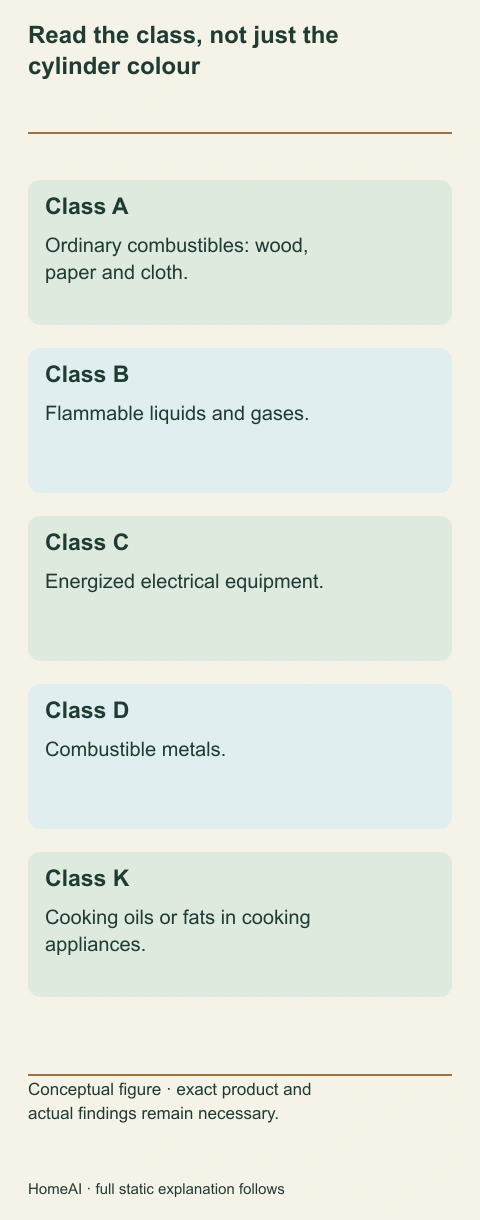
- Class A
Ordinary combustibles: wood, paper and cloth.
- Class B
Flammable liquids and gases.
- Class C
Energized electrical equipment.
- Class D
Combustible metals.
- Class K
Cooking oils or fats in cooking appliances.
What does this illustration leave out?
Vocabulary only; exact product suitability and training remain necessary. No diagnostic fire judgement. This illustration explains an idea. It is not an installation guide.
Which complete fire-class marking and agent does the actual product label show?
Explore this with HomeAI ↗Opens an editable question. Nothing is sent until you choose to send it.Read the class, not just the cylinder colour
The letters identify different burning materials or an energized-electrical condition. A product marked ABC does not acquire a K marking because it is kept near a kitchen.
- Class A
- Ordinary combustibles: wood, paper and cloth.
- Class B
- Flammable liquids and gases.
- Class C
- Energized electrical equipment.
- Class D
- Combustible metals.
- Class K
- Cooking oils or fats in cooking appliances.
Figure scope: Vocabulary only; exact product suitability and training remain necessary. No diagnostic fire judgement.
A useful question: Which complete fire-class marking and agent does the actual product label show?
Full wording shown in this figure
- Read the class, not just the
- cylinder colour
- Class A
- Ordinary combustibles: wood,
- paper and cloth.
- Class B
- Flammable liquids and gases.
- Class C
- Energized electrical equipment.
- Class D
- Combustible metals.
- Class K
- Cooking oils or fats in cooking
- appliances.
- Conceptual figure · exact product and
- actual findings remain necessary.
- HomeAI · full static explanation follows
- The letters identify different burning materials or an energized-electrical condition. A product marked ABC does not acquire a K marking because it is kept near a kitchen.
- Vocabulary only; exact product suitability and training remain necessary. No diagnostic fire judgement.
- Which complete fire-class marking and agent does the actual product label show?
What is stored inside a dry-chemical extinguisher?
A stored-pressure dry-chemical extinguisher contains extinguishing powder and pressurizing gas in a pressure-containing vessel. The gas and the powder do different jobs: the powder is the agent intended to interrupt combustion, while the stored pressure provides the energy for discharge through the intended outlet when the valve operates. This is not an electrically driven water pump.
Amerex’s historical manufacturer explanation says the gas is present among the dry-chemical particles, not only pressing on the top like a separate lid. When the valve opens, expanding gas helps move and fluidize the powder. The conceptual transparent cylinder shows that relationship without specifying an actual fill level, pressure, chemical formula or the internal construction of a particular household unit.
This stored energy is also why a cylinder is not an owner-service container. Do not unscrew its valve, remove its hose, puncture it, heat it or attempt to refill it. The First Alert manual explicitly reserves service to a suitable fire-equipment provider. Looking inside a generated cutaway is a way to understand a function; opening the real vessel to check the picture would create a different and dangerous activity.
A pressurized container can remain hazardous even when it has been used or appears empty. Keep disposal and transport questions with the actual manufacturer and receiving local service. This guide deliberately gives no emptying procedure. An old manual’s disposal paragraph is not adopted as a present municipal acceptance rule, and a low gauge reading is not permission to dismantle the assembly.
Gas and agent do different jobs
The powder is the extinguishing agent; stored gas provides discharge energy when the intended valve operates. The enlarged particles and blue gas marks explain that relationship inside a conceptual see-through vessel.
Numbers identify the parts explained below.
- Agent
The powder supplies the intended extinguishing material.
- Gas
Provides stored discharge energy.
- Vessel
Contains the assembled pressurized contents.
- Visible boundary
The internal route and particle scale are simplified.
What does this illustration leave out?
Particle size and fill level are illustrative. The pickup tube disappears into powder, so the complete internal outlet route is not shown. No actual unit, charge or readiness is established. This illustration explains an idea. It is not an installation guide.
Which actual agent and stored-pressure product does the label identify?
Explore this with HomeAI ↗Opens an editable question. Nothing is sent until you choose to send it.How do the handle, lever, pin, hose and nozzle differ?
The carrying handle supports handling of the assembled unit. The operating lever controls discharge through the valve. A safety pin and its tamper indication help prevent unintended operation and show whether that arrangement has been disturbed. The hose and nozzle provide the intended outward discharge path. These familiar parts have separate functions even when they sit close together on the top of the cylinder.
The assembled-head close-up keeps the lever unpressed, the pin in place and the nozzle stowed. It teaches the part names without turning the picture into a firefighting sequence. The complete operating instructions and suitable training belong to the actual model. Do not assume another cylinder has the same release arrangement, hose retention, carrying position or operating control simply because it is also red.
A missing pin, broken tamper indication, unreadable label or damaged hose changes the readiness enquiry. It does not tell the owner which internal repair would restore the unit. Preserve the ordinary observation and contact the appropriate manufacturer or service provider before relying on it. Do not replace a safety seal with an improvised tie, probe a nozzle or remove a hose to find out what is behind it.
After any actual discharge, the question is no longer just whether the visible parts still look tidy. The type of unit determines the next service or replacement route. A label, invoice and service report can identify that route. The appearance of a pin placed back through the handle cannot erase the use history or prove that the original charge is intact.
The lever, pin, gauge and hose have different jobs
The lever operates discharge, the pin and tamper arrangement help prevent unintended operation, and the hose leads to the outlet. The close-up separates those parts from the gauge indication.
Numbers identify the parts explained below.
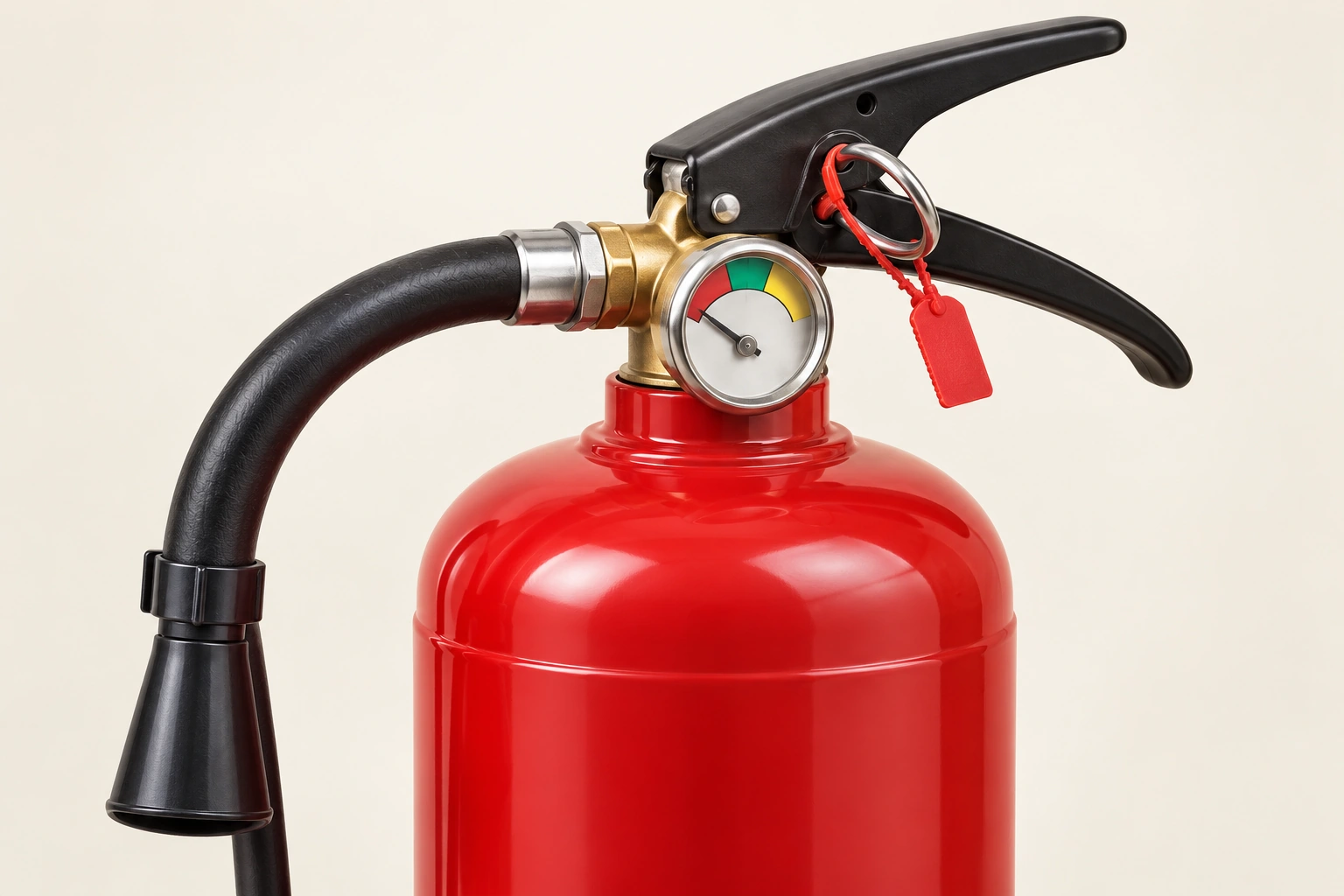
- Lever
Operates the intended discharge valve.
- Pin and seal
Their product-specific safety/tamper role is separate.
- Gauge
One model-dependent indicator, not a full assessment.
- Hose
The external discharge route remains assembled.
What does this illustration leave out?
The pictured pointer is in a red band, not a readiness result. It is an unbranded teaching model with no verified rating or service condition. This illustration explains an idea. It is not an installation guide.
What does the actual matching manual say about each visible part and any concern?
Explore this with HomeAI ↗Opens an editable question. Nothing is sent until you choose to send it.What does a green pressure gauge leave unanswered?
On the named First Alert gauge-equipped example, the marked green band indicates the intended pressurization condition. The gauge is therefore one part of the check. It does not identify the fire class by itself, show that the label is readable, establish that the nozzle is unobstructed or prove that the extinguisher has not been dropped, corroded or used.
Read an indicator together with the correct model instructions rather than treating the illustration’s dial as a test instrument. Some products have another indicator arrangement, and the First Alert Canada FAQ describes model-family differences. This guide does not tell the owner to press a pressure pin, force a stuck pointer or compare a gauge with a homemade pressure source. The exact product determines the intended observation.
A label photograph and an ordinary visible gauge report may be useful in a service conversation. State their limits honestly: the image may be old, glare may obscure the pointer and the view may exclude the underside, mounting arrangement or hose. If safe ordinary viewing cannot settle the reading, leave it unresolved and request appropriate guidance instead of recreating a discharge to see what happens.
The native readiness figure separates indicator, condition, access and history. A concern in any one category deserves its own response. Passing a visual question does not cancel another concern: an easy-to-reach unit can have a damaged label, and an undamaged-looking cylinder can have an unknown discharge history. A useful record keeps these different facts visible rather than converting them into one unexplained ready tick.
One indicator cannot answer every readiness question
Indicator, visible condition, access and use history are different observations. An apparently acceptable pointer does not erase reported use or a damaged component.
Numbers identify the parts explained below.
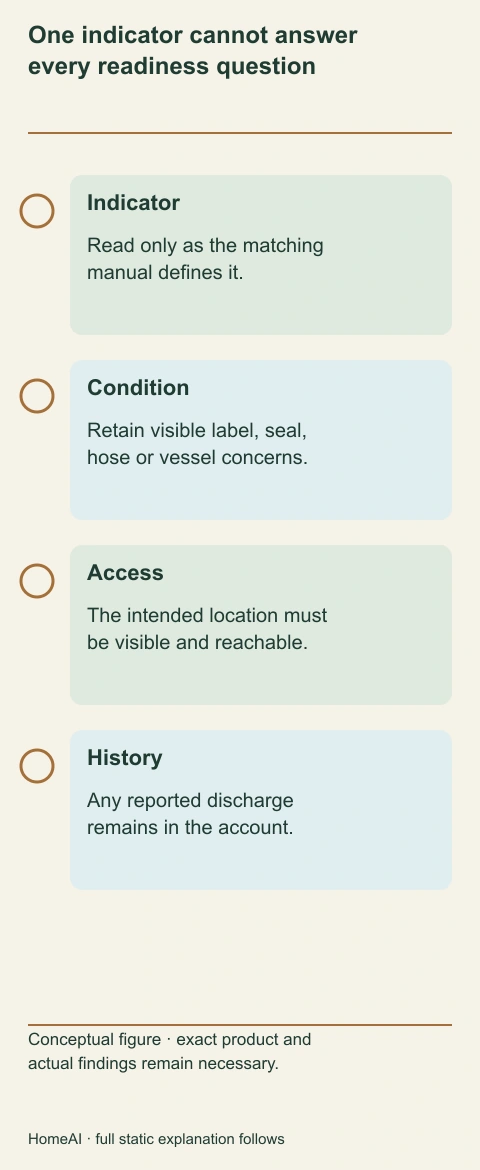
- Indicator
Read only as the matching manual defines it.
- Condition
Retain visible label, seal, hose or vessel concerns.
- Access
The intended location must be visible and reachable.
- History
Any reported discharge remains in the account.
What does this illustration leave out?
No combined pass score, internal inspection, discharge test or actual readiness finding. This illustration explains an idea. It is not an installation guide.
Which observation needs service-provider interpretation before the household relies on this unit?
Explore this with HomeAI ↗Opens an editable question. Nothing is sent until you choose to send it.One indicator cannot answer every readiness question
Indicator, visible condition, access and use history are different observations. An apparently acceptable pointer does not erase reported use or a damaged component.
- Indicator
- Read only as the matching manual defines it.
- Condition
- Retain visible label, seal, hose or vessel concerns.
- Access
- The intended location must be visible and reachable.
- History
- Any reported discharge remains in the account.
Figure scope: No combined pass score, internal inspection, discharge test or actual readiness finding.
A useful question: Which observation needs service-provider interpretation before the household relies on this unit?
Full wording shown in this figure
- One indicator cannot answer
- every readiness question
- Indicator
- Read only as the matching
- manual defines it.
- Condition
- Retain visible label, seal,
- hose or vessel concerns.
- Access
- The intended location must
- be visible and reachable.
- History
- Any reported discharge
- remains in the account.
- Conceptual figure · exact product and
- actual findings remain necessary.
- HomeAI · full static explanation follows
- Indicator, visible condition, access and use history are different observations. An apparently acceptable pointer does not erase reported use or a damaged component.
- No combined pass score, internal inspection, discharge test or actual readiness finding.
- Which observation needs service-provider interpretation before the household relies on this unit?
Why is a quick practice discharge the wrong readiness check?
Discharging agent changes the stored condition. The named First Alert manual says not to check pressure by squeezing the lever, even briefly. Its Canada FAQ also rejects trigger testing. A short puff is therefore not a harmless way to prove that the unit will work later. It can leave the extinguisher needing the proper service or replacement route.
Source instructions require careful reading here. Calgary’s public page includes a suggestion to test before approaching a fire, while the named First Alert product instructions expressly prohibit a discharge test as an ordinary check. This guide does not combine those sentences into a universal procedure. It follows the conservative preparation boundary: do not stage a discharge, and obtain suitable training using the appropriate provider’s equipment and arrangements.
Training and servicing are different tasks. Training helps an adult understand the correct equipment, its operation and when to leave. Servicing addresses the identified unit’s condition with appropriate knowledge, equipment and documentation. A demonstration performed on a training device is not a service result for the cylinder mounted in your home. Nor does watching a demonstration establish that everyone can safely handle a real emergency.
If the history includes even a small use, report that fact. Do not describe the unit as unused because the fire was small, the puff was brief or the gauge still appears acceptable. The professional needs the actual event and product identity. The household can prepare that record without deliberately releasing agent, resetting an indicator or attempting an internal inspection.
How does placement relate to leaving the room?
An extinguisher should be visible and accessible in the intended location without making a person move toward the hazard to retrieve it. Calgary’s education connects placement with escape routes and exits. A cylinder hidden behind stored boxes, inside a crowded cupboard or beside a heat source can raise a different practical problem from whether the product itself has been serviced.
The entry-and-kitchen picture shows a route relationship, not a prescribed floor plan or mounting height. The exit remains a place people can reach, and the extinguisher is not drawn behind the stove. Actual mounting needs the correct bracket, adequate support, product instructions and applicable local requirements. This guide supplies no screw choice, wall-anchor design, unit count or universal spacing rule.
Household abilities and access also matter. A product can be technically present while its location, weight or unfamiliar release arrangement makes the preparation plan unrealistic for the people expected to use it. Discuss those facts with an appropriate fire-safety provider. The solution must preserve the household’s escape and emergency response rather than expecting a child or untrained person to handle equipment.
Revisit the ordinary route when furniture and storage change. Record an obstruction as an obstruction and restore the intended access safely without moving a questionable pressurized unit into another unsuitable location. If an extinguisher’s location or mounting is uncertain, ask the relevant provider to resolve it. A photograph showing open floor today is not a continuing assurance that tomorrow’s storage will leave the route clear.
Keep the equipment question connected to leaving
The extinguisher sits near the illustrated exit route while the kitchen is farther into the scene. That relationship explains why access should not require approaching the hazard.
Numbers identify the parts explained below.

- Exit
The household’s way out remains the priority.
- Access
The unit is visible near the illustrated route.
- Hazard location
The kitchen is distinct from the equipment location.
- Actual arrangement
Product and local requirements still determine suitability.
What does this illustration leave out?
No mounting height, required count, floor-plan approval or real household access finding is established. This illustration explains an idea. It is not an installation guide.
Does the actual placement preserve the household’s intended escape and appropriate access?
Explore this with HomeAI ↗Opens an editable question. Nothing is sent until you choose to send it.What should an ordinary household observation record contain?
Start with the exact extinguisher identity, the location and the matching instructions. Add the date, the reported gauge or indicator state, whether the label can be read and any visible concern with the pin, tamper indication, cylinder, hose or support. Only describe what could be observed safely; leave concealed condition and anything not examined explicitly outside the record.
The observation and the conclusion should be separate. A note can say that a pointer appeared in a marked band and the label was visible. It should not turn that observation into a pressure test, an internal agent assessment or a compliance certificate. An owner photograph, a provider’s inspection and a service operation supply different evidence and may cover different parts of the same unit.
Use the actual manual and local responsibility to decide the check and servicing schedule. CCOHS describes workplace inspection and service duties, Calgary gives local household education, and the named manufacturer manual gives its own schedule. Their scopes are not a single national homeowner law. Keep the adopted instruction and its date in the record rather than borrowing whichever interval is easiest to remember.
If the home is a rental or part of a condominium, also identify who supplies, checks and arranges service for the unit in question. An extinguisher in a shared corridor and one owned inside a dwelling need not have the same responsible party. Confirm the actual local arrangements and management instructions; do not assume a technician attending one location has accepted responsibility for every other cylinder.
What changes after use, damage or an uncertain history?
Rechargeable and non-rechargeable units have different intended next steps. The named First Alert rechargeable model requires appropriate servicing after use, regardless of how little powder was discharged. The Canada FAQ explains that a disposable unit is replaced after use rather than refilled by the householder. Identify the actual unit before treating those routes as interchangeable.
Damage and corrosion also matter independently of discharge. CCOHS identifies conditions that require removal from service and directs uncertainty to the supplier or manufacturer. Do not try to sand away corrosion, repaint a questionable vessel or repair threads, a hose or a valve. A cosmetic improvement can conceal the very condition the appropriate service provider needs to assess.
An inherited unit with no reliable history needs a history enquiry, not a fictional date. A seller’s statement, an old purchase receipt, a gauge photograph and a current service report answer different questions. Ask what the provider can establish now, what remains unknown and whether the manufacturer supports service for that model. A missing document does not prove failure, but it should not be rewritten as a completed inspection.
Keep the next household protection arrangement explicit while a unit is being assessed or replaced. Obtain appropriate local advice rather than leaving a labelled gap in the plan indefinitely. Do not assume a shop’s ability to accept a particular extinguisher, a warranty claim or a collection depot’s disposal route; confirm the exact product, condition and receiving instructions before transport.
The product type changes the after-use route
A rechargeable unit and a disposable unit have different intended next steps. Identification comes before assigning servicing or replacement, even after a small reported discharge.
Numbers identify the parts explained below.
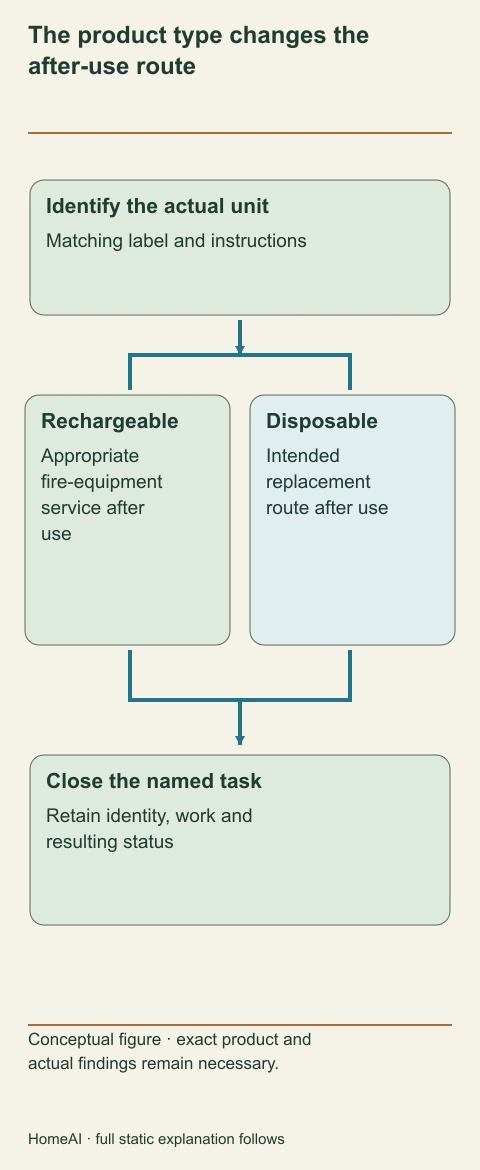
- Identify
Match the model and complete product instructions.
- Rechargeable
Appropriate fire-equipment service after use.
- Disposable
Its intended replacement route after use.
- Closeout
Keep the identified task and resulting status.
What does this illustration leave out?
Actual manufacturer/service instructions govern; no owner refilling, dismantling or disposal procedure. This illustration explains an idea. It is not an installation guide.
What exact unit and use history does the provider’s proposed task cover?
Explore this with HomeAI ↗Opens an editable question. Nothing is sent until you choose to send it.The product type changes the after-use route
A rechargeable unit and a disposable unit have different intended next steps. Identification comes before assigning servicing or replacement, even after a small reported discharge.
- Identify
- Match the model and complete product instructions.
- Rechargeable
- Appropriate fire-equipment service after use.
- Disposable
- Its intended replacement route after use.
- Closeout
- Keep the identified task and resulting status.
Figure scope: Actual manufacturer/service instructions govern; no owner refilling, dismantling or disposal procedure.
A useful question: What exact unit and use history does the provider’s proposed task cover?
Full wording shown in this figure
- The product type changes the
- after-use route
- Identify the actual unit
- Matching label and instructions
- Rechargeable
- Appropriate
- fire-equipment
- service after
- use
- Disposable
- Intended
- replacement
- route after use
- Close the named task
- Retain identity, work and
- resulting status
- Conceptual figure · exact product and
- actual findings remain necessary.
- HomeAI · full static explanation follows
- A rechargeable unit and a disposable unit have different intended next steps. Identification comes before assigning servicing or replacement, even after a small reported discharge.
- Actual manufacturer/service instructions govern; no owner refilling, dismantling or disposal procedure.
- What exact unit and use history does the provider’s proposed task cover?
What does a service report prove, and what belongs with another specialist?
A useful extinguisher service report identifies the unit, its type and location, the date, work or assessment performed, provider and resulting status or outstanding action. Match its serial or other identity with the actual cylinder. A tag that cannot be connected to this unit is weaker evidence than a report with a clear identity and scope.
The technician’s extinguisher work does not automatically assess the home’s smoke alarms, electrical installation, cooking equipment or escape routes. After a fire, re-entry and investigation belong with emergency responders and the relevant specialists. An extinguisher may have operated while a damaged appliance, smoke contamination or affected building material still needs a separate response.
Similarly, cleaning visible powder is not proof that electrical equipment can be energized again. The named manual distinguishes after-fire electrical assessment from residue cleanup. This guide gives no cleanup or restoration recipe: the actual incident, agent, surfaces and affected equipment determine the suitable professional advice. A completed service invoice for the cylinder should not become a clearance for the room.
When comparing proposals, ask whether they concern inspection, recharge, replacement or a different task, and what identifies completion. Keep remaining work with the party responsible for it. This turns a short instruction such as get the extinguisher checked into a reviewable assignment, while preserving the separate household emergency plan and any incident-specific responder direction.
Does a garage, shed or kitchen provide the right storage conditions?
A pressurized unit has a permitted storage environment as well as an intended fire class. The named First Alert manual specifies a temperature range for those particular models and warns against locating the cylinder near an engine, stove or other heat source. Do not turn a fire-rating letter into evidence that the vessel tolerates every storage condition beside that hazard.
For a Canadian household, an unheated garage, a damp shed and a conditioned hall can present different actual conditions. Identify the model’s permitted environment and the place proposed for it. This guide does not prescribe one national winter temperature or say every dry-chemical, water or other extinguisher shares the same range. The manufacturer must answer the question for the exact product.
Moisture exposure and corrosion are also different from whether a gauge appears pressurized. A cylinder repeatedly left wet may need a condition enquiry even if it has never discharged. Record the visible issue without scraping, stripping paint or removing a label to search underneath it. Appropriate assessment should preserve useful evidence instead of turning a surface improvement into a hidden-vessel clearance.
If the existing location is outside the documented conditions, obtain an appropriate replacement or location plan before relying on that unit. Do not heat a cold cylinder with a flame, put it beside a furnace or wrap it so the label and controls disappear. The useful preparation record names the accepted product and location arrangement and the instructions supporting it, while leaving mounting, access and emergency use as their own questions.
What should the next household receive at handover?
Hand over a unit-specific record, not just a cylinder left in a cupboard. The next person needs the model and intended class, matching instructions, normal location, provider contact and the latest relevant inspection or service record. Keep the actual use history with that identity. If the unit was moved, replaced or serviced, the record should say which event occurred rather than copying the previous equipment’s dates.
A service tag can direct the reader to a past task, but its short wording may not describe every exclusion or remaining action. Retain the fuller report when one exists and match it to the current unit. A purchase receipt establishes a transaction; it does not establish that the extinguisher was maintained correctly after purchase. A warranty period is also a different question from present condition.
Explain the practical boundaries in ordinary language. Where is the exit, who arranges service and which concerns must be resolved before relying on the unit? The next occupant should not have to guess whether an indicator was an owner observation or a technician’s result. If information is missing, name the gap and arrange the appropriate assessment; do not write a fictional check into a fresh handover form.
In a sale, rental or shared building, the legal allocation of equipment and maintenance responsibilities needs the actual applicable arrangement. This guide does not determine that allocation. The handover can still be clear about what is present, what documents accompanied it and what remains to be confirmed. That concrete record supports the next decision without promising a future firefighting outcome or merging portable equipment with the home’s other fire-safety systems.
How would a fictional household resolve a green gauge and a reported puff?
Fictional owner Maya inherits a rechargeable extinguisher near the entry. Its gauge appears in the marked green area, but a family member recalls releasing a small puff during the move. The label is readable and a prior service tag belongs to the previous year. There is no fire in progress, no current service finding and no result from this teaching example that establishes the real condition of anyone’s equipment.
Maya records the model identity, ordinary visible condition and the reported use without repeating it. She obtains the matching manual and sends that history to an appropriate fire-equipment provider. The provider’s invented response identifies the cylinder as a rechargeable type requiring the appropriate service after discharge. It does not accept the green photograph as a substitute for the unit’s service assessment.
One explanation concerns a unit that remains pressurized after some agent has been released; another concerns uncertainty in the reported event or identity. Maya does not need to settle that disagreement by opening the vessel or producing another puff. The useful decision is to stop describing it as verified ready and commission the named service scope, while obtaining appropriate advice about the household’s protection during the gap.
In the fictional closeout, a report identifies the same unit and records the service and its resulting status. Maya retains that report with the matching manual and removes an unrelated storage obstruction from the exit route. The service resolves the named equipment task; it does not certify the home’s alarms or authorize anyone to fight a future fire. The example’s achievement is a clear decision and connected record, not a promised emergency outcome.
A green photograph and a reported puff answer different questions
Fictional Maya keeps the reported event, product identity, commissioned task and resulting service record connected. She does not repeat a discharge to resolve uncertainty.
Numbers identify the parts explained below.
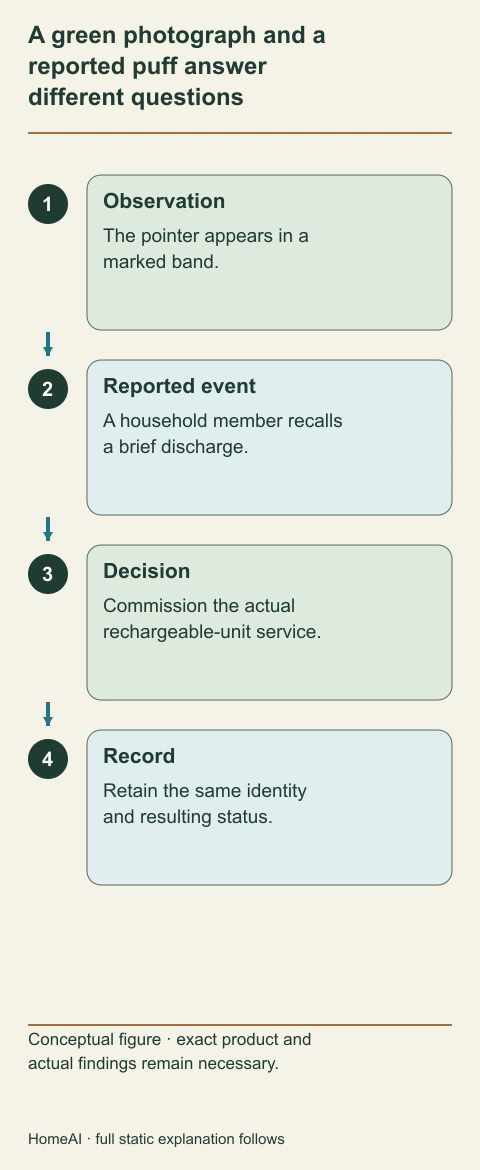
- Observation
The pointer appears in a marked band.
- Reported event
A household member recalls a brief discharge.
- Decision
Commission the actual rechargeable-unit service.
- Record
Retain the same identity and resulting status.
What does this illustration leave out?
Fictional learning record, not an actual unit finding or an approved emergency response. This illustration explains an idea. It is not an installation guide.
Which dated record connects the reported event to the exact unit and completed work?
Explore this with HomeAI ↗Opens an editable question. Nothing is sent until you choose to send it.A green photograph and a reported puff answer different questions
Fictional Maya keeps the reported event, product identity, commissioned task and resulting service record connected. She does not repeat a discharge to resolve uncertainty.
- Observation
- The pointer appears in a marked band.
- Reported event
- A household member recalls a brief discharge.
- Decision
- Commission the actual rechargeable-unit service.
- Record
- Retain the same identity and resulting status.
Figure scope: Fictional learning record, not an actual unit finding or an approved emergency response.
A useful question: Which dated record connects the reported event to the exact unit and completed work?
Full wording shown in this figure
- A green photograph and a
- reported puff answer
- different questions
- 1
- Observation
- The pointer appears in a
- marked band.
- 2
- Reported event
- A household member recalls
- a brief discharge.
- 3
- Decision
- Commission the actual
- rechargeable-unit service.
- 4
- Record
- Retain the same identity
- and resulting status.
- Conceptual figure · exact product and
- actual findings remain necessary.
- HomeAI · full static explanation follows
- Fictional Maya keeps the reported event, product identity, commissioned task and resulting service record connected. She does not repeat a discharge to resolve uncertainty.
- Fictional learning record, not an actual unit finding or an approved emergency response.
- Which dated record connects the reported event to the exact unit and completed work?
Keep learning about the connected parts
- Smoke alarms and escape: understand the whole household plan
- Residential sprinklers: understand the system before you buy
- Portable lithium-ion batteries: connect charging, storage and response
- Build a home-care record that the next person can understand
Canadian context and authorities · Visual atlas · Learning labs
Practice the distinction.
Maya’s green gauge and reported puff
A fictional rechargeable unit looks pressurized, but a household member reports a brief discharge during a move.
Reported observations
- The model label is readable and the gauge appears within a marked band.
- The reported discharge is retained rather than repeated as a test.
- The prior tag predates the move and there is no current service assessment.
Compare the explanations
Expand each possibility to see the evidence needed to distinguish it. Similar symptoms can have different mechanisms.
Pressurization remains after some agent was released
One indicator does not erase actual use or establish the intended complete charge.
Matching manual and appropriate unit-specific service assessment.
The event or unit identity needs clarification
An uncertain report remains a reason to resolve the history, not to create another discharge.
Exact unit identification, household account and the service provider’s bounded findings.
A useful next question
Maya commissions the named rechargeable-unit service and obtains appropriate advice about protection during the gap; the later fictional report is retained with the same unit identity.
Fictional learning record; no actual readiness, fire response, re-entry or code-compliance approval.
Know what the words mean.
- Extinguishing agent
- The material intended to interrupt combustion for the fire classes shown on the actual product label.
- Stored pressure
- Energy held in the assembled vessel that supports discharge through the intended valve and outlet.
- Dry chemical
- An extinguishing powder; it is distinct from the gas that provides discharge energy.
- Fire class
- A category describing the burning material or relevant energized-electrical condition.
- Class K
- The CCOHS category for combustible cooking oils or fats in cooking appliances; not implied by an ABC marking.
- Tamper indication
- A product feature showing whether its intended safety arrangement has been disturbed; it is not a complete service assessment.
- Rechargeable extinguisher
- A unit designed for appropriate fire-equipment servicing after use or another relevant condition.
- Disposable extinguisher
- A non-rechargeable unit with an intended replacement route after use.
- Inspection scope
- The exact unit, condition and questions covered by the reported inspection.
- Escape route
- The household’s path to leave; portable equipment does not replace it.
Questions to bring
to the conversation.
- Which exact model, rating and matching manual identify the unit?
- What do the visible condition, indicator and actual use history establish separately?
- Can people leave without moving toward the hazard or retrieving hidden equipment?
- What service or replacement task remains, and who is responsible for it?
Separate a showing observation, an existing record and a new professional assessment. Unknown means a question remains; it does not automatically mean a defect.
Use the evidence planner ↗Go to the source.
Original HomeAI explanation informed by these public references. Sources support the underlying guidance; they have not reviewed or endorsed HomeAI. Diagrams are conceptual, and calculator outputs depend on your inputs.
Read October20,2026 (America/Edmonton). CCOHS supplies Canadian occupational education, Calgary supplies local fire education, First Alert’s named2020 manual and Canadian FAQ have product-specific limits, and Amerex’s2013 note supplies stored-pressure mechanism context only. Calgary’s discharge-test suggestion is not adopted because the named product expressly prohibits trigger testing. No universal household inspection interval, product listing, mounting dimension, firefighting permission or disposal method is supplied. The worked household is fictional.
Publication & source review
First published .
Sources reviewed .
Have a question about your home?
Start with the symptom, timing and what you have observed.
Ask HomeAI