Buying a home with aluminum wiring? Start with three questions.
Aluminum is a wiring material. The buying questions are which circuits contain it, whether their connections and equipment are suitable, and what previous work actually covered. Gather the original report and repair records, then clarify the needed electrical assessment and your insurer's requirements.
Immediate danger: Smoke, sparks, a burning smell or another immediate electrical danger interrupts the viewing or routine assessment. Keep people clear and contact emergency help when required.
- A green covering is an identification question: separate the outer jacket, individual insulation and product identity.
- Identify the assessed conductor application and locations; age and appearance do not establish the whole installation.
- Connections, compatible equipment and conductor condition need professional assessment under the actual local requirements.
- A repair description and electrical completion record do not guarantee any insurer’s acceptance or establish every concealed route.
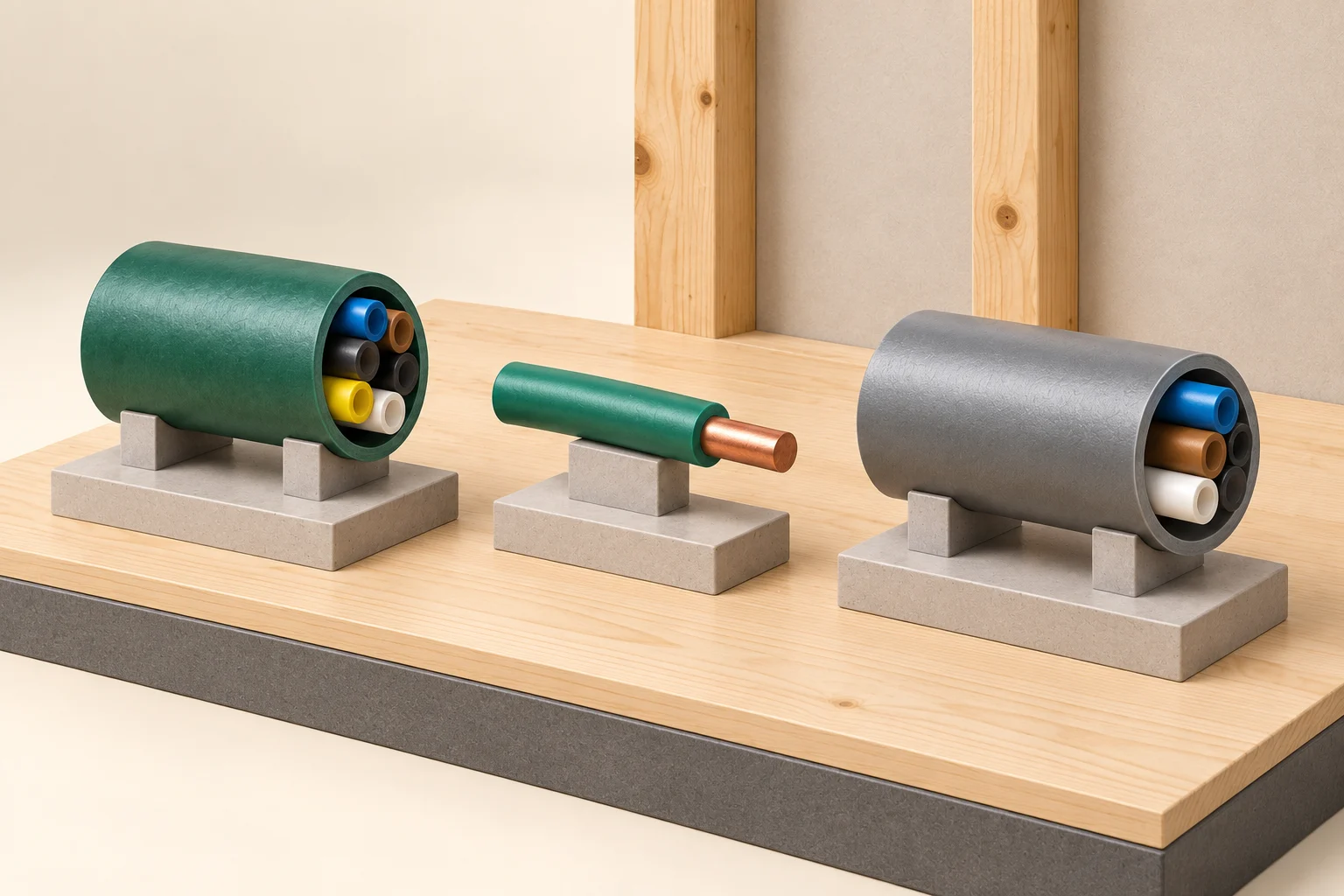
The outer jacket covers the inner parts of a cable. Here, green and gray shells surround several sleeve-like forms, while the middle green covering surrounds one copper-toned example. These enlarged teaching pieces do not identify a real cable.
About this illustration
The hollow inner sleeves are conceptual layer landmarks, not a complete cable cross-section. Metal, alloy, product family, conductor role, historical wiring type, certification and installed condition are not authenticated. No colour identifies a completed repair. This is a conceptual teaching model, not an assessment of your home.
7 picture lessons appear beside the questions in this guide. Use them to understand the explanation, then consider what it means for your home.
Does “aluminum wiring” on a report mean a defect?
It is first a statement about material, within the report’s identification scope. Ask which conductors and locations it describes: supply or feeder equipment, room circuits, an appliance connection or something else. The condition and compatibility of that installation are further questions. ESA’s Ontario guidance calls for assessment of each home and explains that aluminum continues to be used in electrical applications. It does not turn the material’s presence into a verdict about your property.
Preserve who made the finding and how it was established. A seller may be repeating an older report; a listing may use a shorthand description. House age gives context, while additions and renovations can introduce several generations of material. Do not infer the entire home’s conductor identity from its construction decade, a closed-panel photograph, insulation colour or a single visible cable. Have the appropriately qualified electrical professional identify the relevant application and assessment extent.
Locate the assessment across the house
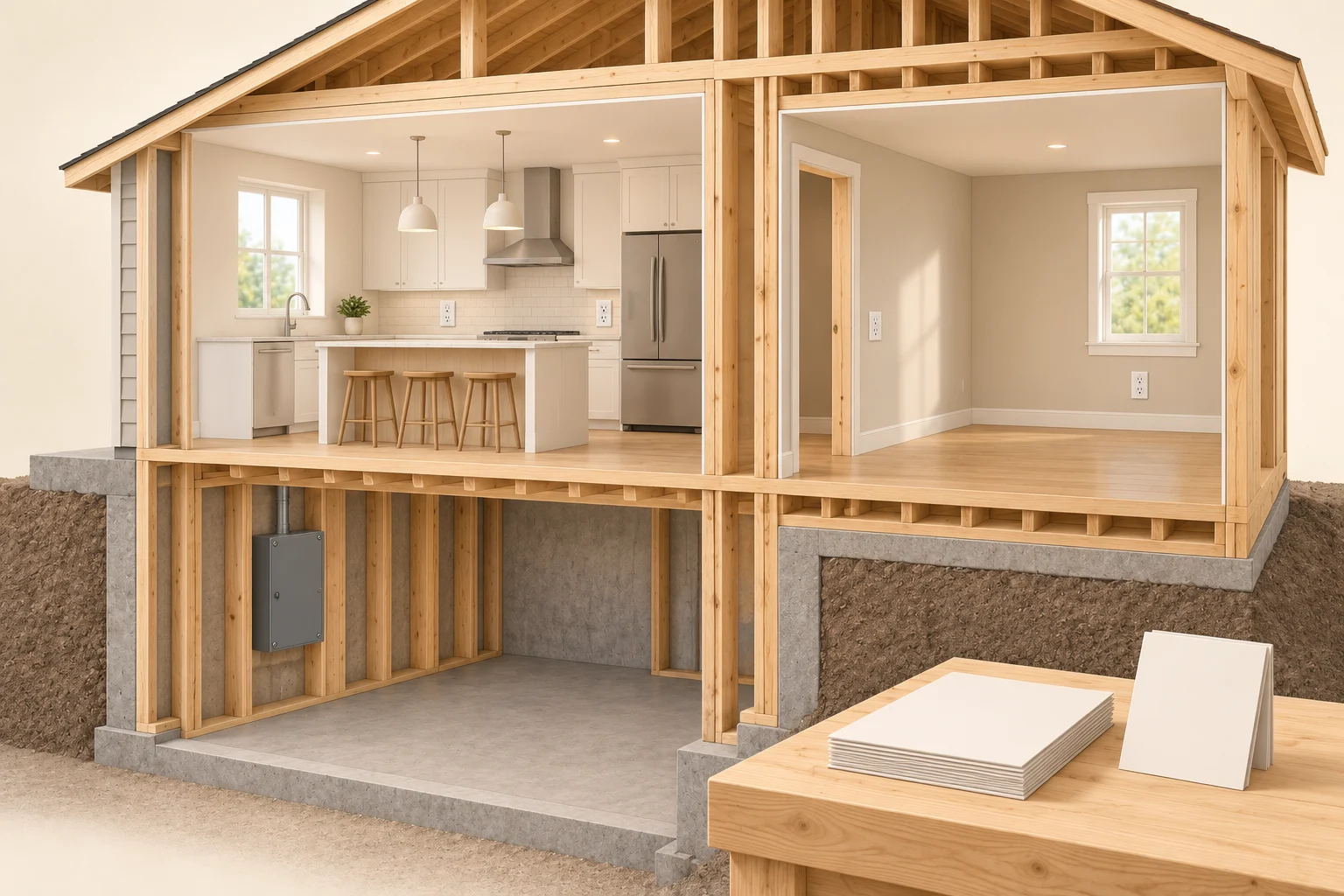
The basement has a closed gray enclosure. A kitchen and adjoining room have closed white receptacle-like faces. Timber framing separates the spaces, while blank sheets and a blank booklet sit apart in front.
Numbers identify the parts explained below.
- Basement location
Attach the actual finding and access limits to their location. A closed cabinet does not identify every branch conductor or internal interface.
- Several room locations
A kitchen project and another room are distinct scopes. Ask which actual locations were assessed, worked on or left outside the engagement.
- Actual scope record
The blank pages supply no inspection or remediation evidence. Useful records name locations, methods, retained material and limitations.
What does this illustration leave out?
No internal wiring, complete conductor route, conductor identity, hidden connection, actual assessment, completed work, approval, insurability or record content is visible. Selected room work cannot be expanded into a whole-house finding from this illustration. This illustration explains an idea. It is not an installation guide.
Which locations and applications does this assessment cover, and what remains inaccessible, retained or unresolved?
Explore this with HomeAI ↗Opens an editable question. Nothing is sent until you choose to send it.Does a green sleeve identify aluminum wiring?
First describe the object. On a multi-conductor cable, the outer jacket surrounds the inner conductors. Individual insulation covers one conductor. Added sleeving or tape and a connector housing are other objects again. Calling all of them a green sleeve loses the distinction that an electrician needs. Keep the original photograph and location rather than converting the colour into a material or repair conclusion.
A concrete counterexample helps: Southwire’s current Canadian catalogue identifies a green-insulated T90 copper conductor and a gray-jacket NMD90 aluminum cable. These are different product families, not interchangeable choices for a home. They demonstrate why a green covering is not a universal aluminum identifier. The fictional specimens below illustrate the layers; they are not replicas or authenticated products.
ESA’s May 2019 Ontario colour bulletin separately discusses outer jackets and identification of individual conductors. It is dated background, not a statement of every province’s currently adopted code. A green sleeve alone does not prove aluminum, the conductor’s role, a completed remediation or safe operation. Leave that identification with the actual marking, product record and qualified assessment.
Which green covering are you looking at?
The outer jacket covers the inner parts of a cable. Here, green and gray shells surround several sleeve-like forms, while the middle green covering surrounds one copper-toned example. These enlarged teaching pieces do not identify a real cable.
Numbers identify the parts explained below.
- Outer jacket
The outer jacket covers the cable's inner components. The larger green shell represents that outside layer; its colour does not identify the conductor metal.
- Individual insulation
Individual insulation covers one conductor. The middle example separates this layer from the larger outer shells. Its colour and copper tone do not authenticate an installed conductor's metal.
- A different outer shell
The gray shell introduces a second outer-jacket appearance. Its hollow inner sleeves reveal no conductor metal or approval.
What does this illustration leave out?
The hollow inner sleeves are conceptual layer landmarks, not a complete cable cross-section. Metal, alloy, product family, conductor role, historical wiring type, certification and installed condition are not authenticated. No colour identifies a completed repair. This illustration explains an idea. It is not an installation guide.
Is the green covering an outer jacket, individual insulation, added sleeve or connector housing, and what actual evidence identifies the metal?
Explore this with HomeAI ↗Opens an editable question. Nothing is sent until you choose to send it.Keep the identification question precise.
Which visible markings and records are useful indicators?
Alberta’s current index-linked aluminum brochure points to an AL marking on an accessible cable’s overall jacket. Where an existing label can be read from an ordinary safe position, record the complete wording and its location. A useful question is: what does this legend identify about this cable, and what did the assessor establish about the remaining circuits? A partial word, jacket colour or home’s construction decade cannot answer the whole-house question.
Prefer an existing professional photograph or report to obtaining a hidden view yourself. Do not move cables, strip or scrape insulation, remove a receptacle or plate, or open a panel to read a marking. A label seen on one accessible cable concerns that cable; it does not identify every concealed route, conductor application or connection.
Ask the report author to separate what was observed, how material was identified, which locations were assessed and which were inaccessible. A new-looking panel or receptacle is a visible component, not evidence that the retained branches were replaced. A complete dated work record is more useful than a listing phrase such as updated electrical.
Read the clue, then preserve its limit.
These are questions for existing observations and records, not directions to expose wiring.
- Green covering → identify which layerOuter jacket, individual insulation, added sleeve and connector housing are different objects. Colour does not supply the metal or repair verdict.
- Readable AL legend → identify that cableKeep the complete existing wording and location. Qualified identification of one cable does not map every hidden circuit.
- Updated device → ask what remainsThe visible component can change while other conductor sections and locations remain. Obtain the actual scope instead of extrapolating.
- Professional report → locations and limitationsPreserve author, date, application, identification method, assessed locations and access limits. A material observation and condition assessment answer different questions.
Canadian source limits: Alberta jacket-identification guidance; May 2019 Ontario colour background; current named Southwire product examples. No national colour table, access procedure or property diagnosis.
Keep the identification question precise.
Why do connections deserve attention?
A conductor carries current; a termination joins it to equipment, and a splice joins conductor sections. The interface has to remain electrically and mechanically suitable. An incompatible or degraded connection can have increased resistance and generate local heat when carrying current. Technical Safety BC’s investigated Delta hot tub illustrates this mechanism: aluminum supplied equipment that required copper, and deteriorated connections were associated with a control-box fire. That installation’s finding is not a prediction for another house.
This explains why asking only what metal is inside the wall misses part of the question. Ask how the electrician will assess the relevant interfaces, conductor condition and equipment requirements. A concern at one connection should retain its location; it does not identify every other connection’s condition. Conversely, an assessed conductor material does not establish that all its terminations are suitable. No on-screen skeleton can supply contact condition, component compatibility or a property-specific temperature finding.
Keep the conductor route and the connection as separate objects in your question. Evidence describing the cable’s material does not describe the contact surface inside a connector. Evidence identifying a compatible device does not establish how the actual connection was made or its present condition. This separation also explains why changing a visible switch is not equivalent to assessing the supplying circuit. The professional’s answer should connect these parts explicitly, state the examined locations and identify what could not be verified. A claim about one object should not silently become a conclusion about all the others.
A wire carries current; its connection joins it to equipment
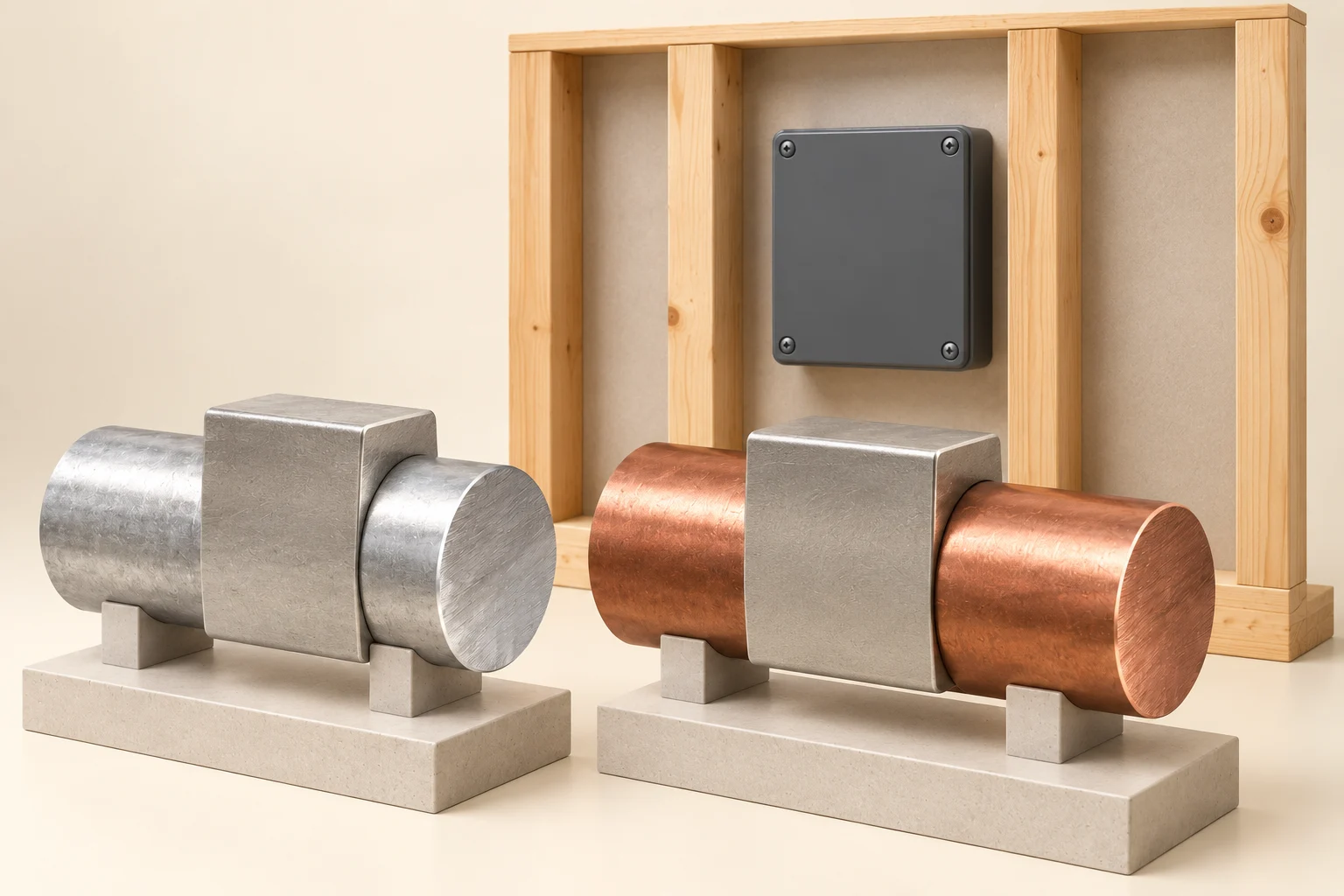
The two enlarged metal-coloured examples overlap broad blocks to introduce where parts meet. In a home, the conductor carries current and its termination joins it to equipment. These teaching shapes do not show an approved residential connection.
Numbers identify the parts explained below.
- Material appearance
The silver-toned specimen illustrates a material question without authenticating metal. Appearance cannot replace the actual report.
- Where parts meet
A termination joins a conductor to equipment; a splice joins conductor sections. The block shows a meeting point in this teaching model. It does not establish the materials, condition or suitability of an installed connection.
- Closed interior
The enclosure’s cover remains in place. Its internal devices, conductor combinations and condition cannot be assessed from this picture.
What does this illustration leave out?
No alloy, contact pressure, oxide film, actual current, temperature, damage, resistance, approved terminal or safe connection is established. These solids are not a workable repair assembly or an instruction to adjust a real connection. This illustration explains an idea. It is not an installation guide.
What did the electrician establish about the exact conductor, its interface and the surrounding installation separately?
Explore this with HomeAI ↗Opens an editable question. Nothing is sent until you choose to send it.How can material and temperature behaviour affect an interface?
Aluminum and copper are different materials, so a connection cannot be selected solely because the parts appear to fit. Alberta’s authority brochure identifies aluminum’s softness and sensitivity to conductor damage during termination. ESA’s technical notice describes oxidation and incompatibility with devices intended for copper. Those material and interface properties belong in professional assessment, rather than a rule that every older conductor has failed.
Temperature changes can also change metal dimensions, and copper and aluminum have different thermal expansion behaviour. ABB’s Canadian technical catalogue describes accommodating that difference in a specified bolted grounding product; it is an illustration of material behaviour, not a residential repair recommendation. The actual connector and conductor arrangement must account for its materials and use. A static photograph cannot show how an interface performs through changing conditions. This guide supplies no tightening, paste, connector-selection or maintenance procedure, and no inevitable loosening rate or lifespan.
An interface can change the local electrical question.
Follow a qualitative relationship. There is no measured temperature, load or failure probability here.
- Conductor and interface are separateThe conductor carries current; its termination or splice provides a particular contact interface. Identifying the metal does not assess that interface.
- Material condition and compatibility → contact behaviourDamage, surface condition and the actual materials and equipment affect what must be assessed. A shiny metal specimen does not establish a sound installed interface.
- Current through resistance → local heatingResistance at the interface can contribute to local heating while current passes. The conceptual sequence is not a diagnosis or an instruction to reproduce heat.
- Property-specific assessment → scoped findingThe electrician establishes the installed combination, condition, access limits and needed work. Different causes can produce overlapping exterior symptoms.
Conceptual mechanism informed by the dated ESA technical notice and investigated BC equipment example. No numerical expansion rate, temperature threshold, torque or repair method.
What does “compatible device” actually mean?
Compatibility concerns the actual device or connector, conductor combination and permitted use, together with applicable requirements and manufacturer instructions. Product identity matters. A recently installed switch, a generic connector colour or a sales description is not enough to establish suitability. In technical records you may encounter CO/ALR or AL–CU markings. They describe relevant equipment classifications; they do not by themselves authenticate the installed item or certify the complete connection.
Ask the professional to explain which documentation supports the specified combination and what was verified at the location. Different device categories and conductor arrangements need their own assessment. Do not treat one marking as permission for every application or copy a repair method from a United States video into Canadian work. Local authority and manufacturer requirements govern the actual project. Keep the explanation attached to the assessed equipment rather than converting it into a universal shopping list.
Connector colour is another clue that needs identity. The current IDEAL Canadian Cu-Al page describes a purple product with a defined conductor combination and excludes aluminum-to-aluminum use. That named example shows why a colour or general Cu-Al description is not enough. Ask the electrician to identify the exact installed item and explain its application against the relevant instructions and local requirements. This is not a product recommendation or a repair recipe.
Can a copper connection leave aluminum elsewhere in the circuit?
A transition between conductor materials is not the same physical change as replacing the complete route. A copper pigtail means a short copper segment connects at an interface; it does not, by that term alone, mean the upstream aluminum was removed. Some homes have mixed material arrangements from their original construction or later work. Ask where the transition occurs and which parts remain, letting the electrical professional supply that information safely.
A repaired interface is also more than the visible device face. Its suitability depends on the actual connection arrangement and surrounding installation. Alberta’s brochure notes that added conductors and connections can affect the available enclosure volume. That helps explain why a generic “pigtails done” statement needs an exact work description. The guide recommends neither a transition method nor whole-house replacement. Ask the professional to compare appropriate options, scope and constraints for this installation, and preserve the applicable completion evidence.
A short copper pigtail can leave other wiring in place
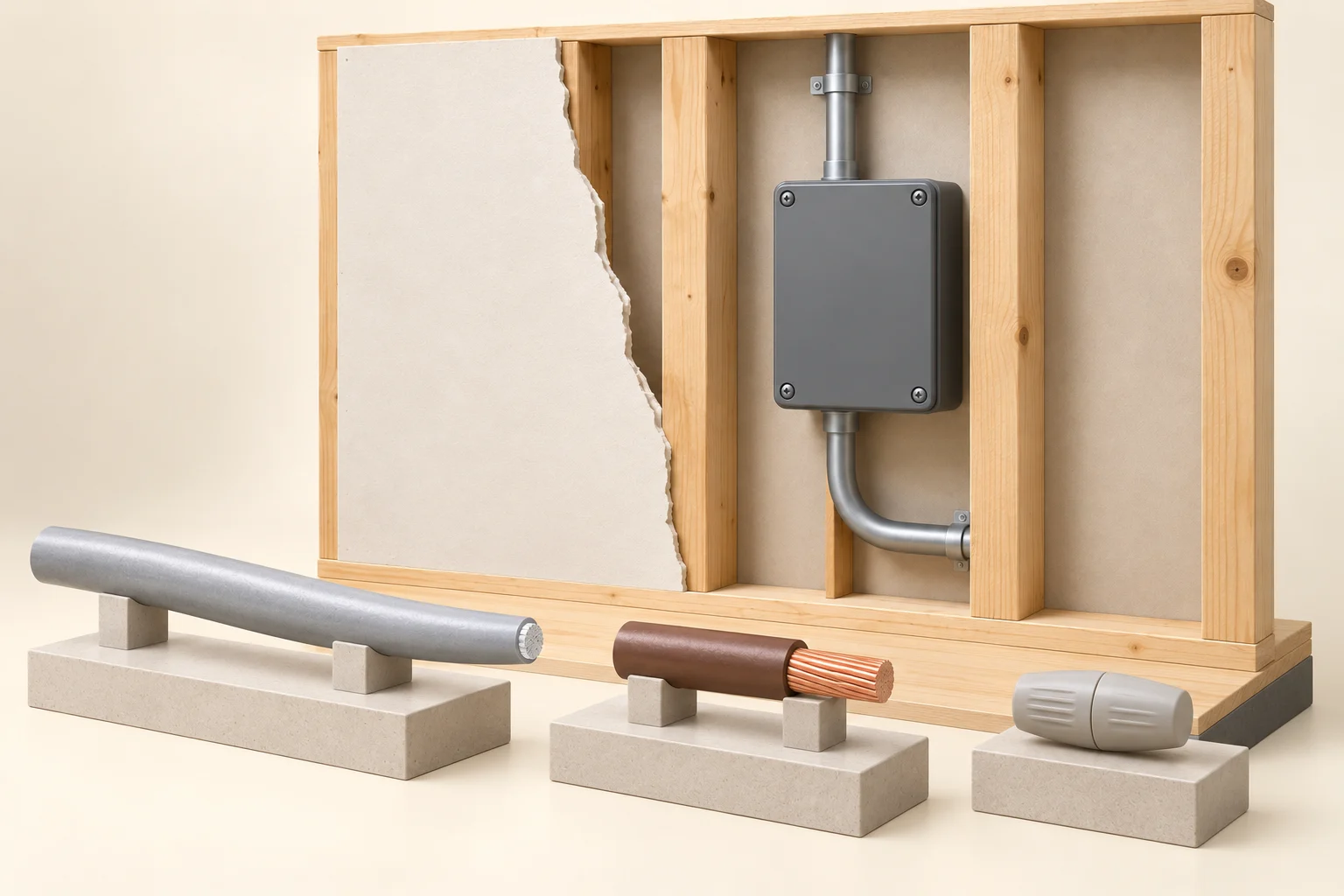
A long silver-toned specimen, a shorter brown-covered copper-toned specimen and a plain gray capsule sit separately. Both cut ends have strand-like detail. The wall enclosure is closed and none of the loose objects is visibly connected to it.
Numbers identify the parts explained below.
- Longer conductor example
A documented short transition can leave another conductor section in place. This loose long specimen establishes no actual retained route.
- Short copper example
The short copper-toned specimen helps distinguish a local interface from complete replacement. It is not an installed pigtail or product choice.
- Detached object and closed box
The capsule and enclosure supply no connection or compatibility evidence. Ask for the exact installed identity and recorded scope.
What does this illustration leave out?
These oversized stranded-looking specimens are not a depiction of historic solid aluminum branch wiring, an authenticated connector, a connected pigtail, retained installed material or an approved repair. Their relative lengths introduce scope only; no route, size, method or condition is verified. This illustration explains an idea. It is not an installation guide.
Which locations were worked on, what conductor sections remained and what evidence supports any whole-home replacement claim?
Explore this with HomeAI ↗Opens an editable question. Nothing is sent until you choose to send it.A short transition changes an interface; scope describes the route.
This is a conceptual relationship, not a wiring layout or recommended remediation.
- Retained conductor section → assessed transition → short copper segment → deviceThe words describe a possible documented scope. They do not establish that this arrangement exists, is appropriate or has been completed in your home.
- Local work: named locations and exact itemsA selected device invoice needs its locations, installed item identity, assessed findings and relevant completion record. It does not describe every upstream or adjacent location.
- Complete replacement: a different physical deliverableIf removal is claimed, ask which complete routes and locations it covered, what remained and how the claim is supported. Do not convert a selected transition into whole-home replacement.
- Enclosure and other connections remain questionsAdditional conductors and connections affect the surrounding arrangement. Their assessment belongs with the qualified provider and local requirements, not a consumer repair diagram.
The still image contains detached, oversized stranded-looking specimens, not historic solid branch wiring or a connected approved repair. No sizes, routing, connector choice or work sequence supplied.
Connect the picture with the work record.
HAUSE: understand the assessed, repaired and retained scope ↗
What assessment extent should a buyer clarify?
Ask which locations and conductor applications were examined and which were inaccessible or outside the engagement. A home inspector’s reported material observation can be useful without being an all-connection electrical assessment. CAHPI’s member standards describe accessible visual inspection, representative devices and important exclusions. Confirm the actual inspector’s agreement and qualifications; association standards are not a national licensing map or proof that a particular report followed them.
For the electrical engagement, ask how the relevant circuits, devices, appliance interfaces and prior alterations will be addressed. An electrician should explain any access or further investigation needed and the limits of the supplied findings. Leave cover removal, exposure of wiring, testing and safe-work arrangements to that professional. Do not offer to open every device before the visit or assume that a sample of observations verifies the entire installation. A clear extent statement lets the buyer distinguish an unanswered location from an assessed concern.
Before agreeing the engagement, ask how the provider will report the assessed locations, findings, inaccessible areas, recommended work and retained conductors. If a thermal image or other test is proposed, ask what question it addresses, under which conditions and what remains outside its scope. No single photograph or unnamed test on this page clears every hidden connection. Keep the actual methods and limitations beside the result rather than asking only for a pass/fail label.
Locate the assessment across the house
The basement has a closed gray enclosure. A kitchen and adjoining room have closed white receptacle-like faces. Timber framing separates the spaces, while blank sheets and a blank booklet sit apart in front.
Numbers identify the parts explained below.
- Basement location
Attach the actual finding and access limits to their location. A closed cabinet does not identify every branch conductor or internal interface.
- Several room locations
A kitchen project and another room are distinct scopes. Ask which actual locations were assessed, worked on or left outside the engagement.
- Actual scope record
The blank pages supply no inspection or remediation evidence. Useful records name locations, methods, retained material and limitations.
What does this illustration leave out?
No internal wiring, complete conductor route, conductor identity, hidden connection, actual assessment, completed work, approval, insurability or record content is visible. Selected room work cannot be expanded into a whole-house finding from this illustration. This illustration explains an idea. It is not an installation guide.
Which locations and applications does this assessment cover, and what remains inaccessible, retained or unresolved?
Explore this with HomeAI ↗Opens an editable question. Nothing is sent until you choose to send it.How should a seller describe previous repair work?
Describe what the documents actually support: assessed locations, relevant findings, agreed work, date, provider, retained wiring and applicable authority outcome. Replacing selected devices, repairing specified connections and replacing complete circuits are different scopes. “Aluminum removed” should not stand in for a narrower documented alteration. Keep original findings and follow-up together so recommendations that remained open are still visible.
Ask the provider or issuer to clarify an ambiguous invoice or completion document. A record for one project does not automatically cover a later addition or appliance replacement. Ontario’s electrical notification and acceptance process is a regional example; other authorities use their own pathways and records. A buyer should understand the completed scope and commission any needed current assessment. None of these records is a permanent whole-house safety guarantee, and payment alone cannot demonstrate the condition of every retained conductor or connection.
A useful record separates the locations assessed, the locations worked on, the material retained and the relevant completion documents. Ask for the precise document title, issuer, date and physical scope. Ontario’s current ESA consumer page uses Certificate of Acceptance; other provinces have their own authority and process. Do not rename an invoice, a general home inspection or a different provincial record as that certificate.
Connect the picture with the work record.
HAUSE: understand the assessed, repaired and retained scope ↗
Does the absence of symptoms establish that connections are sound?
No. ESA’s technical notice warns that aluminum connections can overheat or fail without prior indications. A seller’s account of no noticed problems is still relevant history, but it cannot replace assessment. Reported flickering, discolouration or unusual odour should retain its location and circumstances; several electrical conditions can have overlapping symptoms. Do not assign an aluminum-specific cause from that account.
Do not touch outlets to check warmth, remove plates, open panels, tighten connections or energize equipment to reproduce a concern. If smoke, sparks, a burning smell or electrical danger is present, keep people clear, stop the viewing or use of the affected area and contact emergency help when required. Ordinary assessment planning should not delay that response. Once the immediate situation is addressed, qualified findings can establish what happened and what work is needed. The fictional illustrations on this page provide no diagnosis or safe-to-use finding.
Record a surface change without assigning its cause
Both white receptacle faces remain closed. The right upper opening has a localized brown patch; the left face has no pictured patch. No plug, hand, tool, open device, smoke or measurement appears.
Numbers identify the parts explained below.
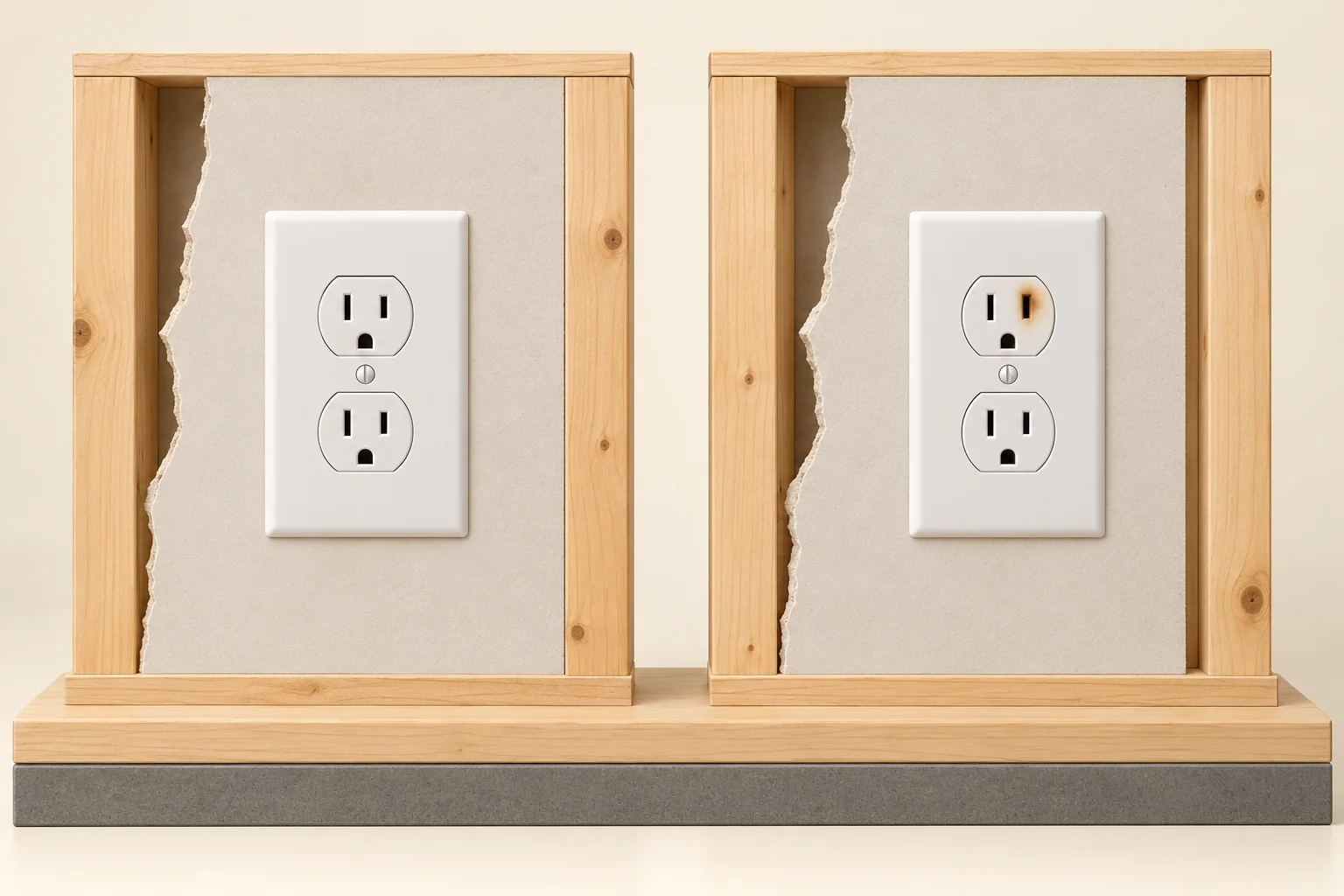
- No pictured patch
An ordinary-looking exterior supplies no assessment of hidden connections. Do not use the left specimen as a safety clearance.
- Localized surface change
Preserve location and circumstances in a real observation. Do not touch to check warmth, remove the plate or reproduce a fault.
- Professional response
Keep people clear of electrical danger and use emergency help when required. Once immediate concerns are addressed, qualified findings establish the technical question.
What does this illustration leave out?
No aluminum conductor, heat, energized state, cause, concealed damage or safe-to-use condition is identified in either fictional specimen. An unmarked-looking face does not clear hidden connections; a surface patch is not an aluminum-specific diagnosis. This illustration explains an idea. It is not an installation guide.
What exterior change was reported, where and when, and what did the qualified assessment establish about its cause?
Explore this with HomeAI ↗Opens an editable question. Nothing is sent until you choose to send it.What should the actual insurer be asked?
Provide an accurate, attributed description and ask what information the insurer needs for this specific property, intended use and policy decision. IBC explains that insurers consider electrical system information and develop different coverage and pricing requirements. ESA’s Ontario guidance also directs homeowners to ask their own insurer. Neither source is an acceptance letter for your home.
Ask which assessment, work description or authority record is required, who may prepare it and how unresolved areas must be described. Confirm the decision and any conditions directly through the insurance provider. Do not promise acceptance after a particular repair, infer coverage from a contractor’s preferred wording or borrow requirements from a neighbour’s policy. Your electrical professional determines the technical scope; your insurance representative explains the proposed policy. Keep those answers distinct, including dates, assumptions and any outstanding review.
How would the evidence differ in a fictional mixed-wiring home?
Fictional case: an invented inspection report identifies aluminum in specified basement circuits. A kitchen invoice describes replacement of selected devices with copper transitions. A seller reports that no problems were noticed. The buyer expects to replace an appliance after purchase. No real property, connector finding, insurance decision or defect is represented.
The buyer asks which kitchen locations the work covered and what conductors remained. They commission the relevant electrical assessment with the full report and invoice, preserving any inaccessible areas. They ask about the proposed appliance’s requirements rather than assuming a copper transition settles its entire supply. They also ask the actual insurer for its requested evidence. The resulting record can identify completed work and unanswered questions without declaring every connection unsafe, all aluminum removed or insurance guaranteed. The example demonstrates scope reasoning, not a repair plan.
Locate the assessment across the house
The basement has a closed gray enclosure. A kitchen and adjoining room have closed white receptacle-like faces. Timber framing separates the spaces, while blank sheets and a blank booklet sit apart in front.
Numbers identify the parts explained below.
- Basement location
Attach the actual finding and access limits to their location. A closed cabinet does not identify every branch conductor or internal interface.
- Several room locations
A kitchen project and another room are distinct scopes. Ask which actual locations were assessed, worked on or left outside the engagement.
- Actual scope record
The blank pages supply no inspection or remediation evidence. Useful records name locations, methods, retained material and limitations.
What does this illustration leave out?
No internal wiring, complete conductor route, conductor identity, hidden connection, actual assessment, completed work, approval, insurability or record content is visible. Selected room work cannot be expanded into a whole-house finding from this illustration. This illustration explains an idea. It is not an installation guide.
Which locations and applications does this assessment cover, and what remains inaccessible, retained or unresolved?
Explore this with HomeAI ↗Opens an editable question. Nothing is sent until you choose to send it.How should this inform an offer, renovation or new equipment plan?
State the consequential unknown before asking for a price or remedy. An appropriately scoped proposal should explain assessed findings, required work, access, retained equipment, relevant approvals, restoration and verification. Compare the physical deliverables instead of assuming all quotes refer to the same number of locations. Discuss transaction access and any unresolved contractual question with the relevant advisers; a material report does not determine the legal outcome.
The same compatibility question matters when new equipment is added to an existing installation or an entirely new home. Newness does not authenticate conductor selection or every connection, and older material does not supply a diagnosis. Carry the exact assessment and completion scope into the Home Plan so later providers know what was retained. HomeAI can explain terminology and help prepare the evidence brief. Qualified property-specific findings and the actual authority and insurer responses determine what the next decision can rely on.
Keep learning about the connected parts
Practice the distinction.
Fictional home: aluminum reported, kitchen work documented
An invented basement material finding and a selected kitchen-device invoice are available, while a future appliance and insurance requirements need separate enquiries.
Reported observations
- The fictional inspection material finding identifies specified basement circuits.
- The kitchen invoice describes selected devices and copper transitions, not complete-route replacement.
- No actual condition or insurer acceptance is supplied.
Compare the explanations
Expand each possibility to see the evidence needed to distinguish it. Similar symptoms can have different mechanisms.
Some earlier work may be documented accurately
A selected interface repair can retain other conductor sections and unassessed locations.
Full scope, assessed locations, retained material and applicable completion documents.
Further property-specific questions remain
The future appliance and insurance decision cannot be answered from the invoice alone.
Qualified equipment/installation assessment and direct insurer clarification.
A useful next question
Match the original reports and work to their locations, agree the needed electrical assessment and clarify actual insurer requirements.
This fictional case supplies no unsafe-connection finding, material verdict for other circuits, repair method, price, insurability guarantee or purchase recommendation.
Know what the words mean.
- Termination
- The interface connecting a conductor to equipment, assessed for its actual materials, condition and application.
- Splice
- A connection joining conductor sections; the installed combination and surrounding arrangement need appropriate assessment.
- Contact resistance
- Resistance at an electrical interface that can contribute to local heating when current passes through it.
- Thermal expansion
- A material’s dimensional change with temperature; different materials can behave differently at an interface.
- Copper pigtail
- A short copper conductor segment at a transition; the term alone does not establish removal of the upstream conductor or a suitable installed repair.
- Assessment extent
- The locations, applications, methods and access limits actually covered by the professional engagement.
- Outer cable jacket
- The outside covering around a cable assembly. Its colour alone does not authenticate conductor metal, a completed repair or suitability.
- Individual conductor insulation
- The covering on one conductor, distinct from a multi-conductor cable’s outside jacket. Appearance alone does not establish the installed role or metal.
- Jacket legend
- The actual printed identification on a cable’s outside covering, interpreted with its full wording and location rather than colour alone.
- Product application
- The defined use and conditions belonging to an identified item. A generic colour or material label does not establish an installed match.
Bring the wiring question and the records.
Request a HAUSE wiring assessment through aluminumwiring.ca. Share the property location, available reports and the question you need answered. The Calgary-focused team confirms coverage, appointment availability and any fees separately.
Request a HAUSE wiring assessment ↗Questions to bring
to the conversation.
- Who reported aluminum conductors, where, and using which assessment scope?
- Does the assessment distinguish branch wiring, feeders, mixed materials and inaccessible locations?
- What exact connections or routes did earlier work address, and what remains?
- What written evidence does the actual insurer request for this property and intended use?
Separate a showing observation, an existing record and a new professional assessment. Unknown means a question remains; it does not automatically mean a defect.
Use the evidence planner ↗Go to the source.
Original HomeAI explanation informed by these public references. Sources support the underlying guidance; they have not reviewed or endorsed HomeAI. Diagrams are conceptual, and calculator outputs depend on your inputs.
Publication & source review
First published .
Sources reviewed .
- Electrical Safety Authority — aluminum wiring
- Electrical Safety Authority — aluminum wiring in residential installations, Flash 22-30-FL
- Safety Codes Council and Alberta Municipal Affairs — aluminum wiring in residential installations
- Safety Codes Council — current Safety Tips index
- Technical Safety BC — final incident report II-1703922-2024 (#45823)
- ABB Electrification Canada — DTW516 technical catalogue
- CAHPI — 2024 National Standards of Practice
- Electrical Safety Authority — buying a renovated home
- Electrical Safety Authority — notifications and inspections
- Insurance Bureau of Canada — how home insurance rates are set
- Canadian Centre for Occupational Health and Safety — electrical safety basics
- ESA · Cable jackets and conductor identification, Bulletin 4-5-13
- Southwire · Green-insulated copper, Canadian T90 specimen
- Southwire · Gray-jacket aluminum, Canadian NMD90 specimen
- IDEAL Canada · A Cu-Al connector has a defined application
Have a question about your home?
Start with the symptom, timing and what you have observed.
Ask HomeAI