Jump to a question in this guide
- What interest would the household actually receive?
- Why must non-equity and equity descriptions be checked?
- Which documents establish the organization and the household's role?
- How do admission and an offered dwelling fit together?
- Which entry payments and continuing charges should be separated?
- How do shared building decisions affect daily housing?
- What do occupancy rules and later household changes require?
- What must be understood about leaving or a proposed transfer?
- What does a fictional application comparison reveal?
- What should a useful decision and move-in record contain?
- Identify the organization, membership model, occupancy documents and continuing responsibilities.
- Separate actual records, reported history, safe observations and professional findings.
- Keep unresolved scope and local-law or design limits with the decision.

Private living spaces connect with a shared entrance and outdoor meeting place. Those familiar building features support daily housing and collective activity, while separate membership and occupancy documents establish the household’s actual arrangement.
About this illustration
No legal ownership boundaries, incorporation status, membership admission, equity interest or unit offer are established by the building or binder. This is a conceptual teaching model, not an assessment of your home.
6 picture lessons appear beside the questions in this guide. Use them to understand the explanation, then consider what it means for your home.
What interest would the household actually receive?
A housing co-operative is an organization through which members participate in providing and running housing. Its buildings can look like apartments, townhouses or other familiar homes. The organization, the household's membership and its right to occupy a particular dwelling are different parts of the arrangement. A conventional-looking front door cannot establish that the household would acquire a condominium unit or its own parcel of land.
Start with a plain question: what exactly is proposed here? The answer should identify the organization, the relevant housing model, the membership or other interest, and the document allowing occupation. Ask the representative and legal adviser to connect those parts using actual records. A sales phrase, application advertisement or quoted monthly payment is not a complete description of the interest.
CMHC's currently served co-operative housing guide describes member participation in decisions such as budgets, directors and policies. That provides a national introduction, not a legal conclusion about every organization. Its visible publication date is June 3, 2018 and it expressly directs specific legal questions to a lawyer because law changes. This guide preserves that edition limit rather than representing it as updated provincial legislation.
The property-types guide separates building form from ownership, and the leased-land guide follows rights to use a site. Here the central enquiry is membership and occupancy through the co-operative organization. Even if a co-op itself leases land, the household's membership documents and the underlying land arrangement need separate explanations. One should not be substituted for the other.
This is a Canadian decision guide for someone considering the arrangement, not a promise that a membership is available to buy or resell. No admission, financing, subsidy, occupancy date or return of capital is guaranteed. The actual organization, local law, documents and professional advice determine the household's options before any commitment.
Similar rooms can have different membership arrangements
Private living spaces connect with a shared entrance and outdoor meeting place. Those familiar building features support daily housing and collective activity, while separate membership and occupancy documents establish the household’s actual arrangement.
Numbers identify the parts explained below.
- Living spaces
Provide daily accommodation. Their appearance does not establish the legal model.
- Shared entrance
Connects households with common circulation. Actual access and responsibility need documents.
- Outdoor table and binder
Prompt the collective-decision enquiry. They do not prove a meeting, rule or membership decision.
- Membership and occupancy records
Establish the actual household arrangement. These documents are not shown as legal evidence.
What does this illustration leave out?
No legal ownership boundaries, incorporation status, membership admission, equity interest or unit offer are established by the building or binder. This illustration explains an idea. It is not an installation guide.
Which actual model, membership status and occupancy documents support the household plan?
Explore this with HomeAI ↗Opens an editable question. Nothing is sent until you choose to send it.Why must non-equity and equity descriptions be checked?
Do not treat co-op as a synonym for either private rental or investment ownership. CMHC's guide principally describes housing co-operatives, including a not-for-profit context in its governing-legislation chapter. That explanation cannot establish the rights in a differently structured share transaction. Ask which model applies and have the relevant incorporating and membership documents explained before comparing it with a condominium purchase.
In a non-equity or not-for-profit context, the household should not assume a right to sell the dwelling at a market gain. Nor should it assume that every payment is recoverable when it leaves. The precise capital, fee, loan, deposit and occupancy terms need their own document-based answers. A general label does not establish ownership of an individual unit or a cash entitlement.
If the proposal is described as equity co-op ownership, request a separate legal explanation of the interest, transfer process, limitations and relationship to occupation. This guide supplies no universal equity-co-op rules. Do not apply the non-profit guide's general statements to certify that transaction, or infer a resale right from the fact that someone is advertising a price.
A condominium unit is another legal model even where its building is visually identical. Its registered unit, common-property interests and governing framework require their own review. A comparison should state the actual rights in each column, rather than call both options homeownership and assume their borrowing, voting, transfer and repair obligations match.
The distinction helps the household ask a useful next question. If the objective is secure suitable housing with participation in collective decisions, investigate those features in the actual co-op. If a particular resale or capital-return plan is essential, obtain support for it before relying on it. A personal preference is valid without inventing rights the documents have not established.
Identify the exact model first
The word co-op cannot establish an equity interest, a resale right or a mortgage option.
Numbers identify the parts explained below.
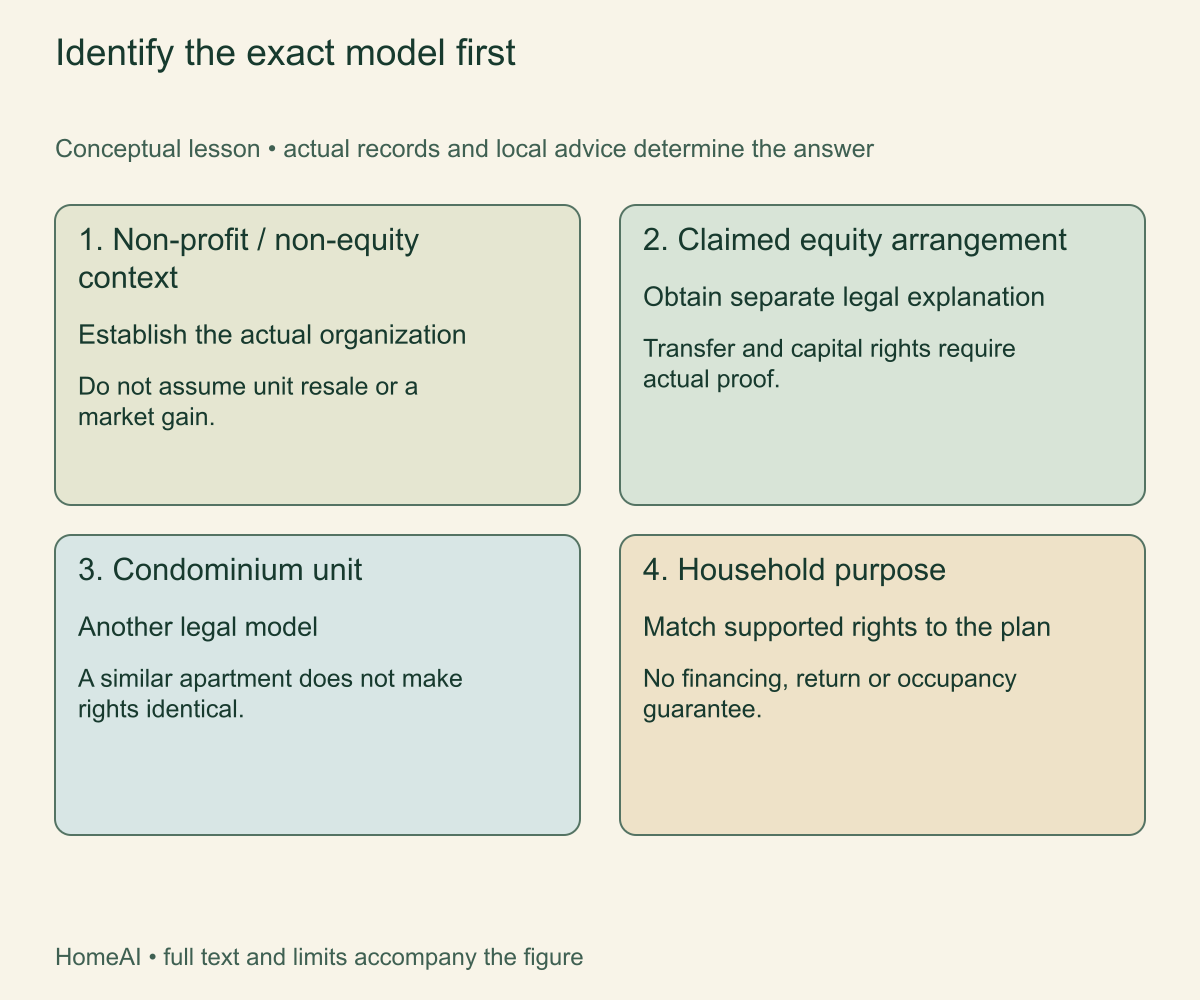
- Non-profit / non-equity context
Establish the actual organization. Do not assume unit resale or a market gain.
- Claimed equity arrangement
Obtain separate legal explanation. Transfer and capital rights require actual proof.
- Condominium unit
Another legal model. A similar apartment does not make rights identical.
- Household purpose
Match supported rights to the plan. No financing, return or occupancy guarantee.
What does this illustration leave out?
No actual admission, capital-return right, unit offer, financing or legal result. This illustration explains an idea. It is not an installation guide.
Which actual model, membership status and occupancy documents support the household plan?
Explore this with HomeAI ↗Opens an editable question. Nothing is sent until you choose to send it.Which documents establish the organization and the household's role?
Ask for the relevant incorporating document, current bylaws or rules, membership information and proposed occupancy agreement through the authorized process. CMHC's documents chapter distinguishes the organization's founding record from its operating rules. These documents do different jobs: creating and describing the organization is not the same as admitting one household or offering it a particular home.
Alberta's currently served incorporation page provides a named provincial example. It describes a cooperative as an organization able to own assets and enter contracts, and separately identifies articles and bylaws. Its general incorporation explanation is not a housing-membership approval or proof of a particular co-op's current standing. No incorporation fee, filing period or application procedure is adopted here as a household instruction.
Check the organization name, document dates and relevant amendments. A shortened marketing name can make unrelated records look connected. An older rules booklet may be useful history while a later amendment changes the current question. Ask the co-op and legal adviser which complete version governs, rather than reconstructing it from isolated pages supplied by different people.
The membership decision and occupancy agreement need to identify their own actual status. An application receipt shows receipt; an admission decision concerns admission; an offered unit and executed agreement concern the particular occupancy arrangement. Preserve conditions or missing steps. The existence of the corporation does not establish that the applicant has been accepted or that a dwelling is available.
Retain a readable index with the source of each answer. It might identify governance, admission, payment, repairs, use and departure questions, with the relevant document and person responsible. Keep private member files and personal financial information appropriately restricted. A prospective household can request relevant explanations without obtaining unrestricted access to other members' records.
Four records do different jobs
Formation, governance, admission and occupancy are separate document jobs. One cannot silently complete all four.
Numbers identify the parts explained below.
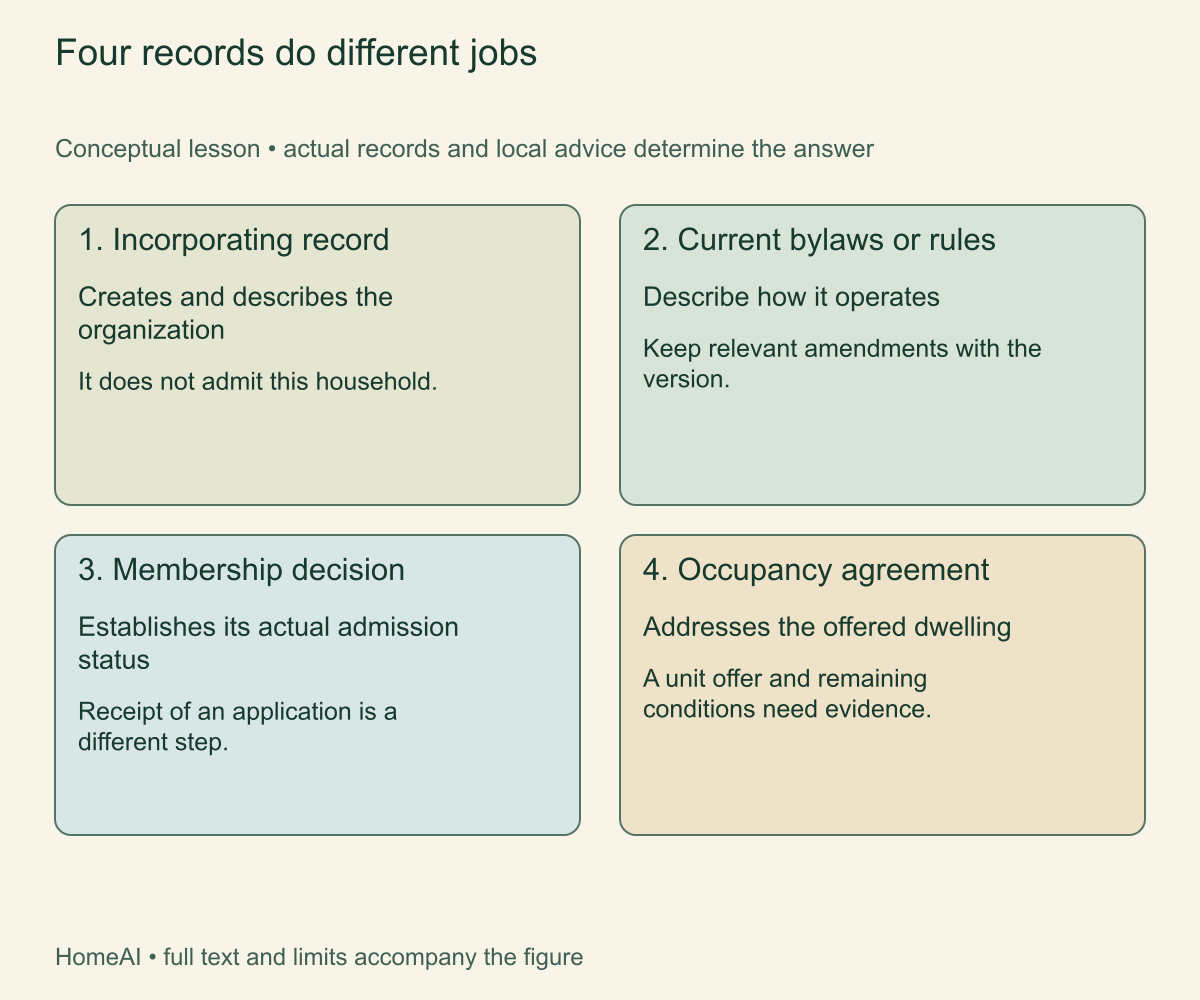
- Incorporating record
Creates and describes the organization. It does not admit this household.
- Current bylaws or rules
Describe how it operates. Keep relevant amendments with the version.
- Membership decision
Establishes its actual admission status. Receipt of an application is a different step.
- Occupancy agreement
Addresses the offered dwelling. A unit offer and remaining conditions need evidence.
What does this illustration leave out?
No actual admission, capital-return right, unit offer, financing or legal result. This illustration explains an idea. It is not an installation guide.
Which actual model, membership status and occupancy documents support the household plan?
Explore this with HomeAI ↗Opens an editable question. Nothing is sent until you choose to send it.How do admission and an offered dwelling fit together?
Ask the co-op to explain its actual application and admission process, which documents describe it and which steps remain. CMHC's admission chapter discusses applications, interviews, waiting lists and membership approval, followed by an occupancy agreement when a unit is offered. These are general process distinctions. They establish no waiting time, guaranteed place or approval for a particular applicant.
Identify the household's requirements accurately: number of occupants, needed room arrangement, access needs and desired timing, as relevant to the actual process. The responsible organization should explain what information it requires and how it handles it. Do not submit unnecessary sensitive information to an informal contact or assume that a resident can privately promise admission on the co-op's behalf.
Admission, housing allocation and any assistance eligibility can be different decisions. A co-op may have funding arrangements affecting some housing, as CMHC's chapter explains. The household needs the actual current programme, agreement and eligibility answer from the responsible party. No general income percentage, subsidy amount or available assisted place is adopted from the dated overview.
Ask what confirms each outcome and when the household can rely on it. A friendly interview, acknowledgement email and approved application can describe different statuses. A desired moving day remains proposed until the relevant occupancy arrangements are confirmed. A prospective resident should not terminate existing housing solely because an application has entered a process.
If an answer is uncertain, compare practical alternatives while respecting the actual rules. Another dwelling, a different move or continued current housing may be necessary options. The guide promises no priority, appeal result or right to transfer a waiting-list position. Questions about discrimination or legal treatment belong with current local professional and human-rights advice, not an invented universal eligibility formula.
Which entry payments and continuing charges should be separated?
Ask what each payment is called, what it pays for, when it is required and which document governs it. Membership capital, a fee, a member loan, a deposit and a monthly housing charge can have different purposes. Do not add them into one figure called the price without first understanding the actual arrangement and which items are recurring or potentially returnable.
CMHC's member-obligations chapter discusses housing charges, possible initial payments and deposits within its general co-op context. Its examples are not a universal Canadian payment schedule or current provincial deposit rule. Request the actual dated amounts and conditions from the co-op, and have the legal adviser explain consequential rights or obligations. No fixed deposit, return deadline or refund guarantee is supplied here.
The monthly charge should be compared on its actual inclusions. Ask which services are covered and which household accounts remain separate. Parking, utilities, insurance, internet or other relevant items should not disappear from the budget merely because a quoted housing charge looks lower than another option. Equally, do not count a service twice if it is demonstrably included.
Future changes need a process explanation, not an invented forecast. Ask how the actual co-op sets and approves charges, how current information is communicated and which known decisions affect the household. A past charge is history. A proposed budget is a proposal until the appropriate decision is established. Neither guarantees the same amount throughout the household's intended stay.
Keep borrowing and insurance as separate enquiries where relevant. Provide the actual interest and agreement facts to the appropriate providers. A conventional condominium mortgage conversation should not be assumed to fund a co-op arrangement. A co-op's building coverage also does not automatically answer personal contents or liability needs. Obtain the actual provider's scoped answer rather than infer approval or coverage.
Entry money and ongoing charges
A monthly housing charge and an entry payment answer different budget questions. Returnability needs the actual terms.
Numbers identify the parts explained below.
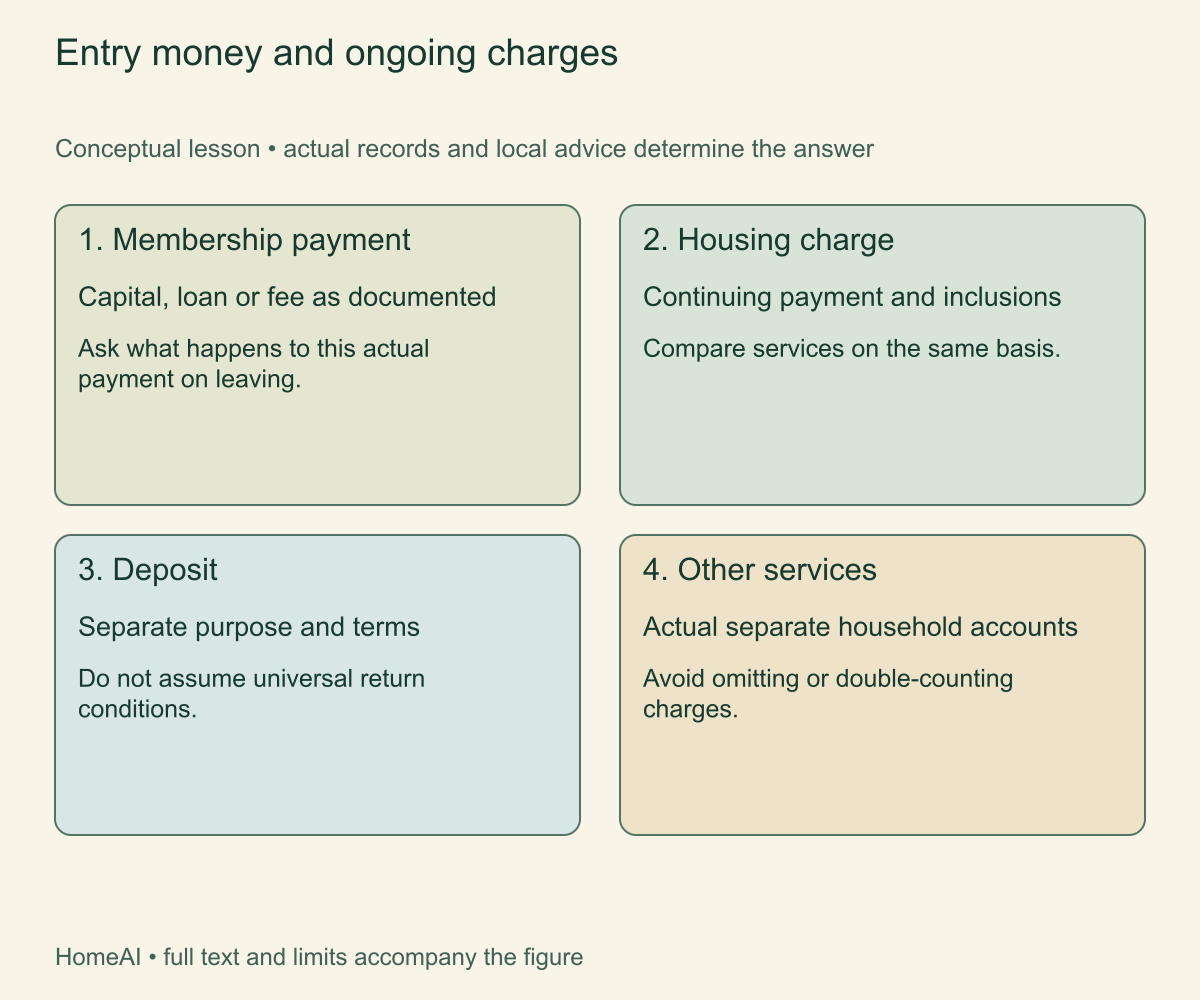
- Membership payment
Capital, loan or fee as documented. Ask what happens to this actual payment on leaving.
- Housing charge
Continuing payment and inclusions. Compare services on the same basis.
- Deposit
Separate purpose and terms. Do not assume universal return conditions.
- Other services
Actual separate household accounts. Avoid omitting or double-counting charges.
What does this illustration leave out?
No actual admission, capital-return right, unit offer, financing or legal result. This illustration explains an idea. It is not an installation guide.
Which actual model, membership status and occupancy documents support the household plan?
Explore this with HomeAI ↗Opens an editable question. Nothing is sent until you choose to send it.How do shared building decisions affect daily housing?
The co-op's governance and the building's physical condition meet in repairs, budgets and practical use. CMHC describes members electing directors and participating in decisions, while its documents chapter explains that rules address how the organization operates. Ask how the particular co-op assigns roles and communicates current decisions. Participation does not mean each member can authorize work on a roof or plant independently.
Request the relevant condition, maintenance and planned-work information through the authorized process. A private unit viewing answers different questions from a building assessment. The inspector should state which shared or inaccessible components fall outside the engagement. A tidy kitchen does not establish roof condition, and a reserve line does not prove that a proposed project is complete.
Ask who receives repair reports, who arranges lawful access and which work belongs to the organization or household under the actual documents. A responsibility can depend on the component and task. The relevant legal interpretation and technical assessment should remain separate. A contractor explaining how a window operates does not determine who must authorize or fund its replacement.
Collective decision-making also affects how the household participates. Request the actual meeting, voting and communication arrangements and discuss any practical accessibility needs through the appropriate process. A general expectation of participation does not establish that every person must undertake a particular physical maintenance task. Avoid treating informal statements about volunteering as the complete member obligation.
If a major project matters to the decision, separate investigation, proposal, approval, funding, contracted work and completion evidence. A meeting notice can identify a proposed discussion without confirming its result. A paid contractor invoice describes a task without certifying all shared assets. Follow the actual project record rather than turning the existence of a committee into reassurance about building condition.
Private rooms connect with shared building work
Rooms sit beneath one roof and above a closed equipment area, while a shared table provides a place for collective activity. Room condition, shared assets and governance therefore need separate evidence in the same housing decision.
Numbers identify the parts explained below.
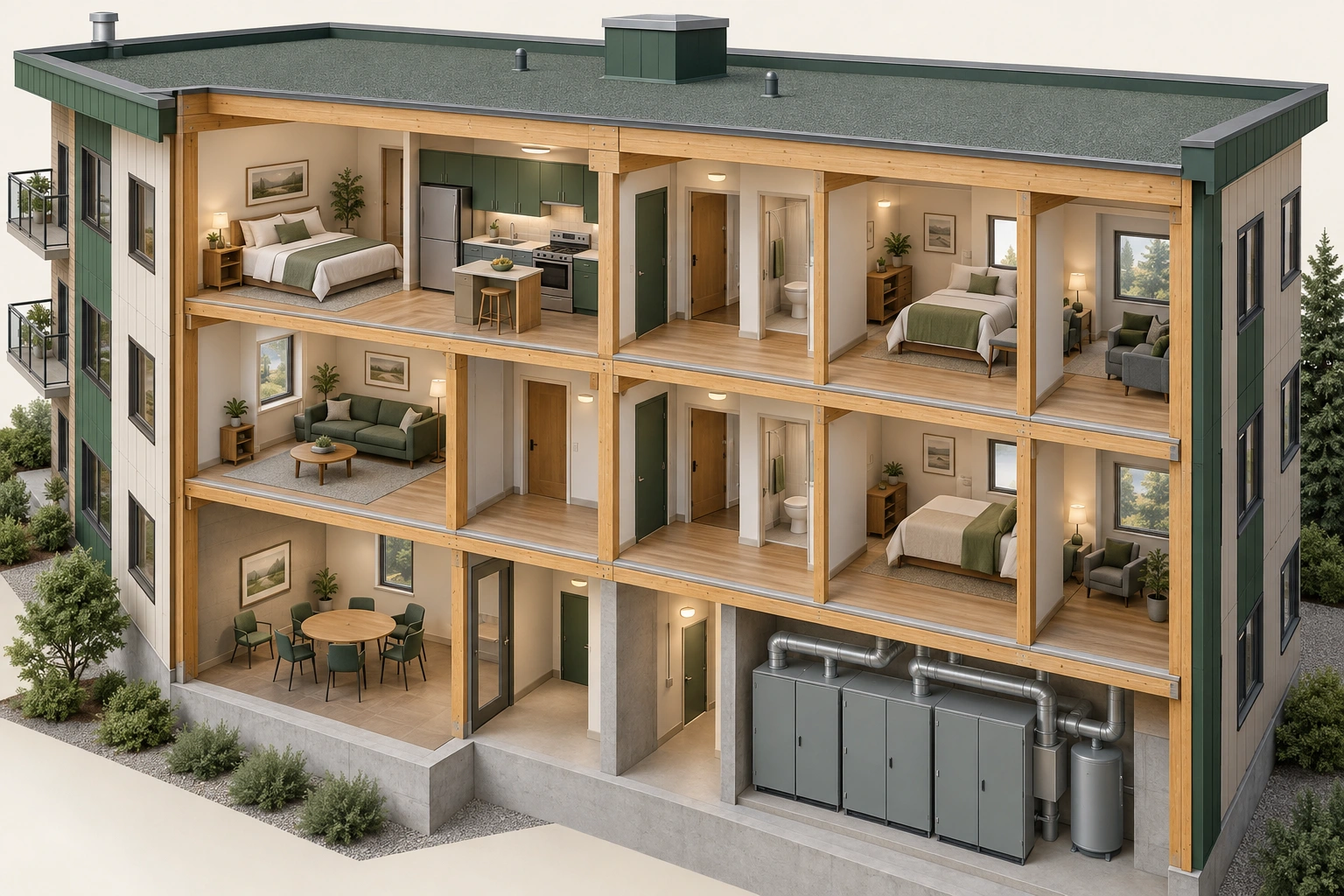
- Private rooms
Support household daily life. A room visit has limited physical scope.
- Roof
Shelters the connected building. Its condition needs actual technical evidence.
- Closed equipment
Represents a separate shared-service enquiry. Do not open or service it from this illustration.
- Shared table
Provides a place for collective activity. A meeting or decision is not technical completion.
What does this illustration leave out?
No certified legal boundaries, actual service connections, structural or enclosure finding, equipment approval or completed collective decision is established. This illustration explains an idea. It is not an installation guide.
Which actual model, membership status and occupancy documents support the household plan?
Explore this with HomeAI ↗Opens an editable question. Nothing is sent until you choose to send it.What do occupancy rules and later household changes require?
The occupancy agreement describes the household's right to live in the offered dwelling and its associated obligations. CMHC's member-obligations chapter identifies this as a distinct document and notes regional differences. Have its actual terms explained with the current local framework. A document resembling a lease should not automatically be treated as governed exactly like every private rental agreement.
Ask about the uses important to the household before committing. Pets, parking, home-based activities, guests, household changes, accessibility adaptations and alterations can raise different questions. Request the relevant actual rule and lawful interpretation rather than rely on a neighbour's account. This guide does not decide that any particular restriction is enforceable or supply a universal list of permitted activities.
If the household's composition or needs change, ask which notification, review or housing options the real documents provide. A bigger unit elsewhere in the co-op is not automatically available, and membership should not be assumed to guarantee a particular internal move. Identify who can explain the process and what current evidence would support a proposed change.
Repairs and improvements still need coordinated scope. A household cannot infer permission to remove a wall, alter a shared service or attach equipment from having an occupancy agreement. Technical design, governance authority and applicable local approvals are separate enquiries. The property and contractor guides provide deeper assessment questions once the actual right to propose work is understood.
Keep complaints and disputes within the appropriate current process. CMHC's governing-legislation chapter emphasizes local legal frameworks and fair procedures, but its 2018 examples are not adopted as current tribunal routes or remedies. Obtain qualified local advice when rights are disputed. The guide provides no termination instruction, legal outcome or authority to withhold a payment or deny lawful access.
What must be understood about leaving or a proposed transfer?
Ask what departure means under the actual model and documents. Ending occupancy, ending membership and dealing with capital or other payments can be related without being identical events. Obtain the applicable process and legal explanation before assuming that a move automatically returns every payment or that another household can simply take over the dwelling.
If a transfer or resale is mentioned, establish what interest can actually be transferred, who must consent and which documents confirm the outcome. The answer may differ sharply between arrangements. This guide supplies no transferable unit, guaranteed purchaser, resale value or automatic release of the departing member's obligations. A market advertisement is not the complete legal evidence.
Return of money needs a separate account explanation. Ask which payments are fees, capital, loans, deposits or charges, and what the actual documents say about each. Keep any required inspection, reconciliation or other condition explicit. A statement that members get their money back is too broad to support a household funding its next move without more precise advice.
Dates matter as actual document questions. Request the required steps and confirmation through the responsible process rather than copying a notice period from another province or a different co-op. A preferred moving date, notice submitted and completed departure have different statuses. Coordinate the next housing plan using supported dates and funds, with a practical contingency for unresolved steps.
Retain the appropriate final account and completion evidence securely. Personal financial and membership records should not be left in a shared public folder. A concise handover or departure summary can state what was completed and who holds the detailed record. It should preserve unresolved tasks rather than imply that returning keys settled every membership and money question.
What does a fictional application comparison reveal?
Fictional Noor is considering an invented non-profit housing co-op and an unrelated condominium purchase. The buildings have similar-looking apartments. The co-op acknowledges Noor's application and supplies a rules booklet, while the condominium listing describes a unit for sale. No actual organization, home, applicant, admission, financing or legal finding is represented in this teaching example.
Noor initially puts the co-op's quoted monthly housing charge beside the condominium's mortgage payment. The comparison is incomplete. Noor asks what the co-op's entry payments and continuing charge include, and what actual interest and occupancy process are proposed. The condominium needs its own unit, borrowing, fees, insurance and building-record enquiries. Neither column gets an invented affordability or investment score.
The co-op acknowledgement is not yet an admission confirmation or a particular unit offer. Noor keeps the preferred move marked proposed and retains current housing while obtaining the actual answers. The example supplies no waiting-list estimate or conclusion that admission will be granted. A positive conversation can be useful without becoming a commitment the organization has not made.
Noor also asks for the current version of the supplied rules and the actual occupancy document. A general statement about participation prompts questions about meetings and the repair-reporting process, not an assumption that members must personally service the shared boiler. The relevant building assessment is requested separately; governance information cannot substitute for technical condition evidence.
The fictional decision remains open until supported arrangements can be compared with Noor's priorities. The lesson is that similar rooms can come with different legal interests, payment structures and decision processes. The household needs those relationships explained before deciding whether the arrangement fits, without treating a co-op as automatically better, worse or equivalent to a unit purchase.
Fictional acceptance is not a unit offer
Noor separates a received application from admission and a unit offer, preserving each unresolved step.
Numbers identify the parts explained below.
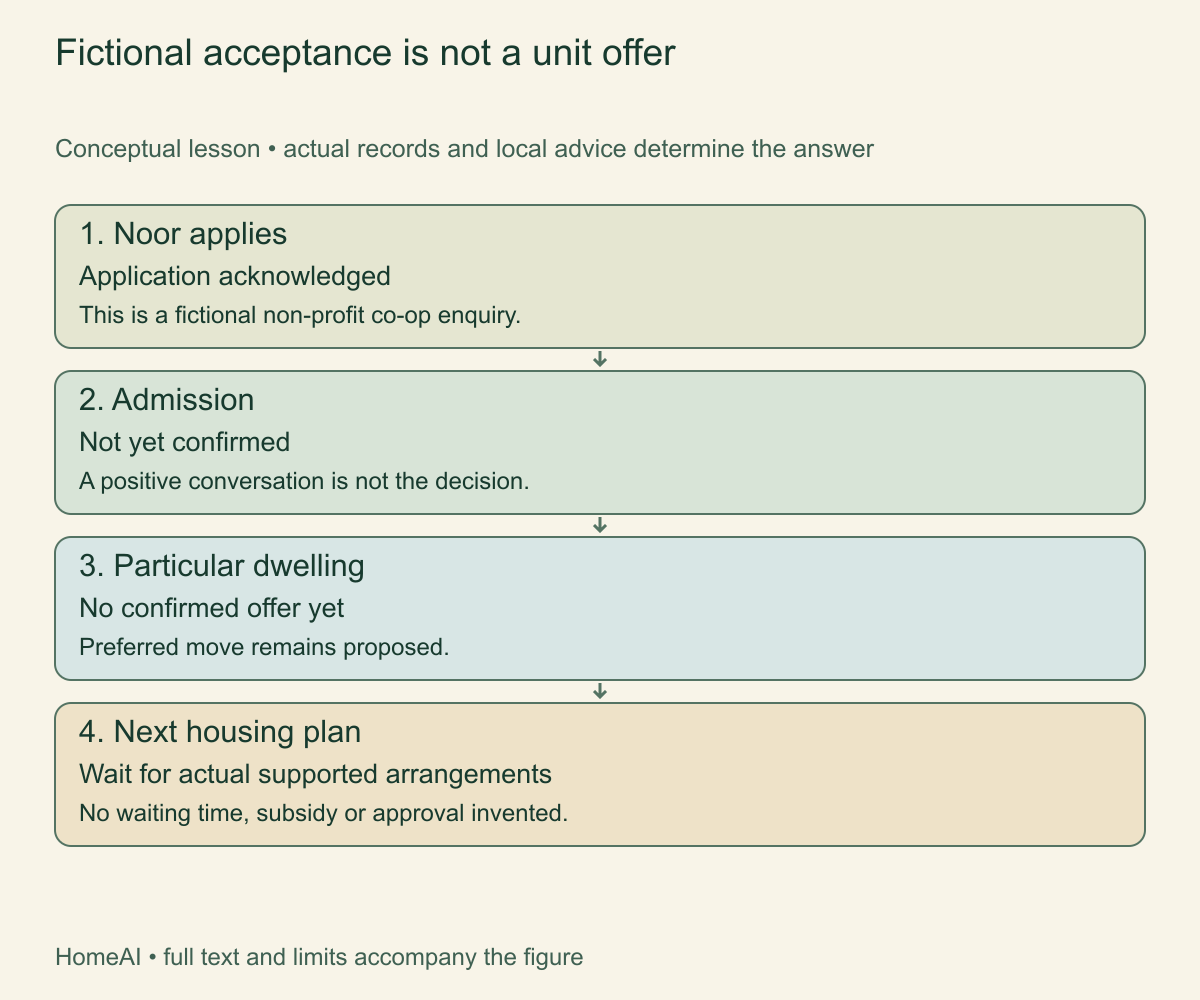
- Noor applies
Application acknowledged. This is a fictional non-profit co-op enquiry.
- Admission
Not yet confirmed. A positive conversation is not the decision.
- Particular dwelling
No confirmed offer yet. Preferred move remains proposed.
- Next housing plan
Wait for actual supported arrangements. No waiting time, subsidy or approval invented.
What does this illustration leave out?
No actual admission, capital-return right, unit offer, financing or legal result. This illustration explains an idea. It is not an installation guide.
Which actual model, membership status and occupancy documents support the household plan?
Explore this with HomeAI ↗Opens an editable question. Nothing is sent until you choose to send it.What should a useful decision and move-in record contain?
Keep the identified organization and model, relevant current governing documents, actual admission confirmation where obtained, offered dwelling and occupancy agreement together. Identify conditions and open steps. Attach the dated explanation of payments, continuing charges and service arrangements. A prospective application file should not gradually be renamed completed membership merely because more documents have accumulated.
Preserve the practical household information: relevant contacts, repair-reporting route, actual rules important to daily use, equipment instructions and known work affecting access or services. Technical findings need their source, date and scope. A shared building project should remain linked to its actual stage. The new resident should be able to distinguish an approved budget from completed physical work.
Use a comparison note that states the household's needs and the supported rights and obligations of each option. Keep unquoted costs, undecided admission, uncertain unit availability and unconfirmed financing visible. Those gaps require different responses. Do not disguise them with an estimated resale value, guaranteed subsidy or invented date that makes a preferred option appear ready.
Primary bodies were captured and read October 15, 2026. The CMHC chapters remain their visible June 3, 2018 editions, used for bounded organizational and document distinctions; their legal procedures, subsidy figures and nationwide assurances are not adopted. Alberta's incorporation page is a provincial general-organization example. Actual current local law and the real documents require qualified advice.
The final explanation should be understandable without the word co-op doing all the work: this organization holds these assets under its own arrangement; this household has this documented membership and occupancy status; these payments and participation responsibilities apply; these building questions are established within their scopes; and these decisions remain open. That supports a considered housing choice without promising rights or outcomes absent from the evidence.
Keep learning about the connected parts
- What changes when the home type changes?
- Buying a home on leased land: identify the home, site and continuing rights
- Condo reserves: connect the money to the building
Canadian context and authorities · Visual atlas · Learning labs
Practice the distinction.
What does a fictional application comparison reveal?
Fictional Noor is considering an invented non-profit housing co-op and an unrelated condominium purchase. The buildings have similar-looking apartments. The co-op acknowledges Noor's application and supplies a rules booklet, while the condominium listing describes a unit for sale. No actual organization, home, applicant, admission, financing or legal finding is represented in this teaching example.
Reported observations
- Noor initially puts the co-op's quoted monthly housing charge beside the condominium's mortgage payment. The comparison is incomplete. Noor asks what the co-op's entry payments and continuing charge include, and what actual interest and occupancy process are proposed. The condominium needs its own unit, borrowing, fees, insurance and building-record enquiries. Neither column gets an invented affordability or investment score.
- The co-op acknowledgement is not yet an admission confirmation or a particular unit offer. Noor keeps the preferred move marked proposed and retains current housing while obtaining the actual answers. The example supplies no waiting-list estimate or conclusion that admission will be granted. A positive conversation can be useful without becoming a commitment the organization has not made.
Compare the explanations
Expand each possibility to see the evidence needed to distinguish it. Similar symptoms can have different mechanisms.
A useful next question
Know what the words mean.
- Co-operative organization
- The legal organization through which members provide and govern housing under its actual framework.
- Membership
- The household or person’s documented relationship to the organization, distinct from a unit title.
- Occupancy agreement
- The actual document addressing the offered dwelling and associated rights and obligations.
- Incorporating record
- A founding organizational document, distinct from admission of an applicant.
- Bylaws or rules
- The actual governance documents and amendments describing how the organization operates.
- Housing charge
- A continuing payment whose amount, inclusions and process require the actual co-op records.
- Non-equity context
- A model in which market resale and capital rights must not be assumed from the word co-op.
- Equity arrangement
- A separately evidenced model requiring its own legal explanation of capital, transfer and occupancy rights.
Questions to bring
to the conversation.
- Which actual model and documents establish the organization, membership and offered occupancy?
- What does each entry payment or continuing charge cover, and what do the terms say about leaving?
- Which admission, unit-offer, building-condition and financing questions remain unresolved?
Separate a showing observation, an existing record and a new professional assessment. Unknown means a question remains; it does not automatically mean a defect.
Use the evidence planner ↗Go to the source.
Original HomeAI explanation informed by these public references. Sources support the underlying guidance; they have not reviewed or endorsed HomeAI. Diagrams are conceptual, and calculator outputs depend on your inputs.
Primary captures and adopted reading extents dated October 15, 2026. Alberta examples are provincial; CMHC 2018 editions are bounded organizational context, not updated law. NRCan source-water differences remain explicit. No actual property findings, legal/approval/financial outcome or future performance is established. Illustrations are conceptual and cases fictional.
Publication & source review
First published .
Sources reviewed .
Have a question about your home?
Start with the symptom, timing and what you have observed.
Ask HomeAI