Jump to a question in this guide
- What do you need to know before you promise to buy?
- What is actually inside an offer?
- Has the lender assessed this home as well as you?
- Will the insurance fit the home you plan to use?
- How do you turn a concern into a useful request?
- Which records answer which questions?
- Do the house, deck and garage match the site documents?
- Can the inspection, access and report fit the time available?
- What should a condition actually help you decide?
- Does this property need a more specific kind of review?
- Would a repair or price change resolve the real concern?
- What changes when other buyers are interested?
- Are the answers clear enough for your decision?
- What should you keep after the decision?
- Start with the use you want and the unanswered questions that could change your decision.
- Read the offer, property information and lender’s answer as different documents with different jobs.
- Arrange authorized access and actual report timing before relying on a condition deadline.
- Discuss unresolved questions and the actual agreement with the appropriate technical, financing and legal advisors.
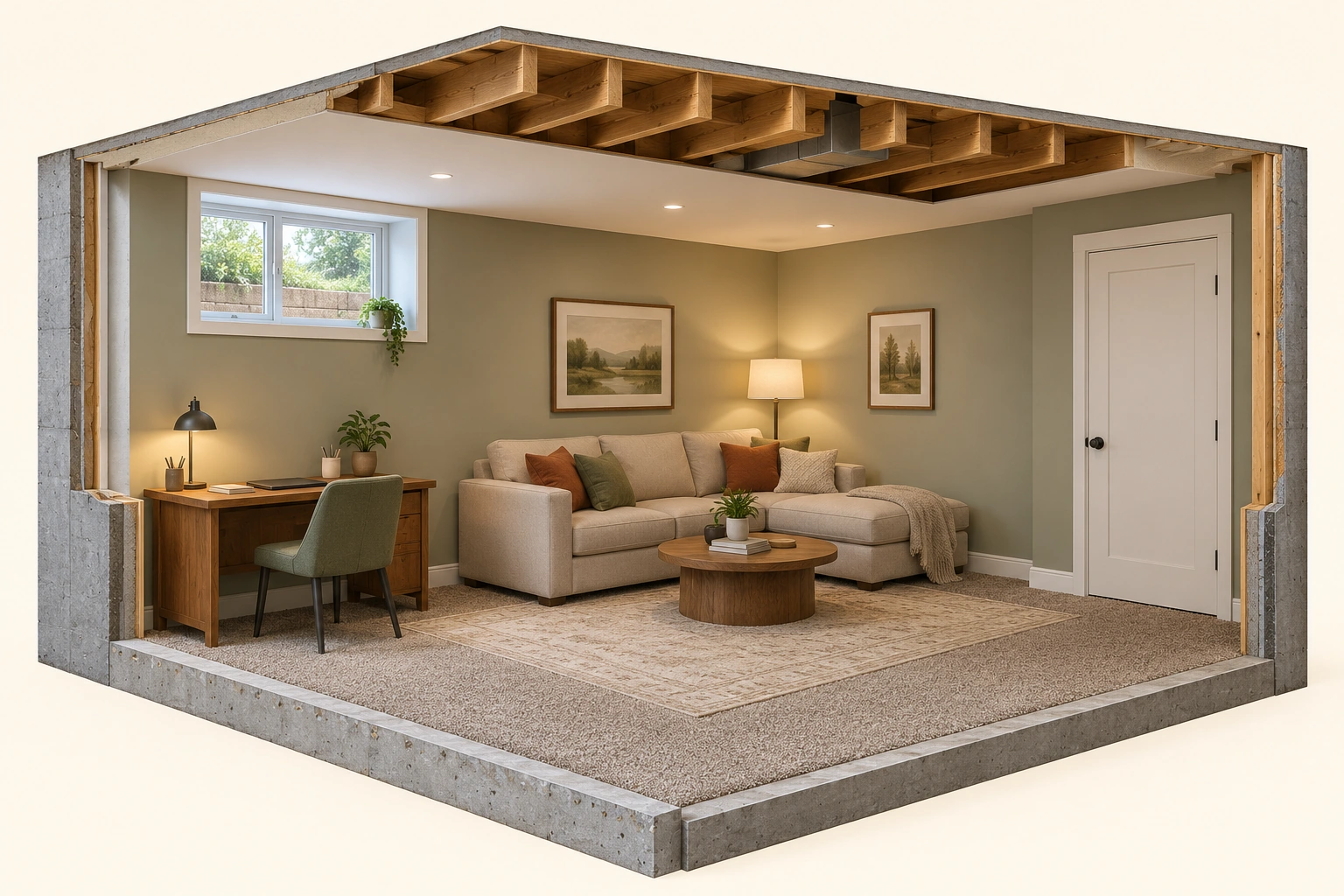
The desk, window and finished surfaces make it easy to imagine using this basement room. Describe the use you want and ask which assessments, records or insurance information apply; furniture and finishes do not settle those questions.
About this illustration
10 picture lessons appear beside the questions in this guide. Use them to understand the explanation, then consider what it means for your home.
What do you need to know before you promise to buy?
The basement looks like the office you have been searching for. The garage could hold your tools, and the kitchen is already renovated. Before those possibilities become your buying plan, connect them with a few concrete questions: can the space suit your intended use, what work was done, and can you arrange the financing you actually need?
Picture the use you want, then name the questions
The desk, window and finished surfaces make it easy to imagine using this basement room. Describe the use you want and ask which assessments, records or insurance information apply; furniture and finishes do not settle those questions.
Explore the labelled parts
- Desk and room use
Describe the intended use before asking what information or assessment applies.
- Window
A familiar window is visible, but this conceptual view supplies no measured opening, legal-room classification or approval.
- Closed side door
The adjoining space is outside this view. Arrange authorized access to relevant areas rather than assuming they were assessed.
A showing helps you decide whether you like a home. Preparing an offer means deciding which unanswered questions matter enough to investigate before you commit. A finished room, a seller’s explanation and a lender’s early estimate each give you useful information. They answer different questions, and none should quietly stand in for the others.
Start with the parts of the home your plans depend on. For a basement office, describe the room and intended use rather than deciding from the window’s appearance that everything is approved. For a workshop, identify the garage and equipment you expect to use. Ask the relevant authority, assessor and insurer what information they need for that plan.
Keep this first list short enough to use during a conversation. Write the important question, why its answer could change your decision, and who can answer it. You are preparing a focused purchase investigation. The detailed home-inspection guides explain the inspection process; this guide connects those findings with records, financing and the actual offer.
Sources for this chapter
What is actually inside an offer?
An offer is more than the amount you are willing to pay. CMHC’s national outline includes the property and parties, price, deposit, included items, possession arrangements, expiry and any conditions. Read those as separate decisions. The washing machine you expect to receive and the financing you need belong in different parts of the discussion.
Read an offer as several decisions
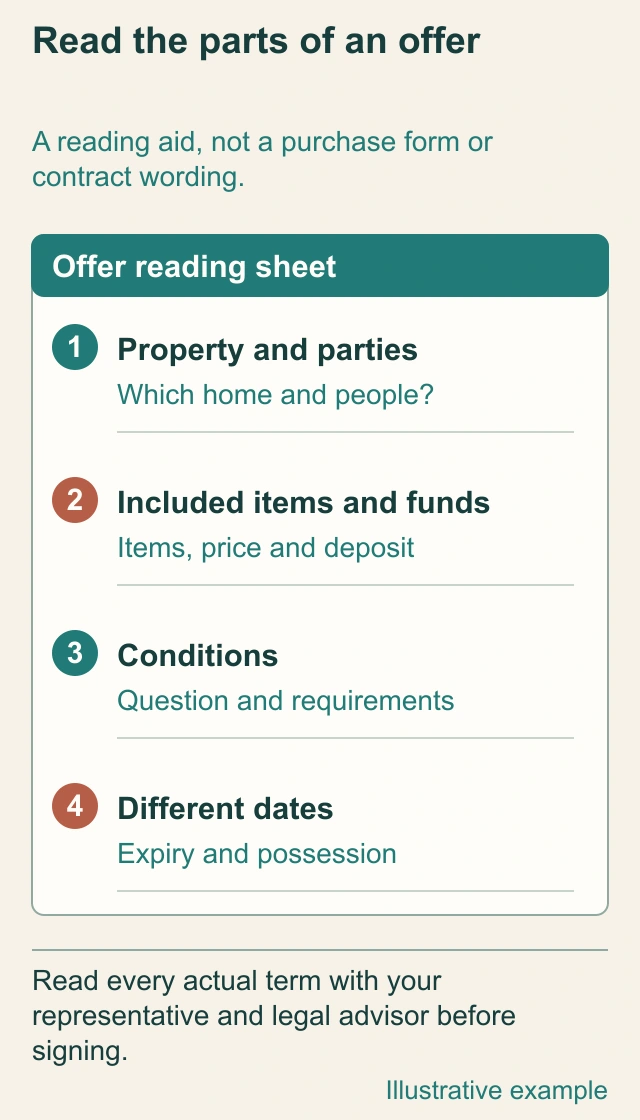
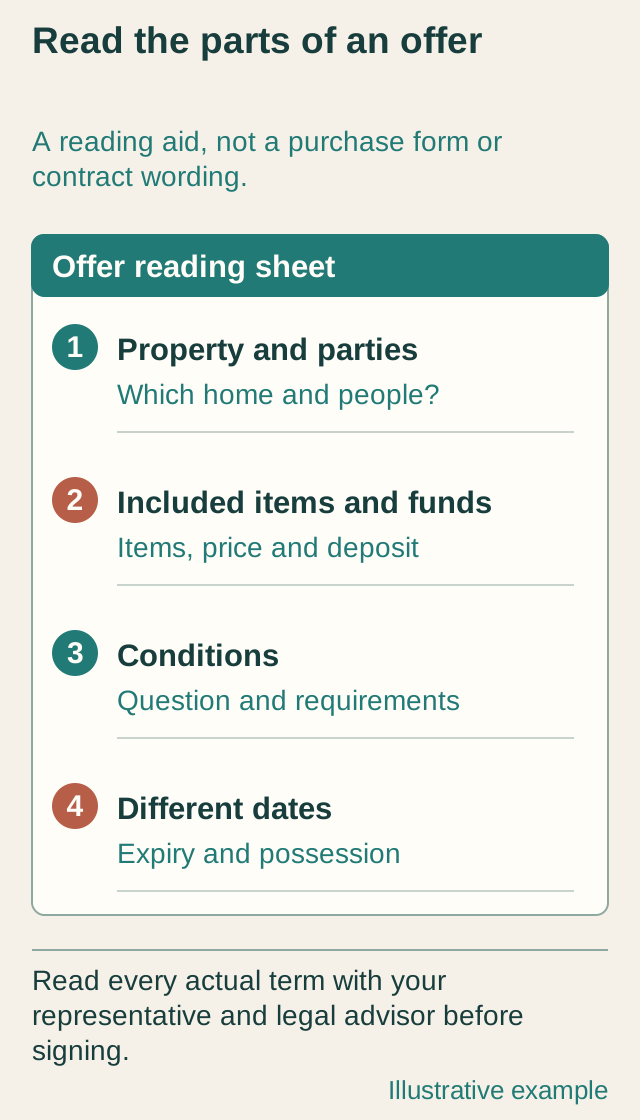
An annotated sample reading sheet separates the property, included items, funds, conditions, offer expiry and possession arrangements. Read those parts of the actual agreement with your advisors before signing.
Explore the labelled parts
- Property and parties
Confirm that the full property identity and parties match the intended transaction.
- Included items and funds
Clarify included items, any separate equipment agreements, the price and deposit responsibilities.
- Conditions
Ask which question each actual condition addresses and what it requires.
- Different dates
Offer expiry, a condition deadline and possession or completion arrangements concern different parts of the process.
Name the things you intend to buy clearly. Ask which appliances, fixtures or other items are included and whether any equipment is rented or financed. A photograph of a water heater shows an appliance; it does not explain ownership or an agreement attached to it. Follow the separate inherited-equipment guide when a contract needs closer review.
Several dates can appear in the same agreement. The time an offer remains open for acceptance is different from a deadline attached to an agreed condition. The possession or completion arrangements concern another stage. Have your representative explain each actual date, time and responsibility, including any notice that must be delivered.
Use professional help to prepare and read the agreement before signing it. British Columbia’s regulator explicitly warns that a signed contract can be binding even while it contains subject clauses. That is a useful reason to take the wording seriously, not a rulebook for every province. This illustration identifies questions to discuss; it is not wording to copy into an offer.
Read an offer as several decisions
An annotated sample reading sheet separates the property, included items, funds, conditions, offer expiry and possession arrangements. Read those parts of the actual agreement with your advisors before signing.
- Property and parties
- Confirm that the full property identity and parties match the intended transaction.
- Included items and funds
- Clarify included items, any separate equipment agreements, the price and deposit responsibilities.
- Conditions
- Ask which question each actual condition addresses and what it requires.
- Different dates
- Offer expiry, a condition deadline and possession or completion arrangements concern different parts of the process.
Read all the diagram text
- Read the parts of an offer
- A reading aid, not a purchase form or
- contract wording.
- Offer reading sheet
- 1
- Property and parties
- Which home and people?
- 2
- Included items and funds
- Items, price and deposit
- 3
- Conditions
- Question and requirements
- 4
- Different dates
- Expiry and possession
- Read every actual term with your
- representative and legal advisor before
- signing.
- Illustrative example
Sources for this chapter
Has the lender assessed this home as well as you?
A preapproval can help you search within a realistic range. It is not the same as an assurance that the lender will finance any home you choose. FCAC explains that lenders use different names and criteria for their preliminary steps, and that a preapproval does not guarantee the final mortgage or the amount you will receive.
The lender needs more than a payment estimate
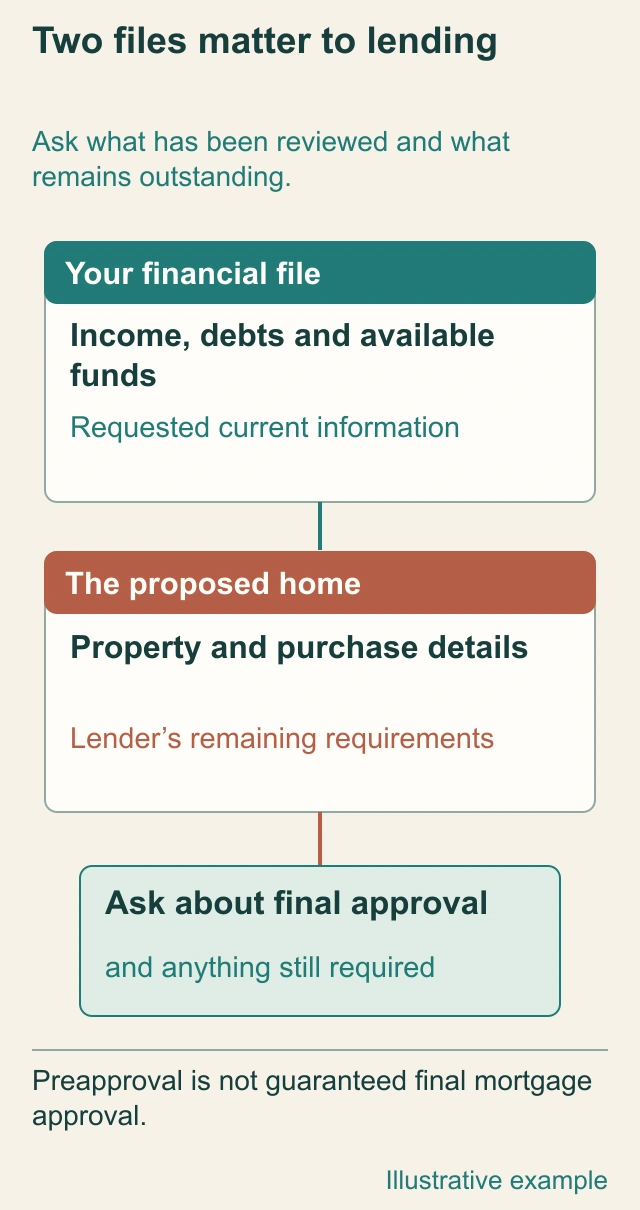
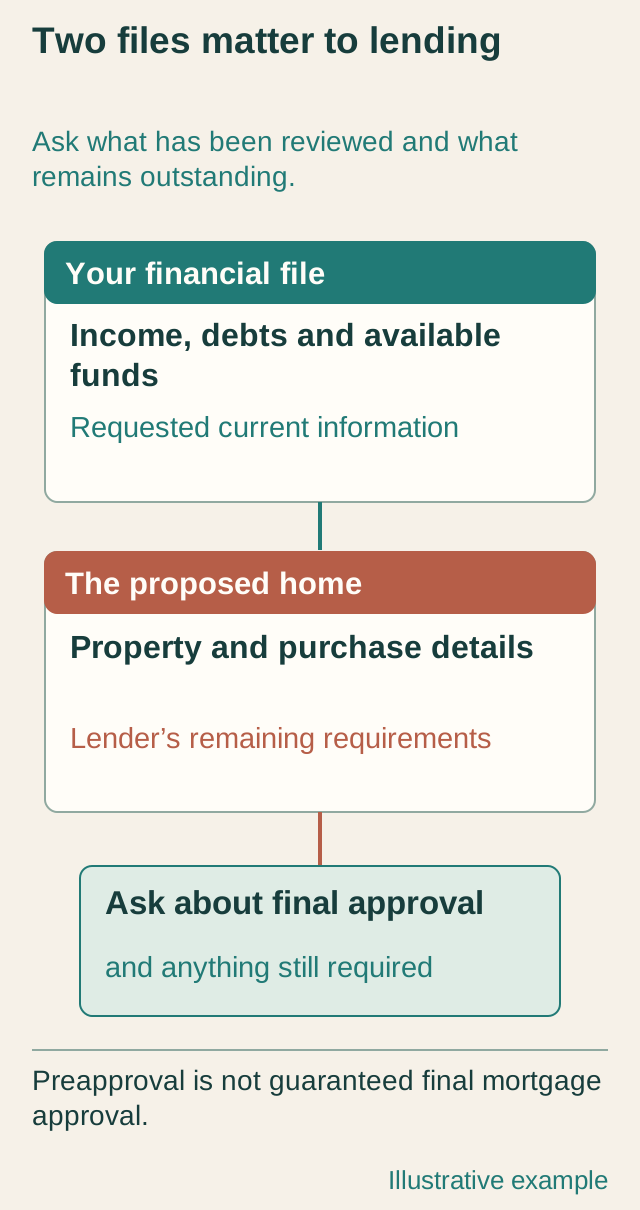
Your financial file and the proposed property both matter to the lending conversation. Ask what the lender has reviewed and what remains outstanding; a preapproval is not guaranteed final mortgage approval.
Explore the labelled parts
- Your financial file
Supply the current information requested by the lender about income, debts and available funds.
- The proposed home
Ask which property information or assessment the lender needs for this purchase.
- Final requirements
Read the actual written answer and ask about anything still required before relying on it.
Think of two files meeting at the lender’s desk. One describes you: income, debts, available funds and the documents the lender requests. The other describes the proposed purchase. FCAC says the lender also checks whether the property meets its standards. A comfortable monthly-payment estimate does not answer every property-related lending question.
Ask your lender or mortgage professional what remains outstanding for this particular purchase. Which property information is required? Is an appraisal or another review needed? What does any written approval still require? CMHC advises returning to the lender for final approval even after preapproval; avoid treating an early letter as permission to remove a financing condition.
Set your own budget below the point where every available dollar is spoken for. Keep the deposit and other purchase funds in view alongside closing, moving, maintenance and investigation costs. If a property question could change the work you must fund, take it back to the financing conversation. A lender’s maximum and a comfortable household plan answer different questions.
The lender needs more than a payment estimate
Your financial file and the proposed property both matter to the lending conversation. Ask what the lender has reviewed and what remains outstanding; a preapproval is not guaranteed final mortgage approval.
- Your financial file
- Supply the current information requested by the lender about income, debts and available funds.
- The proposed home
- Ask which property information or assessment the lender needs for this purchase.
- Preapproval
- Lenders use different definitions and criteria for their preliminary steps.
- Final requirements
- Read the actual written answer and ask about anything still required before relying on it.
Read all the diagram text
- Two files matter to lending
- Ask what has been reviewed and what
- remains outstanding.
- Your financial file
- Income, debts and available
- funds
- Requested current information
- The proposed home
- Property and purchase details
- Lender’s remaining requirements
- Ask about final approval
- and anything still required
- Preapproval is not guaranteed final mortgage
- approval.
- Illustrative example
Sources for this chapter
Will the insurance fit the home you plan to use?
Speak with an insurance professional early enough to understand the proposed cover, its cost and any information still required. Describe the actual property and your intended occupancy. FCAC says you must tell the insurer if you share or rent part of a home, and must notify it about a home-based business. Those plans should be part of the conversation.
Ask what the policy covers, excludes and requires of you. The premium is what you pay for the policy; the deductible is the portion of a covered claim you agree to bear. Having a quotation does not explain every exclusion. Read the proposed cover and ask about the particular risks that concern you rather than assuming that all water or other damage is treated alike.
Keep the insurance and financing answers connected without merging them. Ask the lender what insurance information it needs, and ask the insurer what property details or follow-up it needs. Neither this guide nor a purchase condition can promise that a specific insurer will accept the property or pay a future claim.
Sources for this chapter
How do you turn a concern into a useful request?
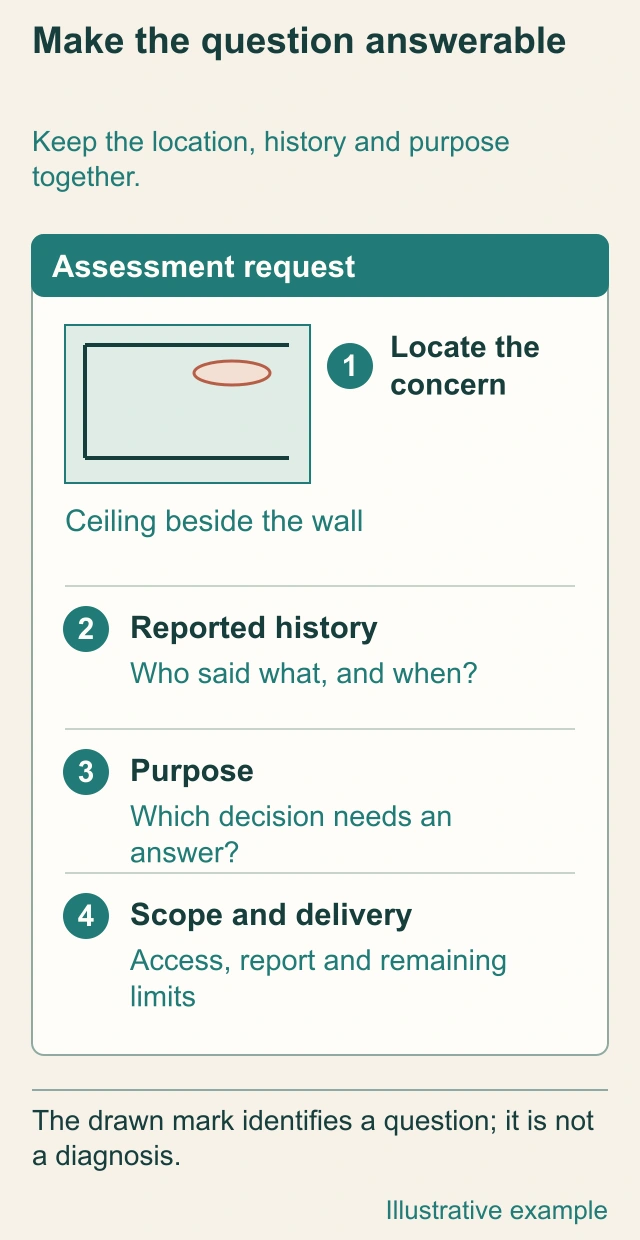
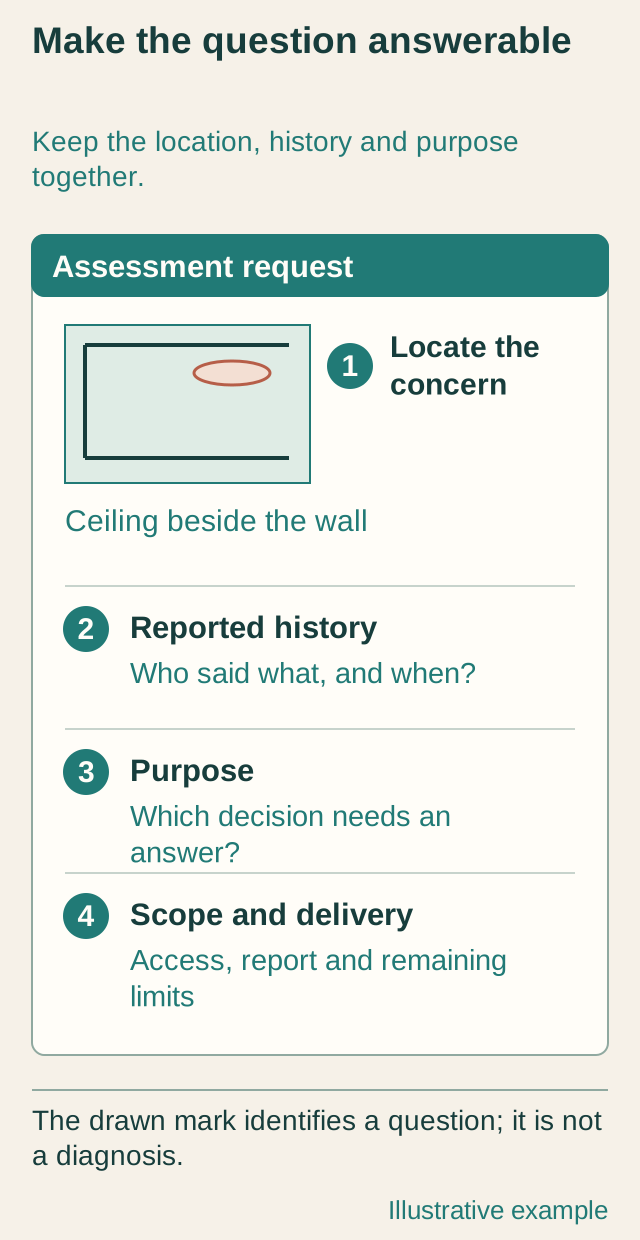
Replace “check the basement” with a question someone can answer. For example: “There is a mark on the ceiling beside this wall; what assessment could explain the reported history and whether further investigation is needed?” Keep the location, your photograph and the seller’s explanation together, with the source and date of each.
Turn “check this” into an answerable request
A specific location, reported history and buying purpose make a concern easier to discuss. Ask the relevant provider to explain the assessment scope, access, written answer and limits rather than confirm an assumed diagnosis.
Explore the labelled parts
- Location
Keep an original photograph and a clear description of where the concern appears. The drawn ceiling mark is illustrative.
- Reported history
Record who supplied an explanation and when; do not rewrite it as an assessed finding.
- Purpose
Explain the purchase or intended-use decision that needs an answer.
- Scope and delivery
Confirm relevant qualifications, assessment scope, authorized access, report timing and remaining limits.
Then identify the decision behind the question. Are you trying to understand active damage, likely work before finishing the room, or a record that does not match the visible layout? That purpose helps the provider propose a useful scope. A general inspection, a focused plumbing assessment and a search for renovation records are different services, even when they concern the same room.
Ask the proposed provider what they will assess, what access they need, what they will deliver and when. Confirm their relevant qualifications and actual scope. Alberta requires both the home inspector and inspection business to be licensed, with a written contract and report arrangements. Check the applicable authority elsewhere instead of assuming that licensing and contract rules are identical across Canada.
A good request leaves room for a professional explanation. Do not tell someone that the mark proves a roof leak or ask them merely to confirm your guess. Ask which possibilities they can assess and what would remain unresolved. The answer may change the next service you order, so keep the investigation and any proposed repair as separate steps.
Turn “check this” into an answerable request
A specific location, reported history and buying purpose make a concern easier to discuss. Ask the relevant provider to explain the assessment scope, access, written answer and limits rather than confirm an assumed diagnosis.
- Location
- Keep an original photograph and a clear description of where the concern appears. The drawn ceiling mark is illustrative.
- Reported history
- Record who supplied an explanation and when; do not rewrite it as an assessed finding.
- Purpose
- Explain the purchase or intended-use decision that needs an answer.
- Provider and deliverable
- Confirm relevant qualifications, assessment scope, authorized access, report timing and remaining limits.
Read all the diagram text
- Make the question answerable
- Keep the location, history and purpose
- together.
- Assessment request
- 1
- Locate the
- concern
- Ceiling beside the wall
- 2
- Reported history
- Who said what, and when?
- 3
- Purpose
- Which decision needs an
- answer?
- 4
- Scope and delivery
- Access, report and remaining
- limits
- The drawn mark identifies a question; it is not
- a diagnosis.
- Illustrative example
Sources for this chapter
Which records answer which questions?
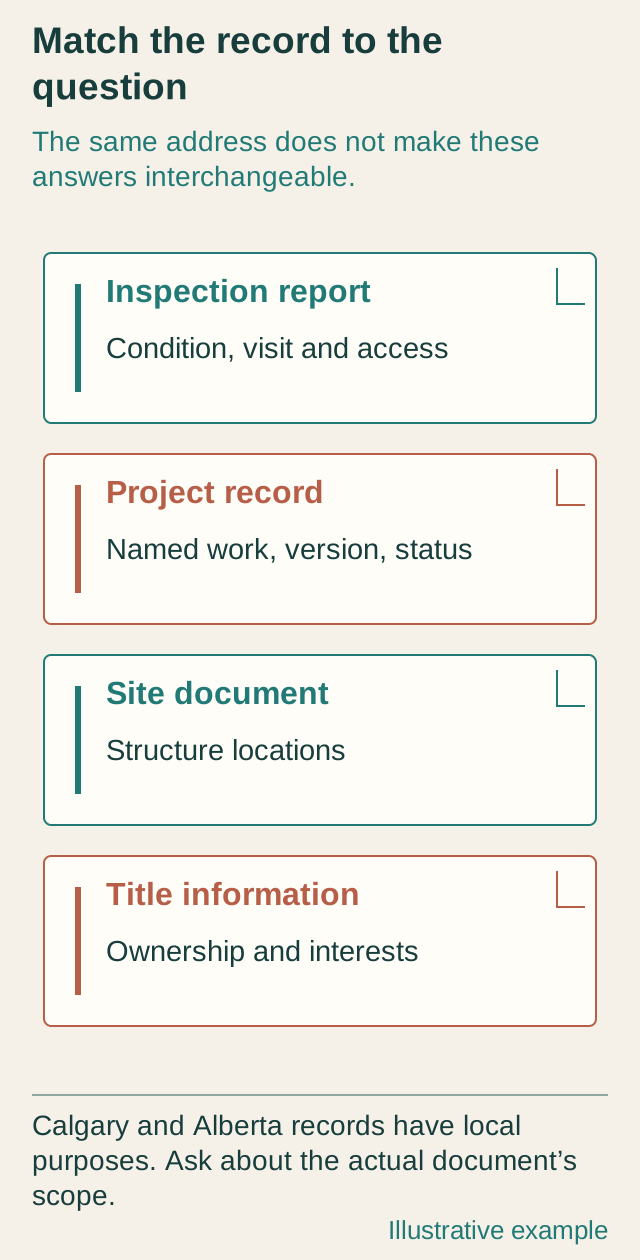
Read the document’s heading before treating it as reassurance. An invoice describes billed work. A permit file describes a particular application or project and its recorded status. A drawing describes a design or revision. An inspection report records findings within its stated scope. Match the address, date and work area to the question you are asking.
Different records answer different questions
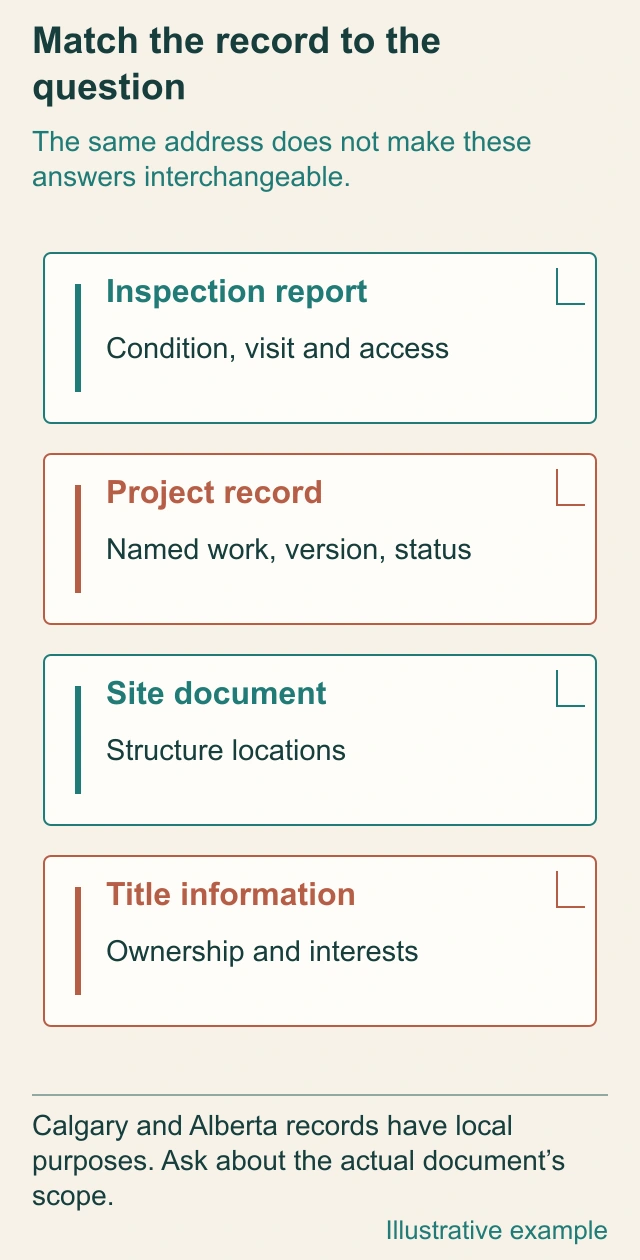
Inspection, project and title or site records can contribute different answers about one property. Match the address, work and date first, then ask the relevant professional what the document actually covers.
Explore the labelled parts
- Inspection report
Read the contracted assessment, visit conditions and recorded access limits.
- Project record
Match the alteration, drawing version and recorded outcome to the question.
- Site document
Compare visible structures with the relevant survey or site record without inferring legal boundaries from a fence.
- Title information
In Alberta, current titles identify ownership and registered interests. Ask legal counsel about relevant entries and supporting documents.
For a reported renovation, ask what was changed and which records relate to that work. Compare the room you saw with the scope described, and ask about discrepancies without immediately declaring unlawful work. The renovation-records guide explains drawing revisions and inspection stages in detail. Here, the important purchase question is which answer you need before relying on the alteration.
Calgary’s property-research service describes several record types and warns that it cannot guarantee what a file contains. It also describes access and reproduction restrictions for copyrighted plans. A request submitted today is not the same as receiving a complete file today. Ask the responsible municipality about its current process, authorization requirements and likely availability.
Keep full reports and records beside any short summary. If a seller supplies an older report, identify who wrote it, what property and work it covered, and what has changed since. Ask the relevant professional whether it answers your present question. The convenience of receiving a document does not expand its author’s scope or make its conclusions current.
Different records answer different questions
Inspection, project and title or site records can contribute different answers about one property. Match the address, work and date first, then ask the relevant professional what the document actually covers.
- Inspection report
- Read the contracted assessment, visit conditions and recorded access limits.
- Project record
- Match the alteration, drawing version and recorded outcome to the question.
- Site document
- Compare visible structures with the relevant survey or site record without inferring legal boundaries from a fence.
- Title information
- In Alberta, current titles identify ownership and registered interests. Ask legal counsel about relevant entries and supporting documents.
Read all the diagram text
- Match the record to the
- question
- The same address does not make these
- answers interchangeable.
- Inspection report
- Condition, visit and access
- Project record
- Named work, version, status
- Site document
- Structure locations
- Title information
- Ownership and interests
- Calgary and Alberta records have local
- purposes. Ask about the actual document’s
- scope.
- Illustrative example
Sources for this chapter
Do the house, deck and garage match the site documents?
Walk the visible property with your plans in mind. Notice the house, deck, garage and other structures you expect to use or alter. You can identify those features and ask for the relevant documents without deciding where a legal boundary lies. A fence, garden edge or illustration is not a survey line.
Match the features you see with the right site records
The house, deck, garage and fence are separate features worth matching to relevant site documents. Ask the appropriate professional about the actual document and any changes; the fence and cutaway soil edge are not legal boundary lines.

Explore the labelled parts
- House
Match the actual property and visible structures with the relevant site information.
- Deck
Identify the deck or later alteration you are asking about; a record’s title alone does not explain its scope.
- Separate garage
Include the structures your plans depend on when asking whether the supplied record reflects the current site.
- Fence
Do not treat a visible fence or the edge of the illustration as a surveyed legal boundary.
In Calgary, a Real Property Report prepared by an Alberta land surveyor and a Certificate of Compliance have a particular role. The City describes the certificate as checking structure locations against the Land Use Bylaw. It expressly separates that service from building-code enforcement and confirmation of permit history. The word “compliance” does not turn the document into an inspection of every building system.
A land title answers another question. Alberta’s current-title guidance lists ownership and registered interests such as mortgages, caveats, easements and builders’ liens. Ask your legal professional which title and supporting documents are needed, what any relevant entry means, and whether it affects your intended use. A title entry should not be interpreted from a cropped image or a familiar-looking name.
Ask what survey, site or title documents your actual agreement requires in your jurisdiction. Have the appropriate professional address missing structures, changes since a survey or a concern about rights affecting the land. The yard picture is an orientation to the features worth matching; it is not a measured survey, an encroachment finding or an approval.
Sources for this chapter
Can the inspection, access and report fit the time available?
Before relying on a proposed investigation, check the whole appointment. Someone needs to arrange authorized access, the provider needs the agreed areas available, and the report needs to reach you in time to be useful. An available appointment is only one part of that sequence. Ask separately when the written deliverable will be ready.
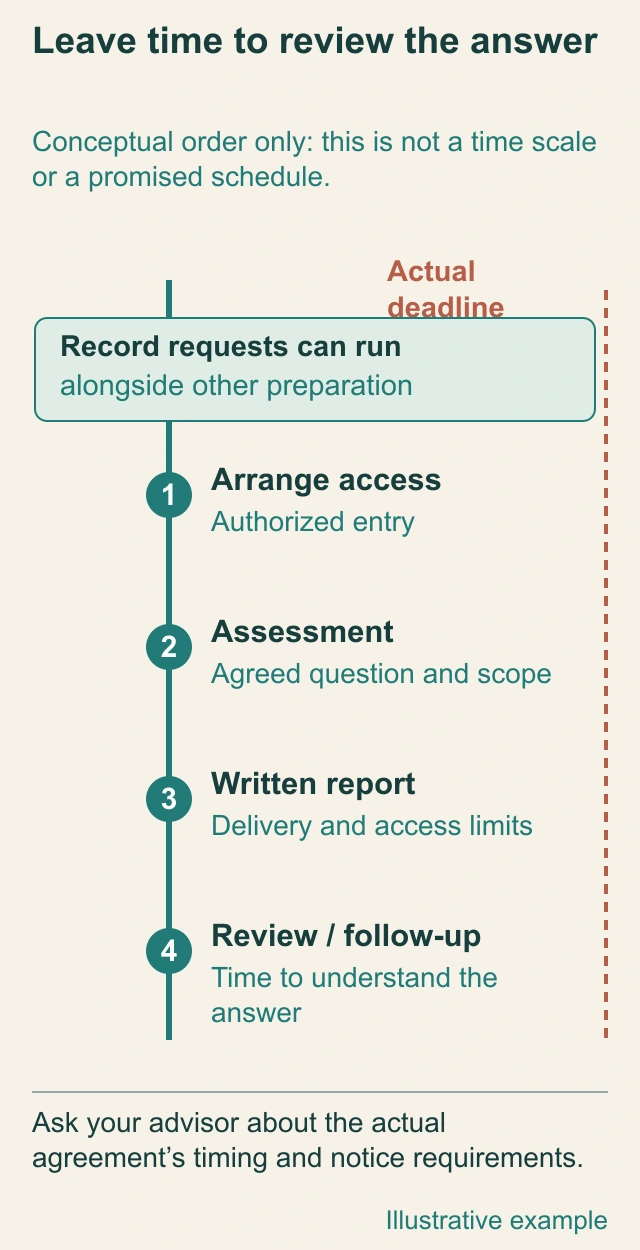
Allow time for the answer and its review
Authorized access, an assessment, the written report and review are separate steps. Some work can run in parallel; some follow-up depends on the first findings. Use actual availability and agreed dates instead of a generic waiting-time estimate.
Explore the labelled parts
- Parallel record requests
Request relevant records while arranging other steps; their arrival is not a substitute for assessment or review.
- Arrange access
Confirm authorized entry and which relevant areas will be available.
- Assessment
Agree the provider’s actual question and scope before the visit.
- Report and review
Confirm report delivery and allow time to understand it or seek matched follow-up.
- Actual deadline and notice
Ask your transaction or legal advisor how the actual agreement’s dates and notice requirements apply.
Explain which spaces or equipment matter before the visit. A locked room, stored belongings, snow-covered surface or unavailable system may limit the planned assessment. Ask how the provider will record such limitations and whether a further authorized visit or another service could answer the important question. Do not open panels, disturb materials or operate unfamiliar equipment to manufacture your own inspection.
Work backward from the actual decision deadline with your representative. Allow for access, assessment, report delivery, possible follow-up and time to review the answer. Some document requests can run alongside an inspection; a specialist’s next scope may depend on what the first assessor finds. The timeline shows dependencies, not a promised number of days.
Ask about current availability instead of assuming the standard booking interval will suit this property. Alberta’s home-inspection guidance requires the written contract to say when the report will arrive. Calgary separately warns about record-request delays and uncertain file contents. If the necessary answer may arrive late, seek advice about the agreement before its deadline rather than assuming more time will appear.
Allow time for the answer and its review
Authorized access, an assessment, the written report and review are separate steps. Some work can run in parallel; some follow-up depends on the first findings. Use actual availability and agreed dates instead of a generic waiting-time estimate.
- Parallel record requests
- Request relevant records while arranging other steps; their arrival is not a substitute for assessment or review.
- Arrange
- Confirm authorized entry and which relevant areas will be available.
- Assess
- Agree the provider’s actual question and scope before the visit.
- Receive and review
- Confirm report delivery and allow time to understand it or seek matched follow-up.
- Deadline and notice
- Ask your transaction or legal advisor how the actual agreement’s dates and notice requirements apply.
Read all the diagram text
- Leave time to review the answer
- Conceptual order only: this is not a time scale
- or a promised schedule.
- Actual
- deadline
- Record requests can run
- alongside other preparation
- 1
- Arrange access
- Authorized entry
- 2
- Assessment
- Agreed question and scope
- 3
- Written report
- Delivery and access limits
- 4
- Review / follow-up
- Time to understand the
- answer
- Ask your advisor about the actual
- agreement’s timing and notice requirements.
- Illustrative example
Sources for this chapter
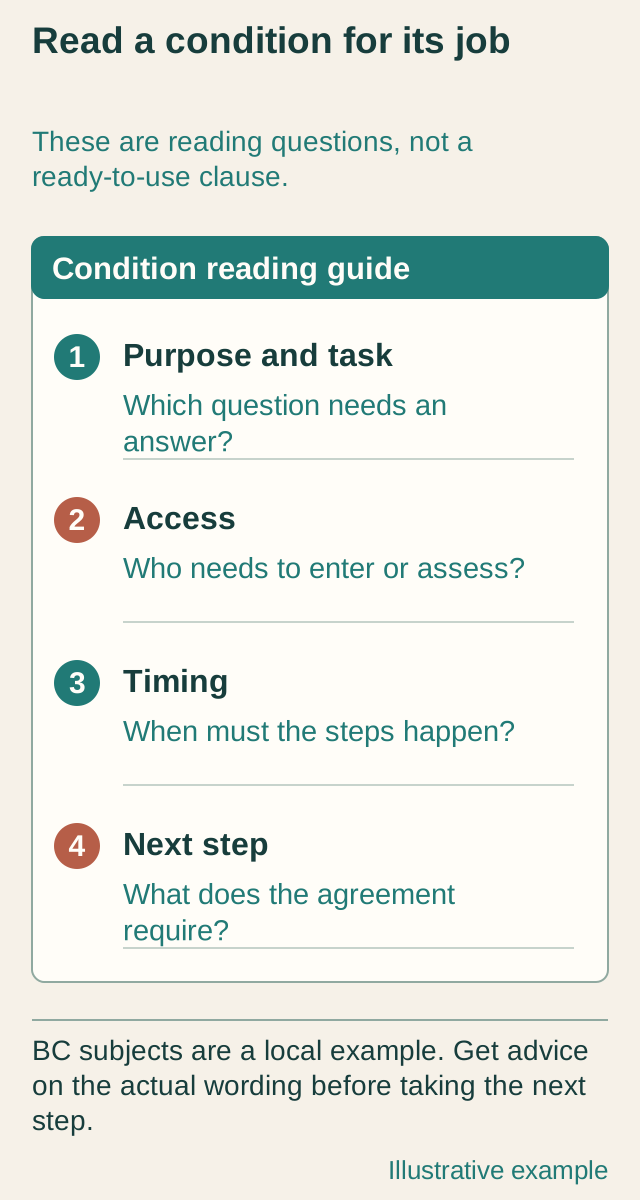
What should a condition actually help you decide?
Start with the uncertainty you need resolved. A financing condition, an inspection-related condition and a document-review condition address different questions. Tell your representative what outcome matters, which information you need and when you need it. Ask them to explain how the proposed wording relates to that purpose and to the rest of the agreement.
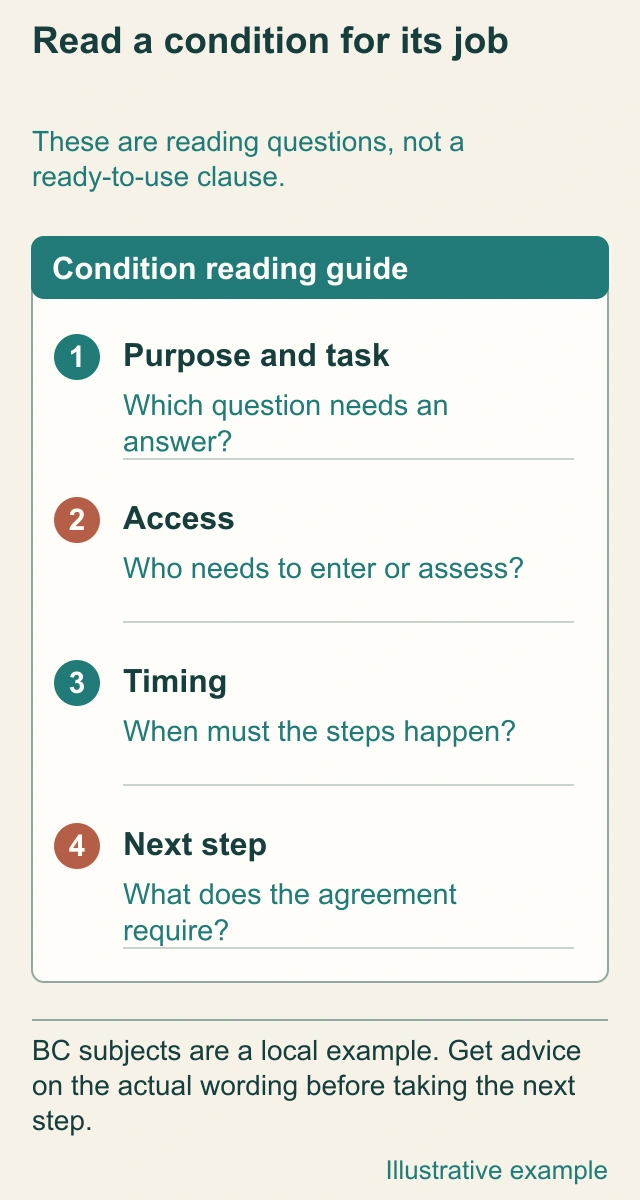
Read a condition for its job and requirements
Use the actual clause to identify its purpose, task, access, timing and next step. These questions support a conversation with your advisors; they do not create contract wording or a right to withdraw.
Explore the labelled parts
- Purpose and task
Explain the answer needed and ask who must obtain, assess or provide it under the actual wording.
- Access
Ask what entry or cooperation the agreement covers; do not assume unrestricted access.
- Timing
Identify the actual date, time and required notice. The image supplies no standard duration.
- Next step
Obtain advice before satisfying, waiving or removing a condition; local rules and the contract control.
Have the actual wording explained in plain language. Who must do something? What assessment or document is contemplated? What access or cooperation is covered? Which date and notice requirements apply? These are reading questions for the agreement prepared with your advisors, not a list of phrases that automatically creates the protection you want.
British Columbia’s guidance describes subject clauses as precisely worded conditions within a binding contract and warns that they are not unrestricted escape clauses. Other jurisdictions and forms need their own advice. Do not assume that booking an inspection, receiving an unsatisfactory answer or deciding not to proceed automatically produces a particular legal result.
Before satisfying, waiving or removing anything, ask which important questions have actually been answered and what obligations remain. Your real estate and legal advisors should explain the proposed step and its consequences under the actual agreement. This guide supplies neither a cancellation right nor a notice form, extension or deposit-release outcome.
Read a condition for its job and requirements
Use the actual clause to identify its purpose, task, access, timing and next step. These questions support a conversation with your advisors; they do not create contract wording or a right to withdraw.
- Purpose and task
- Explain the answer needed and ask who must obtain, assess or provide it under the actual wording.
- Access
- Ask what entry or cooperation the agreement covers; do not assume unrestricted access.
- Timing
- Identify the actual date, time and required notice. The image supplies no standard duration.
- Next step
- Obtain advice before satisfying, waiving or removing a condition; local rules and the contract control.
Read all the diagram text
- Read a condition for its job
- These are reading questions, not a
- ready-to-use clause.
- Condition reading guide
- 1
- Purpose and task
- Which question needs an
- answer?
- 2
- Access
- Who needs to enter or assess?
- 3
- Timing
- When must the steps happen?
- 4
- Next step
- What does the agreement
- require?
- BC subjects are a local example. Get advice
- on the actual wording before taking the next
- step.
- Illustrative example
Sources for this chapter
Does this property need a more specific kind of review?
Let the property set the question. A condominium may need a review of its particular corporation or strata records as well as the unit itself. A rural property may involve a private well, wastewater system or access arrangements. An appliance or tank may have a separate ownership, rental or service agreement. Ask which of these matters applies before ordering a standard bundle of services.
For well water, keep the original laboratory report and sampling information together. Health Canada explains that appearance, taste and smell cannot establish water suitability, and that sampling and handling instructions matter. Ask the local public-health or drinking-water authority and the relevant laboratory about the appropriate tests and interpretation. A result for specified substances does not answer every question about the well, equipment or future supply.
For an extra assessment, ask what question it answers that the available inspection or documents do not. Confirm the provider, authorized access, scope, deliverable and timing. Our specialist guides explain individual systems and records. Keep those technical investigations tied to the purchase decision instead of letting a long list of tests become a substitute for a clear purpose.
Sources for this chapter
Would a repair or price change resolve the real concern?
A price change affects the transaction. It does not physically repair the home or explain the cause of a concern. A repair proposal describes work, but its usefulness depends on the scope. If someone offers to address an issue, first make sure you understand what was assessed, what is proposed and what question will remain afterward.
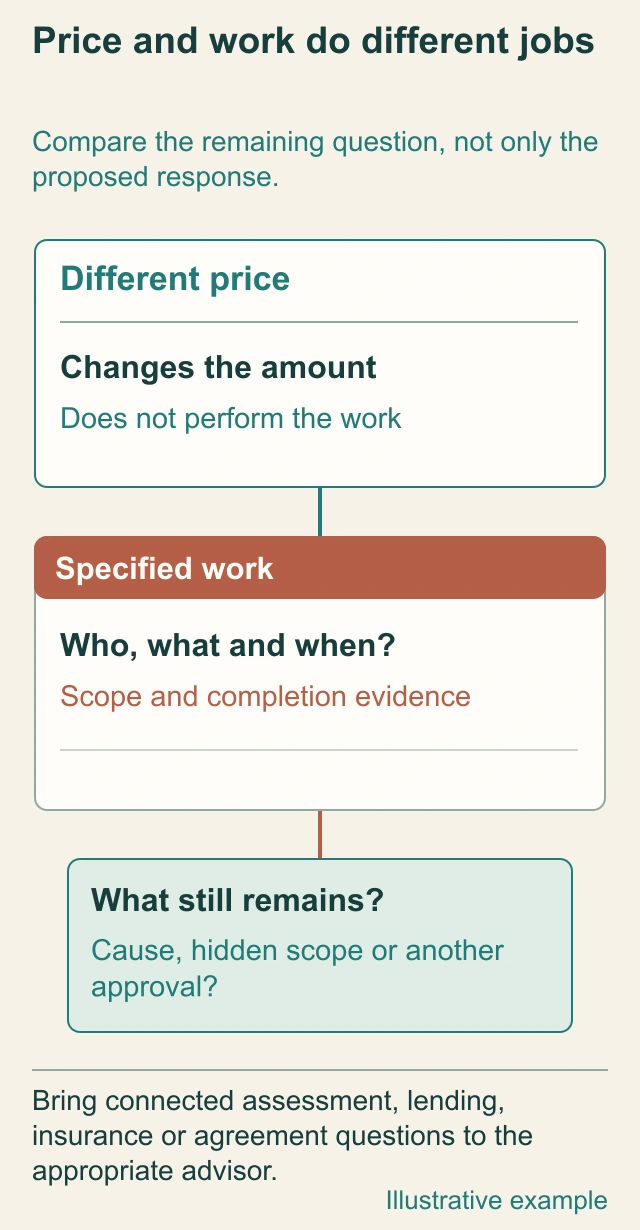
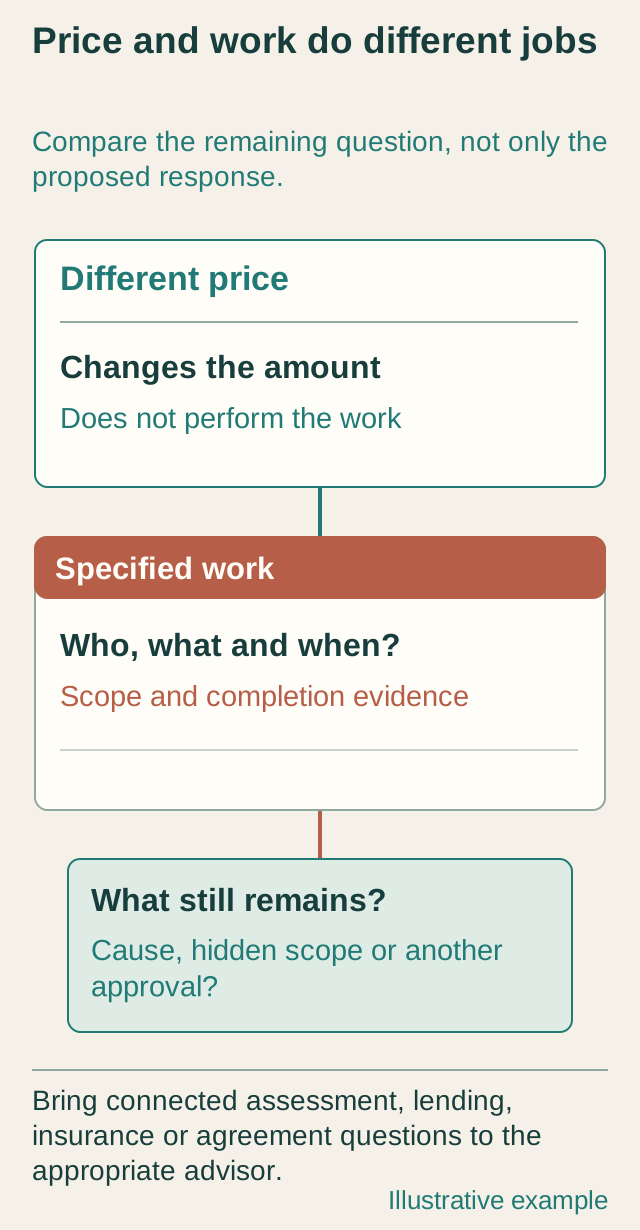
A price change and a repair do different jobs
A different price changes the transaction discussion; specified work needs an understood technical scope. Keep the assessed concern, remaining work and any financing or contract implications connected without treating them as interchangeable.
Explore the labelled parts
- Different price
Identify the work and uncertainty you would still inherit rather than assuming a lower amount fixes the issue.
- Specified work
Match the location, tasks, access, restoration and completion information to the assessed concern.
- Remaining question
Ask which issue still needs explanation or further assessment.
Compare a proposed repair against the actual finding. Ask which location and components the work includes, how access and restoration will be handled, and what completion information will be provided. A general promise to “fix the leak” leaves different questions from a written scope tied to an assessed cause. Let the technical provider explain the work; let your transaction advisors address the promised responsibilities.
Put the proposed arrangement back into the whole purchase plan. Will you still need further assessment? Who would arrange the work and any necessary approvals? What money and disruption would you take on after possession? Use relevant property-specific scopes and quotes, with their assumptions and exclusions visible, rather than treating a generic online allowance as a reliable repair budget.
Tell your financing advisor about proposed changes and ask whether anything needs to be reviewed before you rely on the existing lending answer. Have the purchase wording and any completion or access arrangements checked by the appropriate advisor. A successful negotiation should leave the important technical and transaction questions clearer, rather than simply quieter.
A price change and a repair do different jobs
A different price changes the transaction discussion; specified work needs an understood technical scope. Keep the assessed concern, remaining work and any financing or contract implications connected without treating them as interchangeable.
- Different price
- Identify the work and uncertainty you would still inherit rather than assuming a lower amount fixes the issue.
- Specified work
- Match the location, tasks, access, restoration and completion information to the assessed concern.
- Remaining question
- Ask which issue still needs explanation or further assessment.
- Connected advice
- Ask financing and legal advisors about the implications of a proposed transaction arrangement.
Read all the diagram text
- Price and work do different jobs
- Compare the remaining question, not only the
- proposed response.
- Different price
- Changes the amount
- Does not perform the work
- Specified work
- Who, what and when?
- Scope and completion evidence
- What still remains?
- Cause, hidden scope or another
- approval?
- Bring connected assessment, lending,
- insurance or agreement questions to the
- appropriate advisor.
- Illustrative example
Sources for this chapter
What changes when other buyers are interested?
Decide your limits before the pressure rises. Write down the price range you can support, the information you need and the uncertainties you are unwilling to take on. The presence of another offer does not answer any question about the building or make your financing more certain. Keep those decisions visible when discussing a revised offer.
Ontario’s regulator warns that prequalifying for a mortgage does not safely eliminate the need for a financing condition, and that foregoing an inspection carries significant risk. Those warnings support a careful conversation, not a prediction about which offer will win. The price another buyer may offer is not an assessment of the work you would inherit.
Ask your representative about the local process and the choices available in this transaction. Avoid importing another province’s offer-disclosure rules or assuming that you will be shown competing prices. If you are considering fewer conditions or an earlier deadline, have the unresolved risks and actual agreement explained before deciding. No checklist can promise that an offer will be accepted.
Sources for this chapter
Are the answers clear enough for your decision?
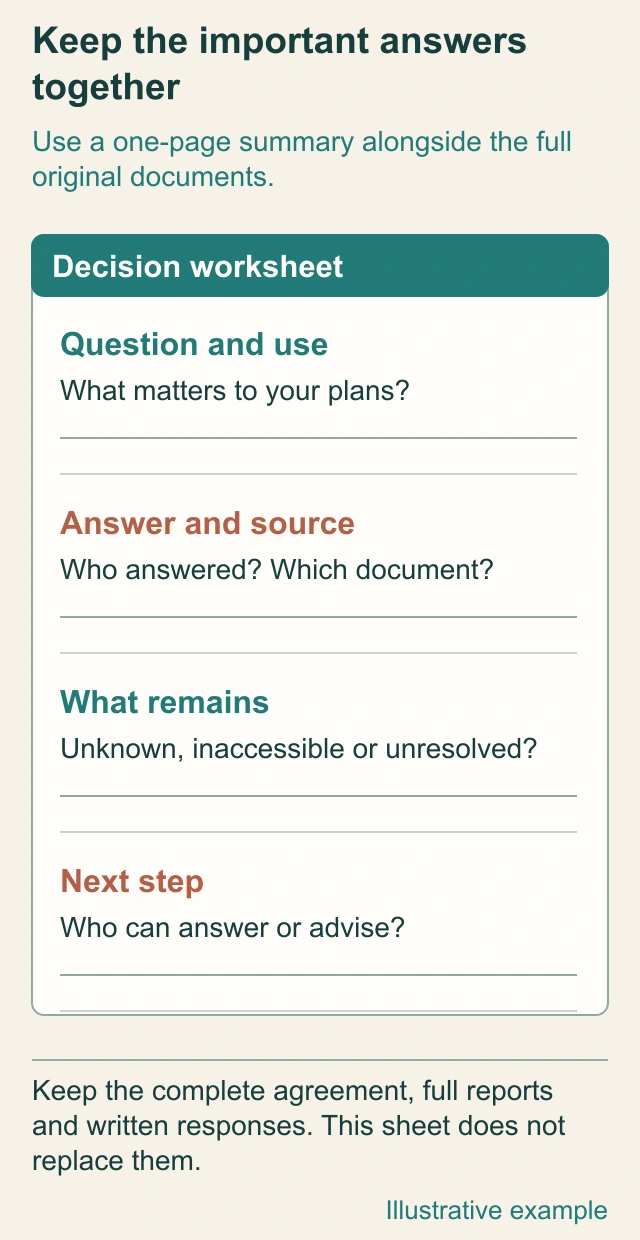
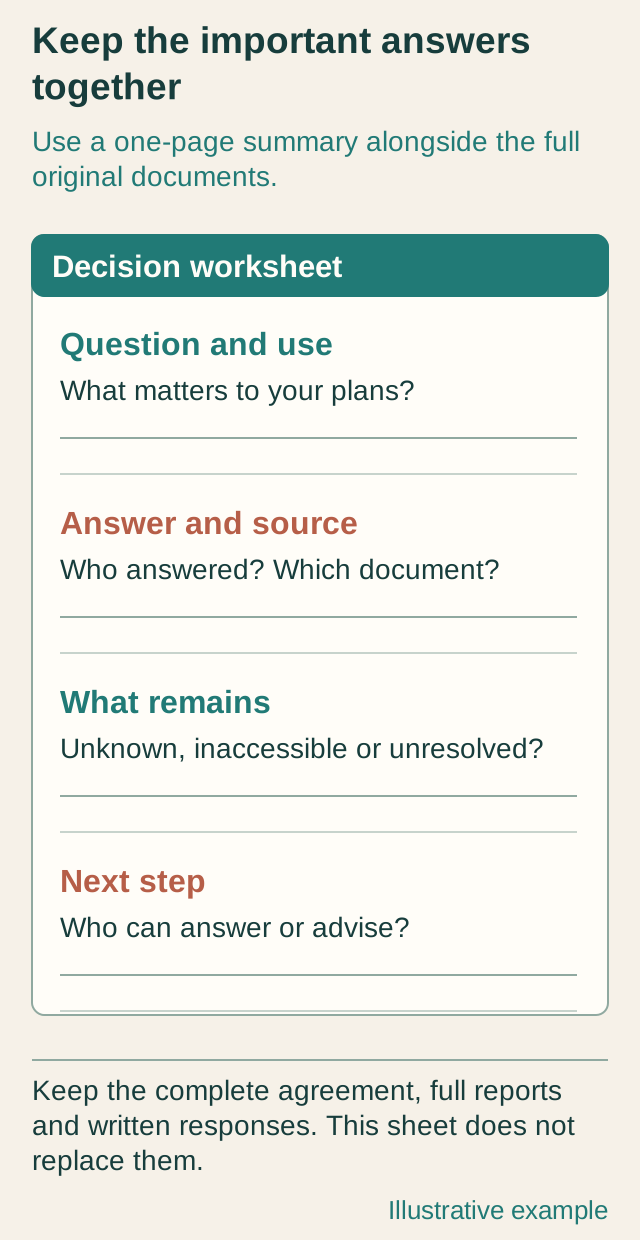
Bring the important threads onto one page. For each question, keep the relevant location or intended use, the answer received, who provided it, and any remaining limitation. Link to the complete document rather than rewriting a qualified finding as a confident conclusion. Mark a requested report as outstanding until you actually receive and review it.
Put the important answers on one page
Keep the property question, financing and cover, and agreement advice visible together. Link each answer to its complete original, retain the limitation and identify the next person or decision when something remains open.
Explore the labelled parts
- Question and use
Name the important property issue or intended use clearly.
- Answer and source
Record an answer actually received, its author and the complete supporting document.
- What remains
Keep scope limits, unavailable information and outstanding requirements visible.
- Next step
Ask the relevant provider or advisor about the remaining question before taking the contractual step.
Separate three kinds of readiness. You may understand the property question, have the financing and insurance conversations you need, and have received advice about the agreement. Progress on one does not complete the others. Ask the appropriate advisor to explain any outstanding approval, requirement or decision before the next contractual step.
When an important answer is still missing, describe the uncertainty specifically. “The garage was not accessible” is more useful than “inspection incomplete”; “the drawing supplied does not show this addition” is more useful than “no paperwork.” Then ask your advisors what options the actual agreement permits. Do not fill the gap with an assumption because the deadline is close.
The decision remains yours. A careful preparation page makes the trade-offs visible: the use you want, the work you understand, the funds you can support and the questions you would still carry. Use it for a clear discussion before committing, rather than as an automatic score that labels a home safe, defective or a good deal.
Put the important answers on one page
Keep the property question, financing and cover, and agreement advice visible together. Link each answer to its complete original, retain the limitation and identify the next person or decision when something remains open.
- Question and use
- Name the important property issue or intended use clearly.
- Answer and source
- Record an answer actually received, its author and the complete supporting document.
- What remains
- Keep scope limits, unavailable information and outstanding requirements visible.
- Next step
- Ask the relevant provider or advisor about the remaining question before taking the contractual step.
Read all the diagram text
- Keep the important answers
- together
- Use a one-page summary alongside the full
- original documents.
- Decision worksheet
- Question and use
- What matters to your plans?
- Answer and source
- Who answered? Which document?
- What remains
- Unknown, inaccessible or unresolved?
- Next step
- Who can answer or advise?
- Keep the complete agreement, full reports
- and written responses. This sheet does not
- replace them.
- Illustrative example
Sources for this chapter
What should you keep after the decision?
Keep the full inspection and specialist reports, supplied records, agreed documents and important communications together. Retain the dates, property or equipment identifiers and the plans on which the advice was based. A short summary is useful when it points back to those originals and preserves the qualifications that affect later decisions.
If you proceed, distinguish work needed for your immediate plans from routine future care. Take confirmed equipment information and unresolved observations into your ownership checklist. Do not relabel an uninspected area as checked simply because possession has occurred. Arrange any further assessment through the appropriate provider with suitable access.
If the property is not the right fit, keep the questions that improved your search. They can help you recognize what matters at the next showing without assuming that the next house has the same problem. The aim is to arrive at your next offer with a clearer understanding of the home, your financing and the agreement you are being asked to sign.
Sources for this chapter
Keep learning about the connected parts
- Read an inspection report without turning it into a guarantee
- Inspecting a luxury or complex home: follow every connected system
- Appraisal, inspection and specialist assessment answer different questions
- Renovation records: what was proposed, approved and built?
- Understanding mortgage structure: payments, balance and flexibility
- Inherited equipment agreements: identify what transfers
- Renew, switch, refinance or break: compare the actual mortgage change
- Title, survey and physical property: reconcile the actual site
- Selling one home and buying the next: money, dates and dependencies
- Comparable sales alongside property condition: ask what the difference means
- Parkades and podium waterproofing: trace the assembly before judging the repair
- Private roads and shared services: connect access, upkeep and the actual agreement
- Buying a designated heritage home: connect protected value with a workable home
- Will this home suit our access needs? Follow the household's everyday routes
Canadian context and authorities · Visual atlas · Learning labs

Several climate questions. Different evidence.
An open timber frame above a visible foundation and soil section. Illustrative rain, roof runoff, a gutter and an above-ground downspout discharge. Roof solar panels, exterior window shading and a closed indoor air-cleaner cabinet.
The evidence the illustration cannot supply
Actual ground slope, drainage connections, foundation moisture and flood performance. Solar output, overheating performance and suitable shading for a particular climate. Filter compatibility, achieved clean-air delivery and an appropriate site-specific design. This is a separate conceptual teaching house, not another view of a surveyed property.
Know the parts.
Know what the words mean.
- Decision dependency
- An answer you need before another plan can be assessed, such as resolving a material question before defining removal work.
- Access limitation
- An area or assessment method that was unavailable or excluded during a particular visit.
- Offer expiry
- The stated point after which an offer is no longer open for acceptance under its actual terms.
- Condition deadline
- The date or time attached to an agreed condition; ask how the actual contract handles the required action and notice.
- Preapproval
- A lender’s preliminary financing assessment; terminology and criteria vary, and it is not a guarantee of final mortgage approval.
- Included items
- Things the purchase agreement says are part of the sale, which should be identified clearly rather than assumed from a showing.
- Registered interest
- An interest recorded on a land title; its meaning for a purchase or intended use needs the relevant document and legal advice.
- Property-specific scope
- A description of the location, question, access, work and exclusions that a particular service or proposal covers.
- Insurance deductible
- The amount of a covered claim that the policyholder agrees to bear before the insurer pays the rest.
- Unresolved question
- An important question for which the available information still does not supply the answer needed for the decision.
Questions to bring
to the conversation.
- Which use or concern could change our decision about this home?
- Has the lender reviewed this particular purchase, and what remains outstanding?
- Which record or assessment answers each important question, with what limits?
- Can authorized access and written answers fit the actual agreed dates?
- What does the agreement require before a condition is satisfied, waived or removed?
- What uncertainty and work would we still carry if we proceed?
Separate a showing observation, an existing record and a new professional assessment. Unknown means a question remains; it does not automatically mean a defect.
Use the evidence planner ↗Go to the source.
Original HomeAI explanation informed by these public references. Sources support the underlying guidance; they have not reviewed or endorsed HomeAI. Diagrams are conceptual, and calculator outputs depend on your inputs.
Canadian offer-preparation education with specifically identified Alberta, Calgary, Ontario and British Columbia examples. Local requirements, provider scope and the actual signed agreement need their own professional advice.
Publication & source review
First published .
Sources reviewed .
- CMHC · Homebuying Step by Step
- Government of Alberta · Hiring a home inspector
- City of Calgary · Certificate of Compliance and its limits
- City of Calgary · Property research and permit records
- Environment and Climate Change Canada · Canadian Climate Normals
- Health Canada · Test your well water
- CMHC · Making an Offer to Purchase a Home
- Financial Consumer Agency of Canada · Getting preapproved for a mortgage - Canada.ca
- Financial Consumer Agency of Canada · Home insurance - Canada.ca
- Real Estate Council of Ontario · Buyer's checklist
- Real Estate Council of Ontario · Competing offers
- BC Financial Services Authority · Offers to Sellers
- Government of Alberta · Find land titles, documents or plans
Have a question about your home?
Start with the symptom, timing and what you have observed.
Ask HomeAI