- Delivered drinking water needs protection through source, transport, transfer, storage and household delivery.
- A tank label, source report and tap sample answer different questions; keep their scope, date and units.
- Use the current local cistern plan and actual service providers rather than blending Canadian regional calendars.
- Keep covers secured; tank entry, chemical work, electrical changes and restart decisions require the appropriate qualified scope.
Why does a cistern need its own care plan?
A delivered-water acreage can have a perfectly ordinary kitchen and bathroom while depending on a less familiar supply chain outside. The water is collected elsewhere, transported, put into a tank at the property and delivered onward to the taps. Understanding that chain helps you arrange reliable service, recognize a missing safeguard and give the right person a useful question.
A cistern is a water-storage container. It does not create a source of water or establish that its contents are fit to drink. This guide is about a household drinking-water cistern supplied by a water hauler, including a property that uses hauled water alongside another documented supply. A rainwater tank, irrigation pond, pressure tank and septic tank have different jobs.
Begin with the arrangement that is actually installed. Some owners have an accessible external fill connection and underground tank; others have a different storage location or pumping arrangement. The conceptual pictures show one understandable example, not every Canadian installation. Match the real components before applying a maintenance plan.
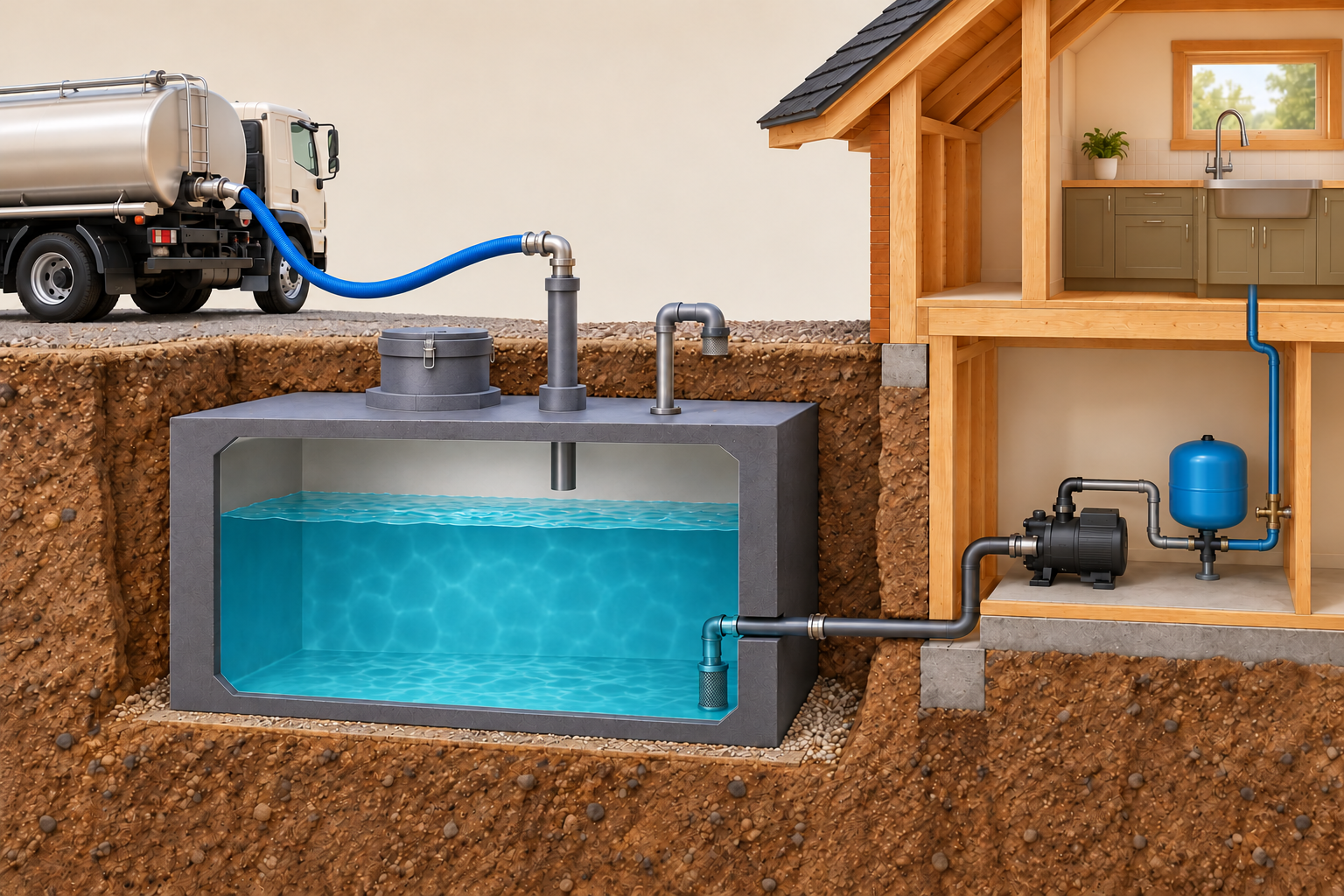
Separate delivery, storage and household pressure roles
The delivery hose fills the cistern through its own connection. A separate withdrawal line carries stored water to the pump and the smaller pressure-tank branch. The blue household line then disappears into a closed kitchen cabinet; the final faucet and drainage connections are concealed.
Conceptual component relationships only. No complete fixture or drain layout, water-quality result, installed pressure/flow, usable reserve, approved fitting, backflow protection, air-gap dimension, tank siting or burial-depth requirement is established. The pictured water level is not a verified high-water limit.
Read the picture labels and part explanations
- The narrow fill tube is separate from the closed broad service hatch and screened vent. Its plain lower end is drawn above the current illustrative water surface. A submerged screened pickup is on the separate withdrawal route to the pump. The small pressure tank branches from the onward route; the kitchen cabinet conceals the fixture plumbing. No grey U/trap assembly is shown.
- Truck and delivery hose
- Carry delivered water to the property fill connection. The picture supplies no source, hauler or water-quality approval.
- Dedicated fill connection
- Transfers incoming water into storage separately from the broad service hatch. The depicted termination does not establish a compliant air gap or backflow arrangement.
- Closed service hatch
- Provides access for authorized service. Keep real access secured; the virtual cutaway is not permission to open or enter a tank.
- Downturned screened vent
- Allows tank air exchange in this conceptual arrangement. Its dimensions and exclusion performance are not verified.
- Cistern storage
- Holds bulk water between deliveries. Tank appearance and drawn water level do not establish quality, usable reserve or delivery frequency.
- Withdrawal line and pump
- Move stored water from the separate pickup toward household delivery. Actual equipment and its instructions determine operation and service.
- Pressure-tank branch and onward household line
- The smaller tank supports the pressure-delivery cycle on a branch. The continuing blue line enters a closed kitchen cabinet; its final connection to the separately pictured faucet and any drain plumbing are concealed.
Conceptual, unscaled view. These four views are not one verified identical installation; no measured property, approved fitting or operating state is established.
Which actual drawings and service records identify the fill, access, vent, storage, pump and household supply connections?
Sources for this lesson: Manitoba Conservation and Water Stewardship — Water Storage Tanks (Cisterns), Government of Alberta: Pressure Tanks (Agdex 716(C31), revised April 2005)
What happens between the original water source and the truck?
Ask the supplier to identify where the delivered drinking water comes from. A company name on an invoice identifies the seller; a source name identifies the water supply. Keep both. If the supplier uses more than one source, ask how the source for a particular delivery is recorded and how any relevant advisory would be communicated to you.
Manitoba’s June 2026 Bulk Water Hauling Guidelines describe an approved source, a permitted hauling vehicle, sanitary equipment and an activity log. Hamilton separately describes its own public-health inspections of drinking-water vehicles. These are useful regional examples of the questions to resolve with your local authority and supplier; neither is a nationwide licence for every Canadian truck.
The useful conversation is specific: which authority covers this service, which vehicle will deliver, what source will it use, and what records can the supplier provide? A copied permit with no current vehicle or operator connection can leave the actual delivery unanswered. No individual hauler or source is approved by this article.
Keep a supplier change or source advisory with the delivery history it may affect. Ask the supplier and responsible public-health contact which source, vehicle or delivery period the notice concerns and what advice applies to the household. A notice about one part of the chain should not quietly become an all-clear or a finding about every later delivery.
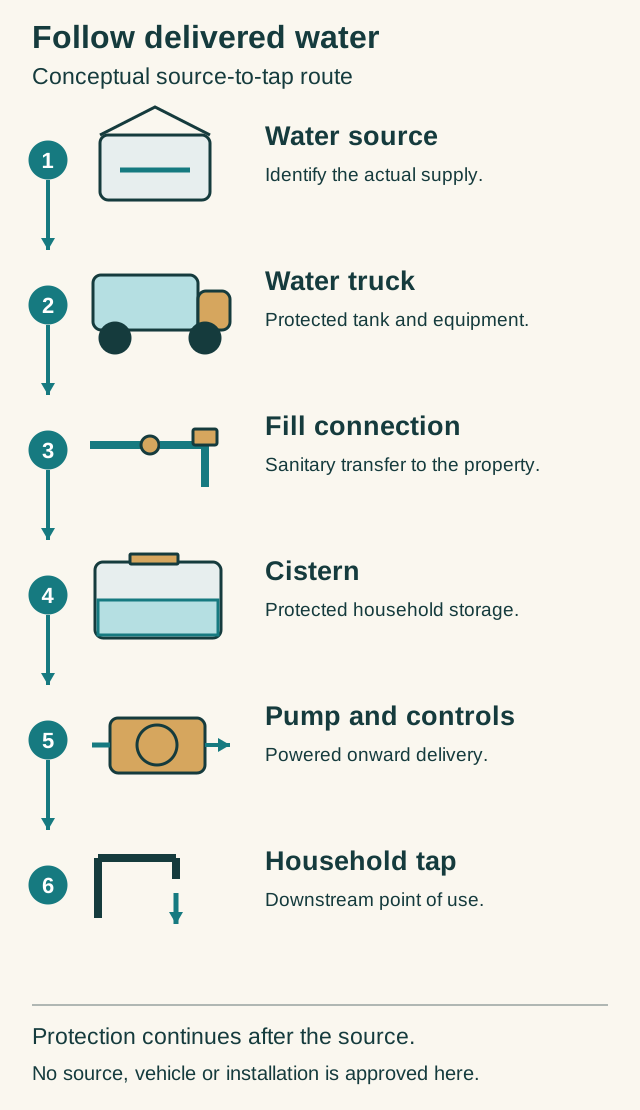
Follow delivered water
Delivered water passes through several systems before a household tap. Identify the source and protect the transfer, storage and onward-delivery links.
A conceptual route, not a piping layout, sanitary certification or operating procedure.
Read the picture labels and part explanations
- Follow delivered water
- Conceptual source-to-tap route
- 1
- Water source
- Identify the actual supply.
- 2
- Water truck
- Protected tank and equipment.
- 3
- Fill connection
- Sanitary transfer to the property.
- 4
- Cistern
- Protected household storage.
- 5
- Pump and controls
- Powered onward delivery.
- 6
- Household tap
- Downstream point of use.
- Protection continues after the source.
- No source, vehicle or installation is approved here.
- 1. Water source
- Identify the actual supply.
- 2. Water truck
- Protected tank and equipment.
- 3. Fill connection
- Sanitary transfer to the property.
- 4. Cistern
- Protected household storage.
- 5. Pump and controls
- Powered onward delivery.
- 6. Household tap
- Downstream point of use.
Conceptual information task; no property measurements or approved arrangement.
Which provider and record identify each link in the actual supply?
Sources for this lesson: Manitoba Health — Bulk Water Hauling Guidelines, City of Hamilton — Drinking Water Haulers, Manitoba Conservation and Water Stewardship — Water Storage Tanks (Cisterns)
Why are the hose and fill connection part of the water system?
The transfer step connects the transport container to the property. The truck tank can be clean while a poorly protected hose end introduces a new problem. The property fill connection also needs protection. Treat this as a sanitary handover between two systems rather than assuming that a good source settles every later step.
Hamilton’s hauler guidance expressly includes tanks, equipment and connections during filling, transport and delivery. Ask the supplier how its hose and nozzle are protected between jobs, and what it does if a connection becomes contaminated. You do not need to handle the supplier’s equipment or improvise a cleaning method to ask that question.
Keep a simple delivery note: date, supplier, source if supplied, amount with its unit, and any reported interruption or unusual event. Record what the supplier said separately from what you personally saw. A delivery receipt supports the delivery history; it is not a laboratory result for the kitchen tap.
The dedicated fill connection and broad service hatch should remain different, recognizable parts in the property record. Ask how the fill is protected between deliveries and how the supplier handles a reported problem at the transfer point. A closed cap is a useful part to recognize; looking at it cannot establish that the delivered water or the entire installation is sanitary.
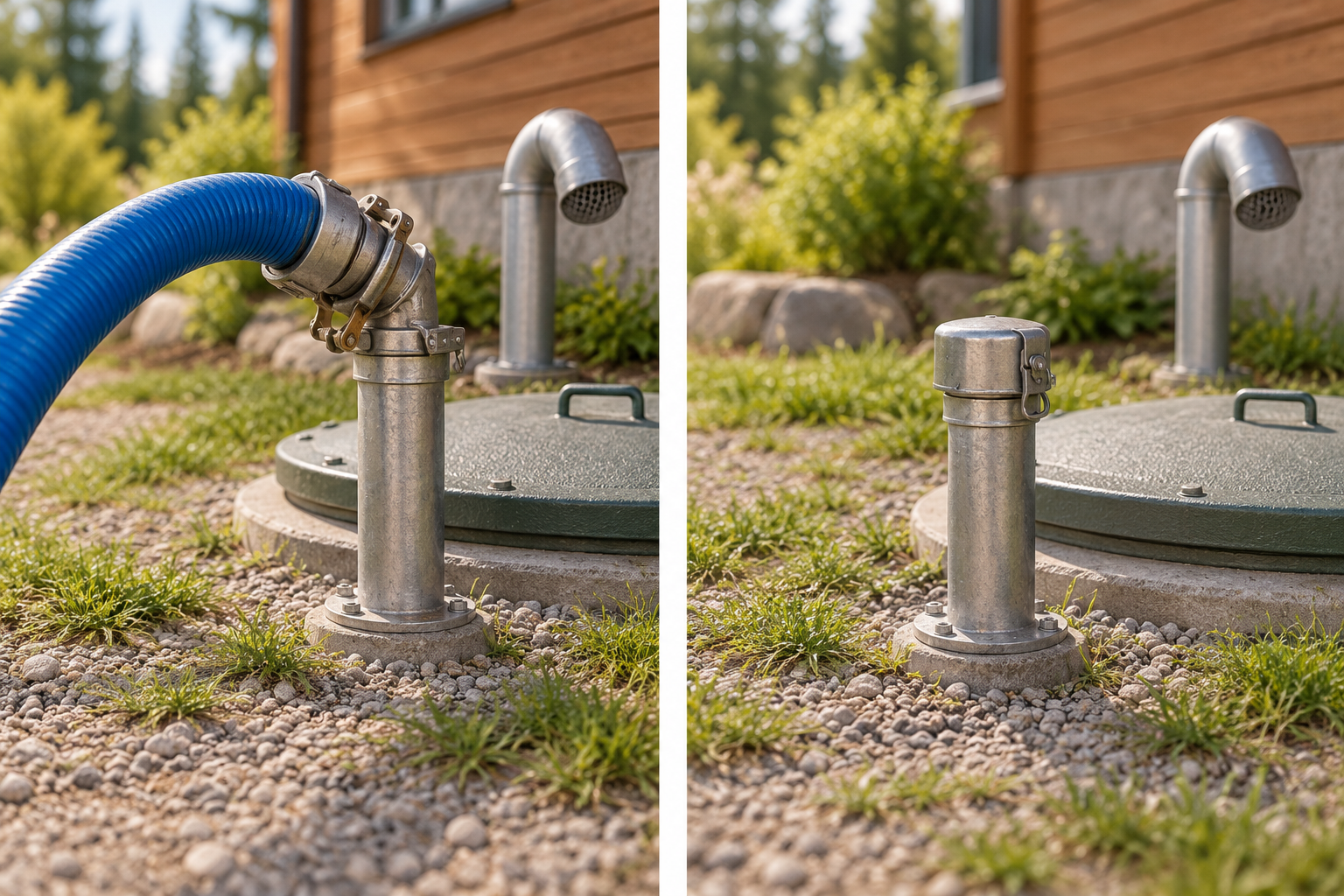
The hose and fill point have a different job from service access
The hose and dedicated fill point form the delivery transfer point; the broad closed cover is for service access. These conceptual views show a connected hose and a capped point, without approving their fittings, sanitation or backflow protection.
Two conceptual states, not a verified operating sequence or certified fitting. No high-water level, internal route, air-gap dimension, backflow protection, source/hauler approval or sanitary result is established.
Read the picture labels and part explanations
- No text labels are baked into this picture; the visible part explanations follow.
- Delivery hose and coupled end
- Illustrates transfer equipment at the property connection. Appearance does not establish an approved water source, hauler, potable rating or sanitary condition.
- Dedicated fill point
- Illustrates the transfer point into storage, separate from broad service access. Its hidden termination and backflow arrangement are not shown.
- Protective cap in the second view
- Illustrates the between-deliveries closure state. The image does not verify the cap fit, seal, handling or maintenance.
- Broad closed service cover
- Illustrates a separate service-access job. Its security and seal are not verified; no opening or entry task is shown.
- Separate downturned screened vent
- Illustrates air exchange at a different opening. Screen performance and dimensions are not established.
Conceptual, unscaled view. These four views are not one verified identical installation; no measured property, approved fitting or operating state is established.
How does the actual supplier protect the hose end and this connection between and during deliveries?
Sources for this lesson: Manitoba Health — Bulk Water Hauling Guidelines, City of Hamilton — Drinking Water Haulers, Manitoba Conservation and Water Stewardship — Water Storage Tanks (Cisterns), Alberta Health Services / MyHealth Alberta — How to clean and disinfect a cistern
What do the lid, vent, inlet and outlet do?
The tank body holds the water. The fill inlet receives incoming water; the withdrawal connection takes water toward the household supply. An air vent allows the tank to exchange air as its water level changes. An access hatch allows authorized service. These openings have different jobs, so one intact-looking lid does not establish that every opening is protected.
Manitoba’s cistern fact sheet illustrates a secured access hatch, protected fill port, screened vent and withdrawal arrangement. Its printed edition is March 2014 and it cites an older CSA edition. Here it supports component recognition only. Its dimensions, installation details, standard-edition references and placement statements are not presented as current Canadian construction requirements.
Ask the installer for a labelled component drawing that matches your tank. It should make the normal fill connection and the service access unmistakable. Leave covers secured. Do not open the tank, reach through a port, lean over an opening or climb onto an unfamiliar tank to inspect its contents.
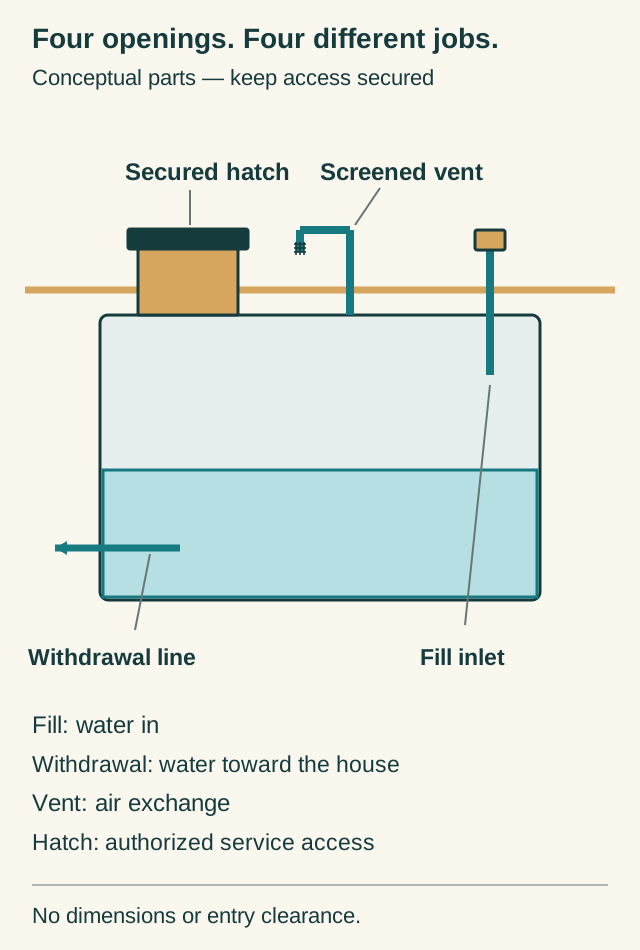
Four openings. Four different jobs.
A fill inlet, withdrawal line, air vent and secured service hatch do different work. Keep their identities clear in the actual component drawing.
Historical Manitoba mechanism reference only; no installation dimensions, current product approval, construction detail or owner entry.
Read the picture labels and part explanations
- Four openings. Four different jobs.
- Conceptual parts — keep access secured
- Secured hatch
- Screened vent
- Fill inlet
- Withdrawal line
- Fill: water in
- Withdrawal: water toward the house
- Vent: air exchange
- Hatch: authorized service access
- No dimensions or entry clearance.
- Fill inlet
- Receives water.
- Withdrawal line
- Carries water toward the household.
- Screened vent
- Allows air exchange.
- Secured hatch
- Provides authorized service access; leave secured.
Conceptual information task; no property measurements or approved arrangement.
Which drawing identifies the openings on the actual tank?
Sources for this lesson: Manitoba Conservation and Water Stewardship — Water Storage Tanks (Cisterns), CCOHS — Confined Space: Introduction
How does stored water reach an upstairs tap?
In a pumped arrangement, an electrically powered pump moves water from bulk storage into the household distribution system. Where a pressure tank is used, water entering it compresses an air cushion. That compressed air can push some water back into the system while the pump is not running. The water available between pump cycles is different from the cistern’s bulk stored volume.
A sealed diaphragm tank keeps the air and water apart; older air-water-contact tanks use a different arrangement. Alberta’s revised April 2005 Pressure Tanks publication explains those component roles. It is historical farm-water education, not a current sizing, pressure-setting or maintenance instruction. Ask the provider which actual tank and control arrangement serves this home.
That is why a label saying large water tank needs an identity. It may describe bulk storage, a pressure tank or another component. A pressure-tank label establishes neither guaranteed outage supply nor the amount a pump can still deliver. Read the rural-water quantity and delivery guide for replenishment, usable storage and pressure-tank drawdown.
Ask the provider which operating observations the owner should report and which alarms or displays are intended for normal owner use. Keep the equipment identity and matching instructions with that answer. Leave pump settings, pressure adjustments, electrical work and unfamiliar valves to the appropriate provider. A photograph of closed equipment identifies what was photographed, not its tested performance.
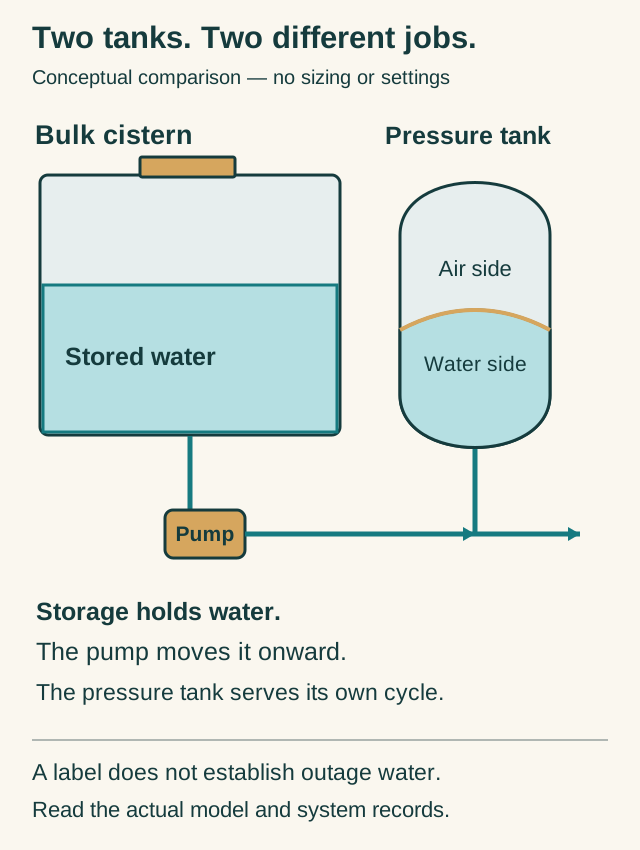
Two tanks. Two different jobs.
A bulk cistern stores water. The pump moves it toward the house, while a separate pressure tank serves the delivery control cycle.
No model, pressure setting, capacity, drawdown or outage quantity is specified.
Read the picture labels and part explanations
- Two tanks. Two different jobs.
- Conceptual comparison — no sizing or settings
- Bulk cistern
- Stored water
- Pressure tank
- Air side
- Water side
- Pump
- Storage holds water.
- The pump moves it onward.
- The pressure tank serves its own cycle.
- A label does not establish outage water.
- Read the actual model and system records.
- Bulk cistern
- Holds the separately supplied water.
- Pump
- Moves water onward in this conceptual arrangement.
- Pressure tank
- Contains air and water within its defined pressure-cycle arrangement.
Conceptual information task; no property measurements or approved arrangement.
Which tank and model manual describe each actual job?
Sources for this lesson: Manitoba Conservation and Water Stewardship — Water Storage Tanks (Cisterns)
Connected explanation: Rural water: understand replenishment, delivery and usable storage
What should the level display tell me?
A level display can help you plan a delivery, provided you understand what it reports. Ask whether the display shows a measured level, an estimated volume, a percentage or a warning threshold. Keep its unit and stated limitations with the reading. The appearance of a full bar is less useful than knowing what the installer means by that bar.
Create the reorder plan with the supplier and system provider. It should connect normal use, usable storage, the delivery lead time and the response to an alarm. Keep the contact and the agreed instruction beside the display. A sensor is a reporting component; it does not reserve a truck, confirm water quality or establish that the pump can deliver the remaining water.
The plan should say what to do when a reading is implausible or unavailable. Do not open the cistern and dip a stick into it to check an electronic number. Report the conflicting readings and let the provider specify the appropriate assessment.
Keep the reading and the instruction as two records. The reading needs its reported unit, date, basis and limitation. The instruction needs the person who confirmed it, the actual contact method and the event that should prompt a booking request. Leave that instruction blank until it has been agreed; copying a neighbour’s percentage or booking interval supplies no assessment of this tank.
Also separate request sent, booking confirmed and water delivered. The first records your communication; the second records the supplier’s response; the third is an actual delivery with its own time, amount and source information. A sensor cannot move the record from one state to another. If a reading and a delivery receipt conflict, send both to the provider without choosing a new tank capacity or reserve estimate yourself.
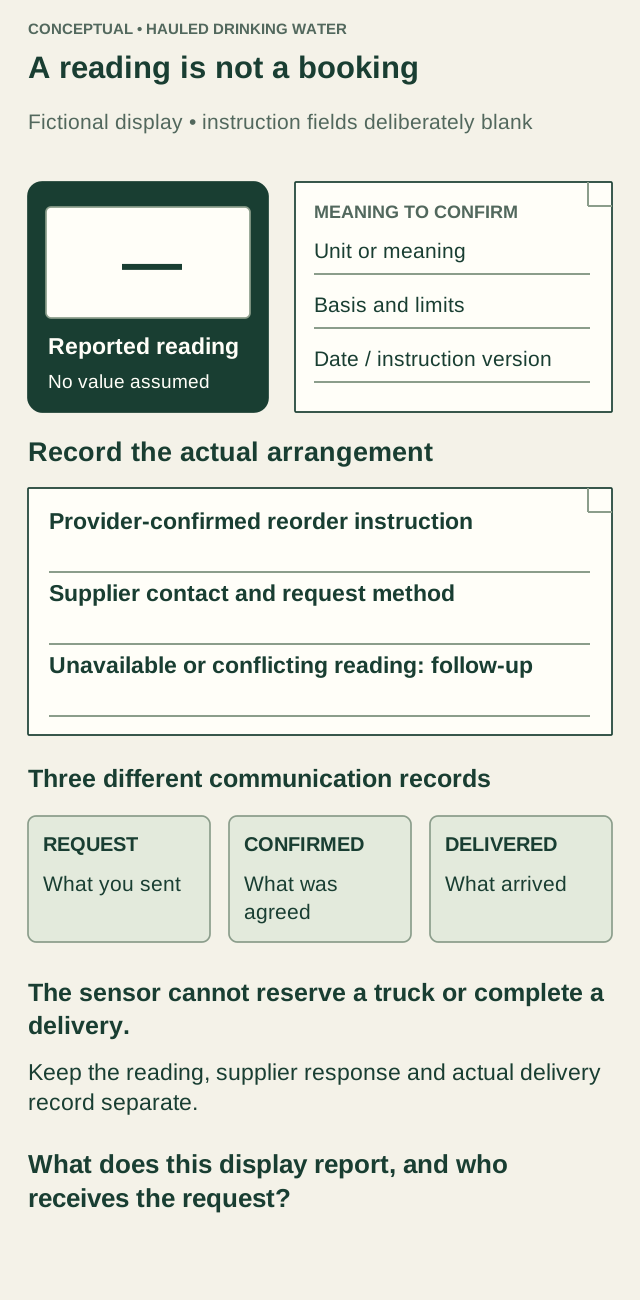
Connect the display meaning to the agreed booking instruction
The display reports a reading. The booking record connects its stated meaning to the supplier’s actual agreed arrangement.
Fictional display and unfilled instruction. No calibration, alarm setting, percentage, tank size, safe reserve, delivery lead time or hauler availability is established.
Read the picture labels and part explanations
- CONCEPTUAL • HAULED DRINKING WATER
- A reading is not a booking
- Fictional display • instruction fields deliberately blank
- —
- Reported reading
- No value assumed
- MEANING TO CONFIRM
- Unit or meaning
- Basis and limits
- Date / instruction version
- Record the actual arrangement
- Provider-confirmed reorder instruction
- Supplier contact and request method
- Unavailable or conflicting reading: follow-up
- Three different communication records
- REQUEST
- What you sent
- CONFIRMED
- What was agreed
- DELIVERED
- What arrived
- The sensor cannot reserve a truck or complete a delivery.
- Keep the reading, supplier response and actual delivery record separate.
- What does this display report, and who receives the request?
- Display
- A reporting component needs an identity, unit or meaning and stated limitations. Its appearance supplies no tank capacity or water-quality finding.
- Meaning, basis and date
- Keep the reported value with its basis, date and matching instruction version. Do not replace a missing explanation with a guessed percentage or volume.
- Provider-confirmed instruction
- The reusable HTML record leaves the instruction blank until the actual provider has confirmed it for this installation.
- Supplier contact
- Record the actual request route and the response. A stored contact name is not confirmation that a truck is booked or an alternative supplier is available.
- Request, confirmed and delivered
- These identify communication and delivery records, not three states that a level sensor can establish. Enter the actual message or delivery with its date and scope.
- Conflicting or unavailable reading
- Give the provider the conflicting information or the missing reading. Do not open the cistern, dip a stick into it or invent a remaining-days estimate.
A level or warning device and a delivery arrangement serve different jobs. The historical Manitoba cistern sheet discusses level warning as a component; it does not establish what a particular display reports or an actual booking instruction.
Use the blank worksheet to preserve the real unit, basis, provider instruction and supplier response. A record is useful precisely because it keeps unconfirmed information visibly unresolved.
Conceptual information task. No numerical display or threshold is filled. The Manitoba component source is March 2014 historical guidance; no sizing, dosing, alarm setting or delivery interval is established. Use the complete text labels and blank worksheet beside the picture.
What does this actual display report, and who receives the delivery request?
Sources for this lesson: Manitoba Conservation and Water Stewardship — Water Storage Tanks (Cisterns), Alberta Health Services / MyHealth Alberta — How to clean and disinfect a cistern
How can I plan for deliveries without pretending to size a tank?
Use the history of this home rather than a generic household average. Put delivered litres beside the delivery dates and the occupancy or unusual uses for that period. If there is a meter, retain its unit and reading dates. Explain gaps or estimates instead of making the table appear more precise than the evidence.
For illustration only, suppose a supplier’s record says 4,000 litres were delivered and the next delivery occurred 10 days later. Dividing gives 400 litres per day of delivered water over that interval. That is arithmetic on the invented delivery record. It is not measured household demand unless changes in stored volume, other sources and losses have also been reconciled.
A second useful question is whether your intended use differs from the history. More occupants, a new dwelling, animal watering or another proposed activity should be described before relying on the earlier pattern. The supplier and relevant technical advisers can then say which further information is needed. This page specifies no tank size, per-person allowance or Canadian minimum supply.
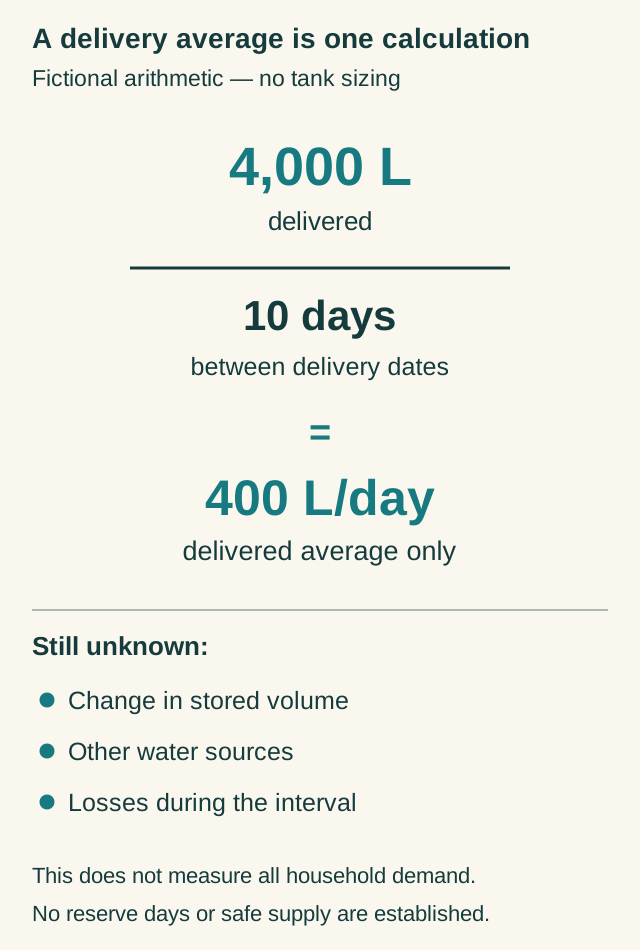
A delivery average is one calculation
The fictional delivered-water average is 4,000 L / 10 days = 400 L/day. It is not a complete measurement of household demand.
No source date for invented inputs; arithmetic verified October26,2026. No tank size, emergency allowance, reserve days or safety prediction.
Read the picture labels and part explanations
- A delivery average is one calculation
- Fictional arithmetic — no tank sizing
- 4,000 L
- delivered
- 10 days
- between delivery dates
- =
- 400 L/day
- delivered average only
- Still unknown:
- Change in stored volume
- Other water sources
- Losses during the interval
- This does not measure all household demand.
- No reserve days or safe supply are established.
- Delivered amount
- 4,000 L is an invented teaching input.
- Delivery interval
- 10 days is an invented teaching input.
- Delivered average
- 400 L/day is the fictional quotient; stored-volume change, other sources and losses remain unknown.
4,000 L and 10 days are invented teaching inputs.
Start/end stored volume, other supplies and losses are unknown.
4,000 L ÷ 10 days = 400 L/day delivered
L = litres
L/day = litres per day
Explicitly fictional arithmetic: 4,000 L delivered / 10 days = 400 L/day delivered. No measured demand, sizing, reserve or safety prediction.
Which actual records would be needed before interpreting use?
Connected explanation: Rural water: understand replenishment, delivery and usable storage
Why does a bigger reserve not solve every water problem?
Storage is only one part of the arrangement. A fuller tank does not confirm a later delivery, safe water at every tap, protected pipes or powered delivery. A reserve plan must state what it is intended to cover and which links still depend on another service. Keep a drinking-water contingency separate from an assumption that the whole house will operate normally.
Nova Scotia’s current water-shortage guidance describes separate storage as one way to supplement a low-yield well. It also warns against pouring other water into a well. A designed storage system and an attempt to refill the ground through a well are different acts. Do not connect a truck hose to a well or add water to it as an improvised remedy.
If the property has both a well and a cistern, request a confirmed map of their relationship. Which source fills which storage, where treatment occurs and how the sources are kept appropriately separated must be established for that installation. Do not invent a changeover procedure from the conceptual picture.
What can a source report and a tap sample each establish?
Keep the location and date attached to every water-quality result. A report for the supplying waterworks describes its stated supply, parameters and period. A sample from the delivery equipment describes the sampled water there. A kitchen-tap sample comes after the property’s storage and plumbing. Those records can inform different questions without becoming interchangeable.
Health Canada’s well-testing guidance distinguishes microbial, chemical and general water-quality tests and directs owners to appropriate laboratories and local authorities. It also explains that appearance, smell and taste do not reveal every contaminant. For a cistern, ask local public health and the laboratory which tests and sampling locations fit the actual supply and concern.
Keep the original laboratory report, sample location, collection date and the laboratory’s instructions. A negative bacterial result is not a complete chemical analysis, a tank-condition inspection or a guarantee about later deliveries. If a finding or incident raises a safety concern, obtain public-health advice and use a confirmed safe alternative for drinking rather than relying on a reassuring appearance.
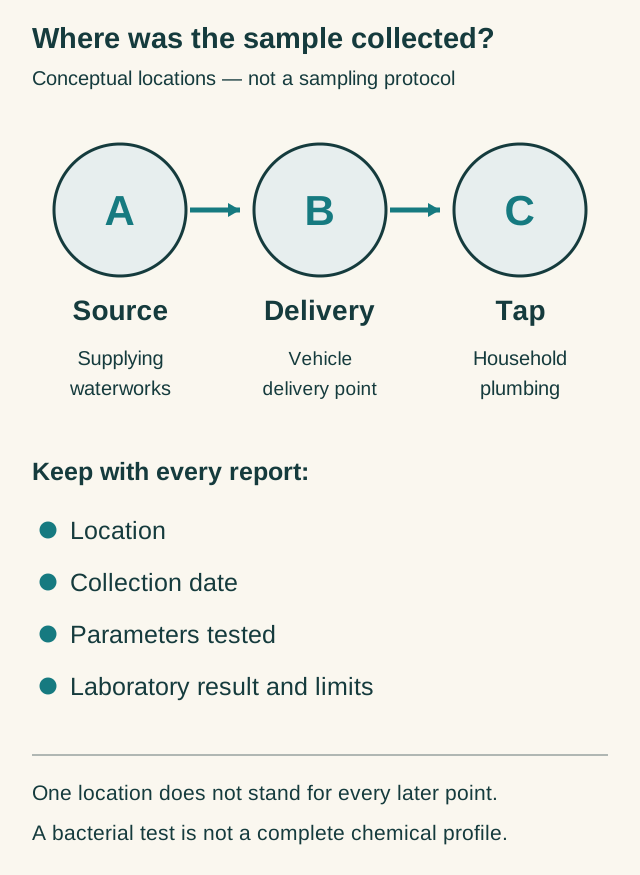
Where was the sample collected?
A sample keeps its location in the supply chain. A supplying-source report, delivery sample and household-tap sample answer different questions.
No actual sample, required site, result, sampling technique or water-safety finding.
Read the picture labels and part explanations
- Where was the sample collected?
- Conceptual locations — not a sampling protocol
- A
- Source
- Supplying
- waterworks
- B
- Delivery
- Vehicle
- delivery point
- C
- Tap
- Household
- plumbing
- Keep with every report:
- Location
- Collection date
- Parameters tested
- Laboratory result and limits
- One location does not stand for every later point.
- A bacterial test is not a complete chemical profile.
- A
- Supplying waterworks.
- B
- Vehicle or delivery point.
- C
- Household tap.
Keep with the report: Location, Collection date, Parameters tested, Laboratory result and limits.
Conceptual information task; no property measurements or approved arrangement.
Which locations and parameters fit the actual question according to the local laboratory and authority?
Sources for this lesson: Health Canada — Well water and health: Test your well water, City of Hamilton — Cistern Maintenance & Water Testing, Manitoba Health — Bulk Water Hauling Guidelines
Why should the sampling schedule be local?
Canadian guidance is not one interchangeable calendar. Alberta Health Services’ cistern page, current May 2, 2025, recommends routine bacterial testing twice a year and additional testing in stated circumstances. Hamilton’s cistern page, modified September 3, 2026, recommends at least four bacterial tests each year. Both should retain their own geography and scope.
Use the current advice for the actual address and system, with any additional event response specified by the responsible authority or provider. Put the agreed schedule, laboratory, sample locations and result follow-up into the home-care record. Do not average two sources or quietly choose the least frequent interval.
A routine reminder is only a reminder. Record whether the sample was actually collected, whether the laboratory accepted it and what follow-up was advised. If the home is seasonally occupied, explain that pattern when the schedule is set; a permanent-residence checklist may omit the question you most need answered.
An event row makes that follow-up usable. Record the reason for the enquiry, the advice received, the sample location and the planned collection. Later add the actual collection date, laboratory acceptance, report and responsible advice. A reminder tick, a collected bottle and a laboratory result are separate events. Keep an uncollected or unaccepted sample visible rather than filling the result cell with an assumption.
Describe the sampling point in relation to any treatment. A result from one stated location should retain that location; it is not automatically a result for every upstream component, outlet or later delivery. Follow the laboratory’s collection and handling instructions and obtain advice about the results. This is a record method, not a sampling technique or a substitute testing schedule.
What can I observe safely from outside?
From normal, safe access, notice whether the closed external cover or fill connection appears damaged, displaced or surrounded by unusual ponding. Record the location and date without claiming to see the buried structure or the quality of its water. Keep children and visitors away from tank access points.
Water-system maintenance may involve confined-space hazards. CCOHS explains that such hazards can include unsafe air, moving equipment, difficult rescue and liquids, and that appearances are not a risk assessment. This guide does not authorize tank entry, opening a hatch, atmosphere testing or rescue by entering. Keep clear and call emergency services if someone is in danger.
A photograph of a damaged external part can help the service provider prepare a visit. It does not require you to remove the part. If the defect could affect drinking-water safety, describe it promptly to the provider and local public-health contact and ask what use restrictions and alternative supply apply.
Make the report specific enough to identify the part: which closed cover, cap or visible connection, when the change was noticed, and what can be seen from ordinary access. Separate an observed displaced part or standing water from a claim that water entered the tank. If reaching the point is uncertain or unsafe, keep away and report that access is unavailable; the record does not require a closer photograph.
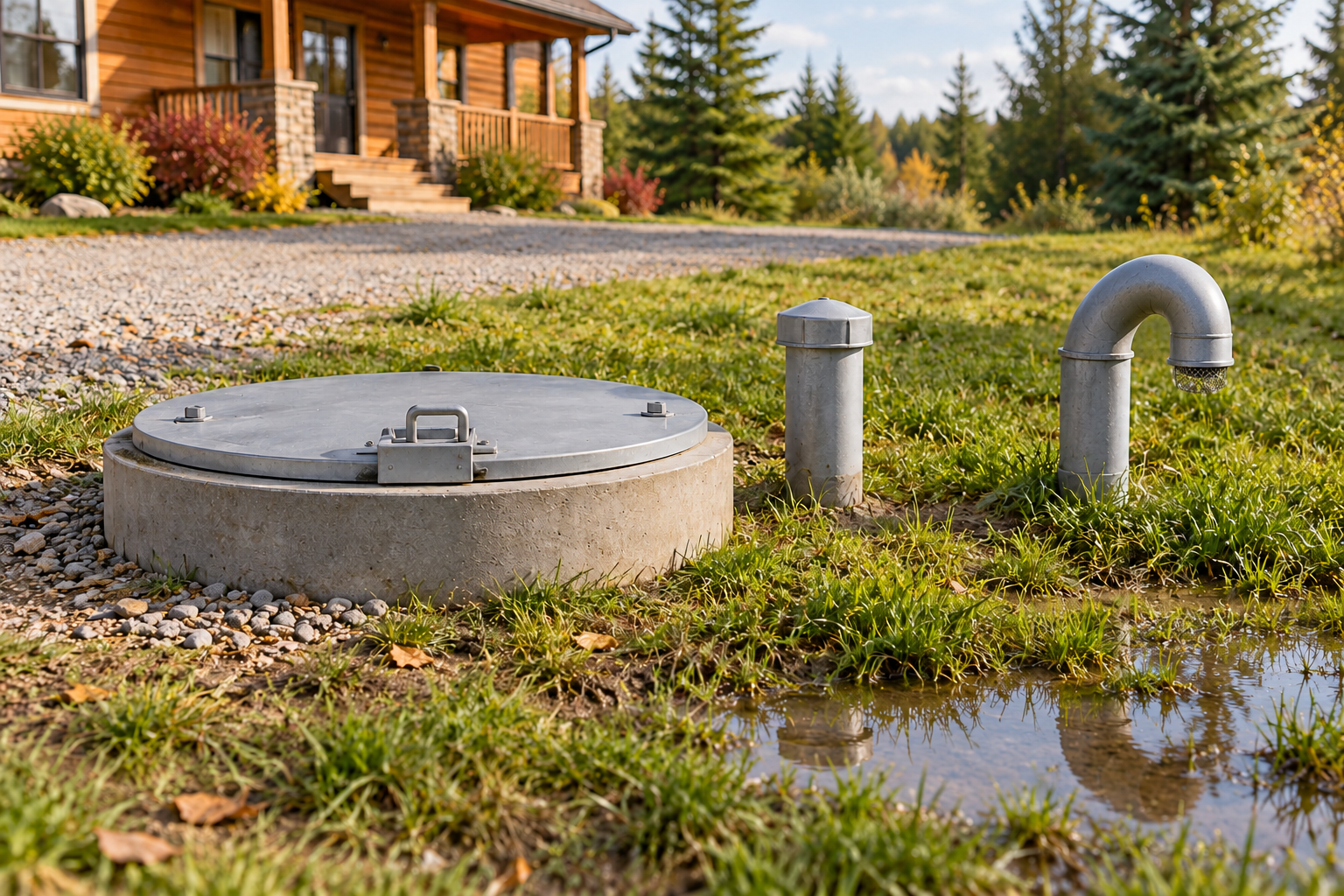
Describe exterior changes while keeping real access closed
The closed cover, capped fill and downturned screened vent have separate access, transfer and air-exchange jobs. Nearby ponding is an exterior observation to report; this view establishes no hidden damage, leak or contamination route.
No property defect, contamination route, underground crack, tank security/seal, compliant vent height, entry clearance or opening/service instruction is established.
Read the picture labels and part explanations
- No text labels are baked into this picture; the visible part explanations follow.
- Closed broad cover
- Identifies service access as an exterior feature. Its closure hardware does not verify a seal, structural condition or safe access.
- Capped fill point
- Identifies a separate transfer landmark. Its hidden route, fitting and cap performance remain unknown.
- Downturned screened outlet
- Shows the intended vent orientation in this conceptual example. Mesh is visible on the downward-facing outlet, but exclusion performance, height and suitability are not assessed.
- Surface ponding and surrounding ground
- Provide a visible location/context to describe to the actual provider. The picture does not show water entering the tank or prove the cause or duration of ponding.
- House and gravel approach
- Provide exterior context only. They do not establish a surveyed position, safe route, setback or cistern location below ground.
Conceptual, unscaled view. These four views are not one verified identical installation; no measured property, approved fitting or operating state is established.
Which external change should the actual provider and local public-health contact assess?
Sources for this lesson: Alberta Health Services / MyHealth Alberta — How to clean and disinfect a cistern, City of Hamilton — Cistern Maintenance & Water Testing, Manitoba Conservation and Water Stewardship — Water Storage Tanks (Cisterns)
How are cleaning, disinfection and repair different?
A cracked component, accumulated sediment and microbial contamination ask related but different questions. Repair addresses an identified defect; cleaning removes unwanted material; disinfection addresses microbes through a defined process. Alberta’s current cistern guidance says the contamination problem must be corrected before the cistern is cleaned and disinfected.
Commission a service scope that identifies the actual tank and what the contractor will assess, clean or repair. Ask how the household’s water will be managed during the work, which other equipment is involved, what record will be supplied and who will advise on return to use. Keep a proposed quotation separate from completed work.
Chemical doses, electrical isolation, tank access, disposal and restart are not owner procedures in this guide. In particular, do not assume that a cleaning mixture can be sent into the septic field. Alberta’s guidance warns that highly chlorinated water is unsuitable for that disposal route. The responsible service team must define the actual work and disposal plan.
Before booking, put the concern and the proposed work in separate fields. A service description may cover only one component or one kind of work. Ask what will be assessed, what is included, what depends on a finding and who will explain any changed scope. An unexecuted quotation should remain a proposal even if it uses the same equipment name as the final service invoice.
The household also needs an arrangement during the work. Ask which water uses will be affected, which confirmed alternative supply is needed, who coordinates delivery and what disposal responsibility the service team will take. Record the actual advice rather than adapting another municipality’s timing or a chemical procedure from the internet.
At completion, keep the actual work record and any remaining restriction or follow-up with the installation identity. Ask who gives return-to-use advice and what information that advice relies on. A completed cleaning task or one bacterial report should keep its stated scope; neither silently resolves an unrelated chemical concern or proves that an identified defect was repaired.
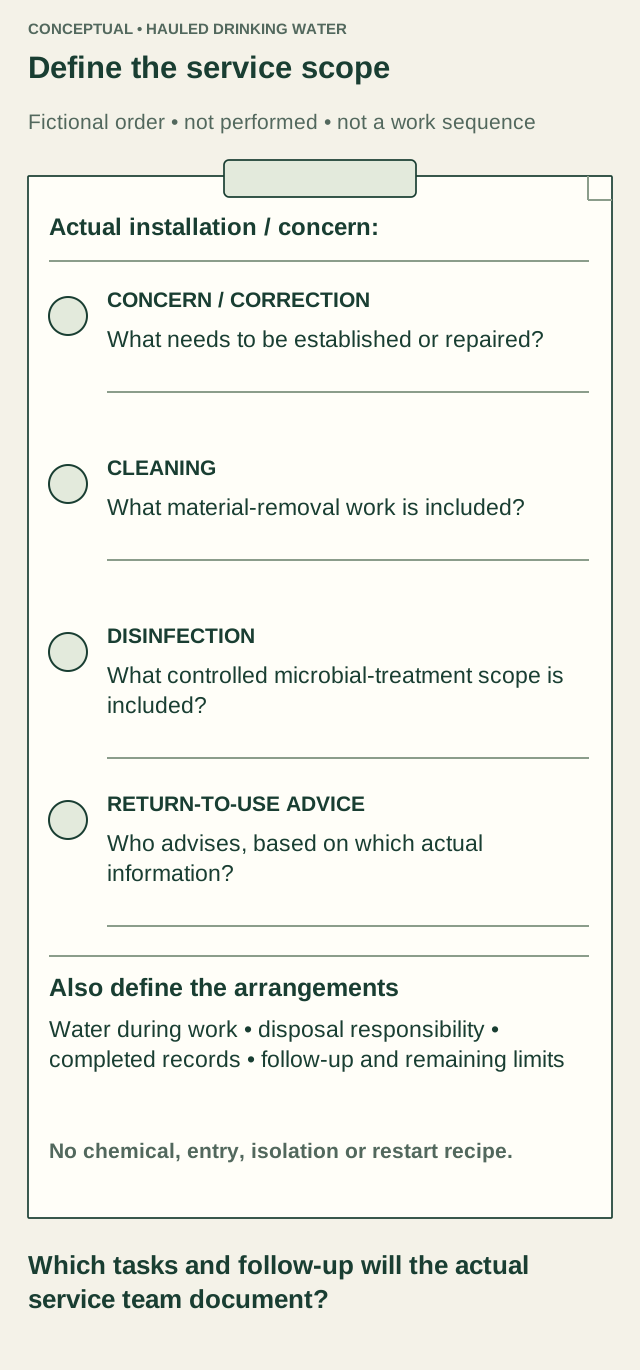
Keep cistern service tasks and return-to-use advice separate
The service scope names repair, cleaning, disinfection and return-to-use advice separately.
No completed work, certification, chemical dose, tank-entry method, electrical isolation, disposal route, restart procedure or all-water-quality assurance is established.
Read the picture labels and part explanations
- CONCEPTUAL • HAULED DRINKING WATER
- Define the service scope
- Fictional order • not performed • not a work sequence
- Actual installation / concern:
- CONCERN / CORRECTION
- What needs to be established or repaired?
- CLEANING
- What material-removal work is included?
- DISINFECTION
- What controlled microbial-treatment scope is included?
- RETURN-TO-USE ADVICE
- Who advises, based on which actual information?
- Also define the arrangements
- Water during work • disposal responsibility • completed records • follow-up and remaining limits
- No chemical, entry, isolation or restart recipe.
- Which tasks and follow-up will the actual service team document?
- Concern and correction
- Identify the actual concern and installation before describing proposed correction. Alberta Health Services says a contamination problem must be corrected before its stated cleaning/disinfection process; that is not a universal work order supplied by this diagram.
- Cleaning scope
- Cleaning is the material-removal task. Record the defined work and exclusions instead of treating the word service as a complete description.
- Disinfection scope
- Disinfection addresses microbes through a defined controlled process. This picture supplies no agent, concentration, contact time or owner procedure.
- Water during work
- Obtain the actual advice on affected uses and confirmed alternative supply. A neighbouring household’s timing does not establish this arrangement.
- Disposal responsibility
- The actual team must define disposal. Alberta guidance warns about highly chlorinated water reaching septic fields; no disposal method is taught here.
- Completed record
- A proposed quotation and an actual work record have different scopes. Retain what was performed, when, and any outstanding information.
- Return-to-use advice
- Record the responsible advice, the information it relies on and any remaining restriction or follow-up. A completed task or one bacterial report is not a whole-chain certificate.
Repair, cleaning and disinfection answer different concerns. A damaged component, accumulated material and a microbial result should remain separate questions in the service discussion, even if one actual visit addresses several.
CCOHS explains why confined-space work requires competent assessment and controls. The homeowner’s task here is to obtain a defined service and household-water arrangement, not to open or enter the tank or carry out a procedure from the diagram.
Fictional, unexecuted service scope with blank response lines. The visual rows are categories, not a universal prescribed order. No doses, times, volumes, approvals, professional availability or work findings appear. Alberta and Hamilton procedures remain jurisdiction-specific and are not reproduced.
Which tasks, temporary supply, disposal responsibility and follow-up will the actual service team document?
Sources for this lesson: Alberta Health Services / MyHealth Alberta — How to clean and disinfect a cistern, City of Hamilton — Cistern Maintenance & Water Testing, CCOHS — Confined Space: Introduction
Does an extra filter make the whole supply safe?
Treatment equipment should have a named purpose. Record its model, the condition or contaminant it is intended to address, the manufacturer’s operating requirements and the service history. Ask how the provider will verify that the selected equipment is suitable for the actual water and use. A new cartridge is a completed component task, not a verdict on the complete supply chain.
The existing filter, UV and softener guides explain their different functions. Use those lessons to read a proposal instead of assuming that all devices do the same work. Any new treatment, bypass or change in the supply arrangement needs a review of its actual installation and local requirements. Do not reconfigure the system to imitate a picture.
If results remain unsatisfactory after work, retain the unresolved finding and request the next defined investigation. Repeatedly buying another device can obscure the original question if nobody has established the source, pathway or target contaminant. No product or treatment train is selected here.
For a proposed device, connect four questions: what finding it is intended to address, where it would act in this supply chain, how its performance will be assessed, and who maintains it. Those questions let a provider explain a defined treatment proposal without treating the word filter as a complete answer. Keep unresolved source or storage concerns in view alongside the device discussion.
What changes when the lane is icy or a storm delays the truck?
The water service also depends on reaching the fill point. Review seasonal access with the hauler before the difficult season: which approach it uses, where it can stop, what it needs cleared and how it communicates a failed delivery. Put those actual requirements in the property’s winter plan; this article supplies no truck turning radius, grade limit or carrying-capacity verdict.
Mark the agreed fill connection on the owner’s orientation plan without encouraging a driver to cross an unverified buried system. Confirm the truck route with the appropriate providers where tank locations, underground services or sewage-treatment areas are relevant. A route that worked once is not evidence that every vehicle or season is acceptable.
Also agree what happens if a delivery is delayed beyond the ordinary booking window. Who contacts the household? Is another supplier actually available, and can it use the installation? Which restrictions or alternate supplies have been arranged? Record a second supplier as confirmed only after that supplier has actually agreed.
Write down the communication stages before the first weather disruption. A request is not the same as a confirmed booking, and a confirmed booking is not a completed delivery. If the supplier reports a delay, retain its actual message and ask how the existing contingency applies. Do not turn a usual delivery interval into a promised arrival or a guaranteed number of days remaining.
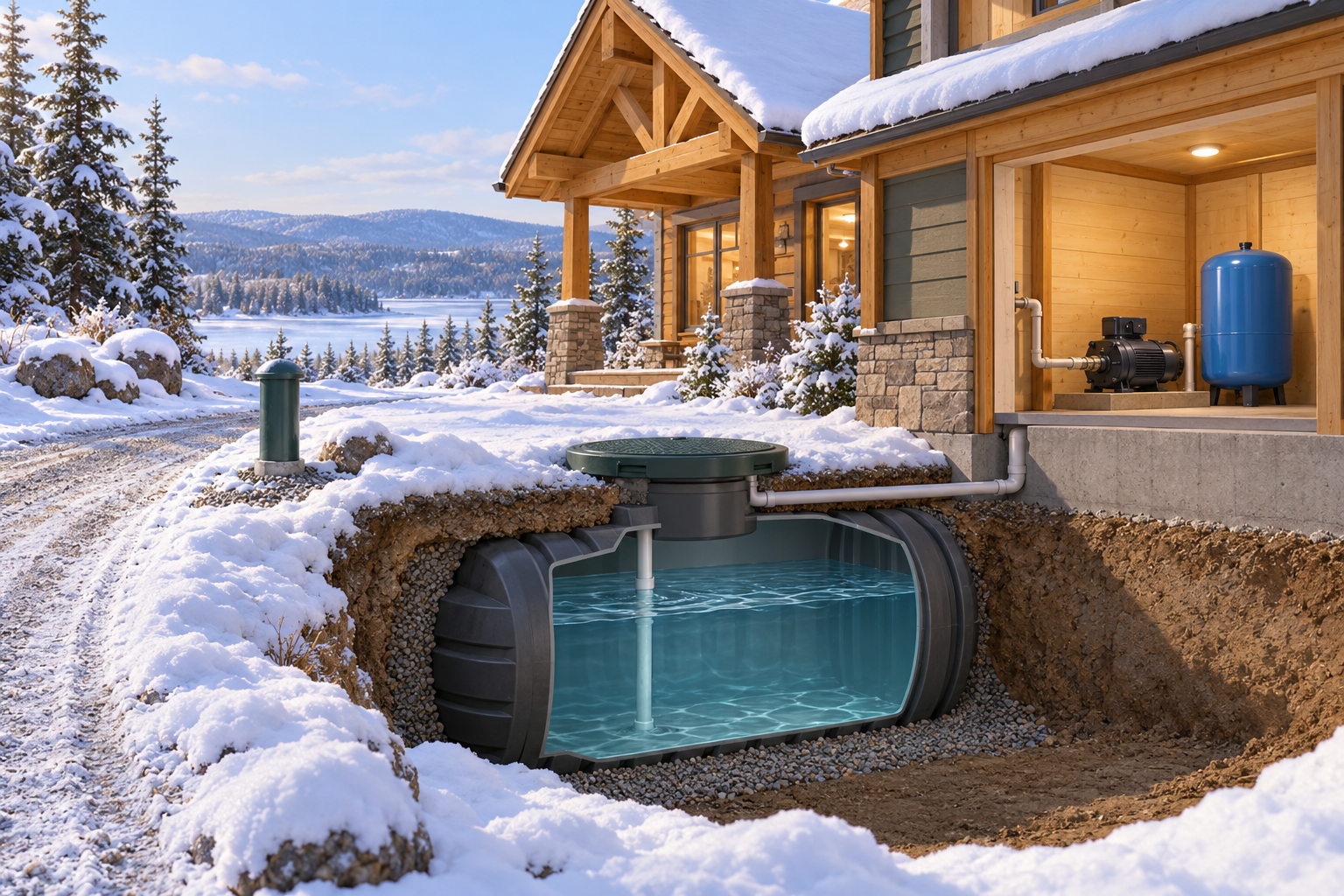
Stored water, delivery equipment and winter access are separate questions
The bulk cistern stores water, while the separate pump and small pressure tank illustrate pressure-delivery equipment. The snowy approach adds a delivery-access question. Pipe connections and winter protection are unresolved in this conceptual view.
No complete route/connection, pressure-tank branch, actual power state, frost depth, insulation/heat design, frozen-pipe diagnosis, backup runtime, thawing or restart procedure is established. A lit room is not evidence that the delivery system operates.
Read the picture labels and part explanations
- No text labels are baked into this picture; the visible part explanations follow.
- Bulk cistern and illustrated water
- Illustrate water held in storage. Neither appearance nor the drawn level establishes quality, usable reserve, replenishment or delivery interval.
- House-side pump
- Illustrates a delivery-equipment role. The image does not show whether it is powered, operating, primed, protected or connected to the depicted tank.
- Small blue pressure tank
- Illustrates pressure-delivery equipment distinct from bulk storage. Its actual branch connection and compatibility with the pump are not visible or established.
- Exterior capped landmark
- Provides an exterior point for the seasonal delivery discussion. Its buried connection and exact installed function are not established by this image.
- Snowy approach
- Illustrates a seasonal-access question for the actual hauler. No clearance, bearing, route suitability, snow-removal plan or assured access is established.
- Tank neck and white piping
- Show partial, ambiguous geometry. Do not label the pipe as a complete fill, vent or withdrawal route; reconcile the actual installation with its drawings and provider.
- Illustrative cutaway
- Reveals conceptual storage for teaching; it is not an open-tank or excavation scene, measured burial depth or winter-protection design.
Conceptual, unscaled view. These four views are not one verified identical installation; no measured property, approved fitting or operating state is established.
Which actual records and instructions explain this installation’s power interruption, winter protection and delayed delivery?
Sources for this lesson: Manitoba Conservation and Water Stewardship — Water Storage Tanks (Cisterns), Government of Alberta: Pressure Tanks (Agdex 716(C31), revised April 2005)
Which parts depend on electricity and winter protection?
A tank can contain water while a powered pump cannot deliver it. Ask the installer which pump, controls and treatment components are needed for the intended service and which are included in a separately assessed backup arrangement. No backup capacity or runtime follows from the words whole-home generator.
The existing private-well outage guidance retains Health Canada’s warning about drawing water and losing pressure during a well outage. Do not turn that well-specific advice into an invented procedure for every cistern. Ask the responsible provider and public-health authority what the actual installation requires after a power, pressure or treatment interruption.
For winter, request the documented protection of the tank, fill connection, lines and mechanical space. Manitoba’s older cistern sheet explains the freezing question, but its suggested burial depth is not a national frost-depth rule. Do not add improvised heaters, thaw pipes with flame or change electrical protection. A loss of water needs a qualified assessment rather than an assumed frozen pipe.
Follow the functional links on the actual equipment drawing: bulk water held in storage, withdrawal and pumping, controls, any required treatment, then the household outlets. Ask which link an interruption affects. The presence of stored water answers the storage question while leaving the powered delivery or treatment question open; a closed cabinet photograph cannot establish a working backup arrangement.
Keep the installer’s winter-protection scope and the hauler’s approach requirements together without confusing their jobs. The first concerns the installed tank, lines and equipment; the second concerns a delivery visit. Snow clearance cannot certify buried protection, and a protection record cannot confirm truck access. Refer detailed backup planning to the home outage guide, with the water provider’s actual instructions alongside it.
How do rainwater, dugouts and septic change the site conversation?
A storage container does not turn every source into drinking water. Keep a roof-runoff collection system separate in the property description from a delivered drinking-water cistern. Hamilton’s guidance warns against directing rainwater into its drinking-water cistern arrangement. A label such as water storage is not enough to identify the intended use of a second tank.
Ponds and dugouts receive surface runoff and have their own water-quality and land-management questions. Agriculture and Agri-Food Canada explains how that runoff can carry unwanted material. Saskatchewan’s livestock-water page considers source availability, water quality, pumping distance, power and relevant approvals for its agricultural context. Those resources do not clear pond water for a household tap.
Keep the water-hauler route, cistern location, sewage components, fuel storage and drainage in the same site conversation. HealthLink BC describes vehicle, excess-water and other interactions with onsite sewage systems. Ask the relevant local professionals to reconcile the actual layout. Do not copy an illustrated separation distance or draw an unverified exclusion circle as a design.
On the orientation record, give each water store an identity, source and intended use. Put the drinking-water cistern, roof-water container and any pond or dugout in separate entries. Do the same for the sewage tank and dispersal area. A simple symbol can help the conversation, but its position on a conceptual diagram is not a located component at this property.
Then bring the actual layout and delivery approach to the relevant people. Ask which dated drawing or assessment identifies each component and which route the hauler has considered. Leave unconfirmed locations and routes unresolved; do not join stores with a proposed pipe, copy a separation circle or route a heavy vehicle over an unverified sewage-system area. The septic-bed location guide explains those different records.
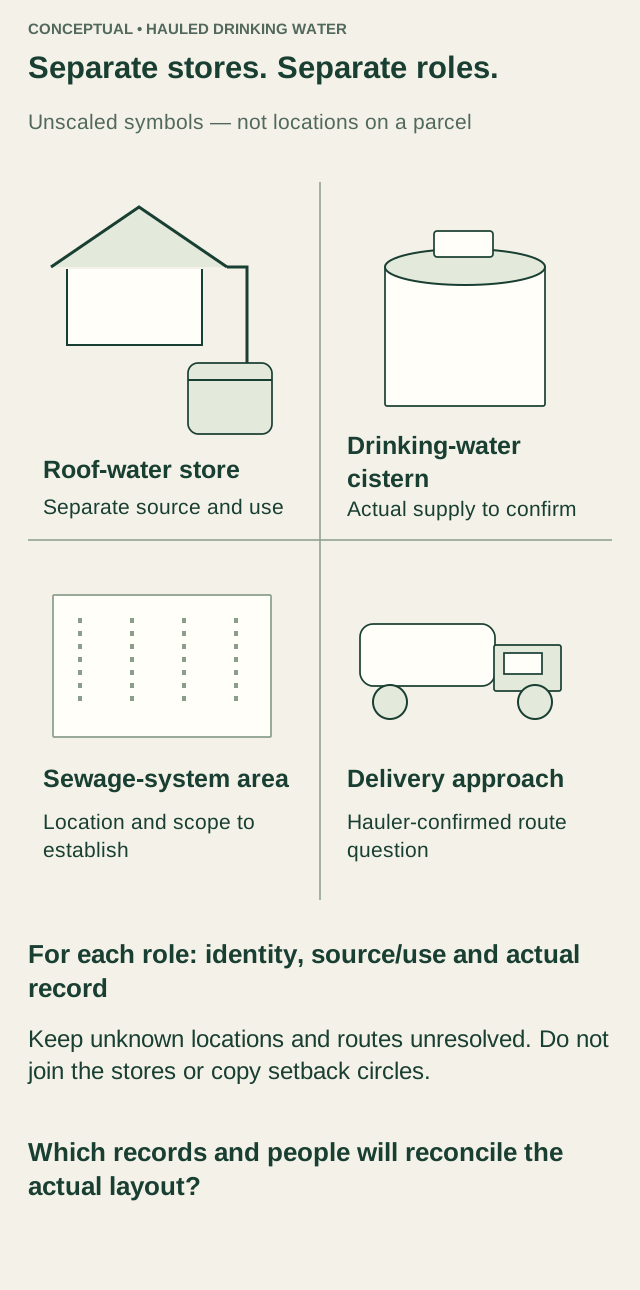
Keep drinking-water, roof-water, sewage and delivery roles distinct
The site conversation keeps drinking-water storage, other sources, wastewater and vehicle access in separate roles.
No potable classification for surface water, surveyed location, completed locate, setback, approved vehicle route, site design or property finding is established.
Read the picture labels and part explanations
- CONCEPTUAL • HAULED DRINKING WATER
- Separate stores. Separate roles.
- Unscaled symbols — not locations on a parcel
- Roof-water store
- Separate source and use
- Drinking-water cistern
- Actual supply to confirm
- Sewage-system area
- Location and scope to establish
- Delivery approach
- Hauler-confirmed route question
- For each role: identity, source/use and actual record
- Keep unknown locations and routes unresolved. Do not join the stores or copy setback circles.
- Which records and people will reconcile the actual layout?
- Drinking-water cistern
- Identify the actual source, intended household use and supply/service records. A container symbol alone does not establish safe drinking water.
- Roof-water store
- Keep a roof-runoff store as a separate source/use entry. Hamilton warns against directing rainwater into its drinking-water cistern arrangement; this symbol does not propose a connection.
- Sewage-system area
- The symbol stands for a location and assessment question, not a found dispersal area or safe exclusion boundary. HealthLink BC describes the separate tank/dispersal roles and vehicle/surface-water concerns in BC.
- Delivery approach
- The truck is a route question to resolve with the actual supplier and the relevant site information. No route crosses the sewage symbol, and no capacity or right of access is established.
- Ponds or dugouts elsewhere
- Add a separate actual record if the property has one. AAFC explains runoff-related water-quality concerns; Saskatchewan’s source-planning page is agricultural/livestock guidance, not household potable-water approval.
- Identity, purpose and record
- Reconcile the actual source, intended use, dated drawing or assessment and responsible response. Keep unknown routes and positions unknown rather than copying this arrangement onto a parcel plan.
A general label such as water storage can hide different purposes. A drinking-water cistern, roof-runoff tank, pond and sewage tank should not become interchangeable entries just because they all contain liquid.
The symbol board intentionally has no common scale, route lines, separation circles or located parcel features. Use the actual records and professional scopes to discuss the real layout and delivery access.
Original unscaled symbols, not a parcel map or construction arrangement. No numerical distances or capacity, connection between stores, load finding, setback circle or burial detail. Regional Hamilton and BC statements retain their limits; agricultural resources do not establish household drinking-water safety.
Which actual professionals and records will reconcile the component locations and delivery approach?
Sources for this lesson: City of Hamilton — Cistern Maintenance & Water Testing, Agriculture and Agri-Food Canada — Ponds and dugouts, Government of Saskatchewan — Dugout Development and Site Selection Tool for Livestock Watering, HealthLink BC — Maintenance and operation of onsite sewage systems
What changes for another dwelling, guests or a public-facing use?
A plan to serve another dwelling or a business should be described before the supply is extended. The technical demand, system responsibilities and applicable water-system classification may change. A domestic arrangement that serves one house is not evidence that a larger or different use is authorized.
Manitoba’s current permitting page explicitly distinguishes a single-home or cottage private supply from public and semi-public systems, while warning that other permissions may still be needed. Its classification is a Manitoba example. Elsewhere, ask the authority covering that address and intended use; do not reuse a provincial threshold from a different article.
Have the design and permission questions answered alongside wastewater, electrical and access implications. Keep each answer with its actual scope. The water supplier can explain delivery terms, but cannot by that conversation approve a second dwelling or settle all land-use questions.
Give the reviewing authority the intended users, activity and any planned supply extension, rather than asking only whether a larger tank is possible. Keep the response with that description and its date. If the activity changes again, ask what needs to be reconsidered. A delivery agreement, water sample or equipment quotation is not by itself a land-use or system-classification decision.
What should a buyer receive at handover?
Request one clear orientation page and the original supporting records. It should identify the tank and equipment, normal fill connection, supplier contacts, the actual sampling and service plan, recent results, completed work and anything unresolved. The best orientation lets the next owner find the right record without opening the tank or guessing which valve to use.
Keep drinking-water records separate from the septic service record, even when one property visit discusses both. The delivery history, water-quality report, tank inspection and pump-service invoice each have a different scope. A pumping receipt for the septic tank cannot describe the household drinking-water cistern.
A buyer’s advisers should explain how unresolved supply, condition or documentation questions affect their own financing, insurance, conditions and timing. This guide gives no property-specific approval or price deduction. Its practical goal is a complete question and a named next task before someone relies on an incomplete file.
Make responsibilities explicit at the handover. Who makes the delivery request, receives an advisory, maintains the equipment, follows up a result and updates the record after work? The next household needs actual contacts and instructions, not a provider name assumed to cover every role. Keep personal account details and access codes out of general copies shared for discussion.
Use the whole-property acreage buying guide to connect an unresolved supply question to the wider purchase enquiry. Here, keep the cistern’s unresolved item, responsible next enquiry and the record it requires clearly identified. A handover folder can be organized while an important answer is still pending.
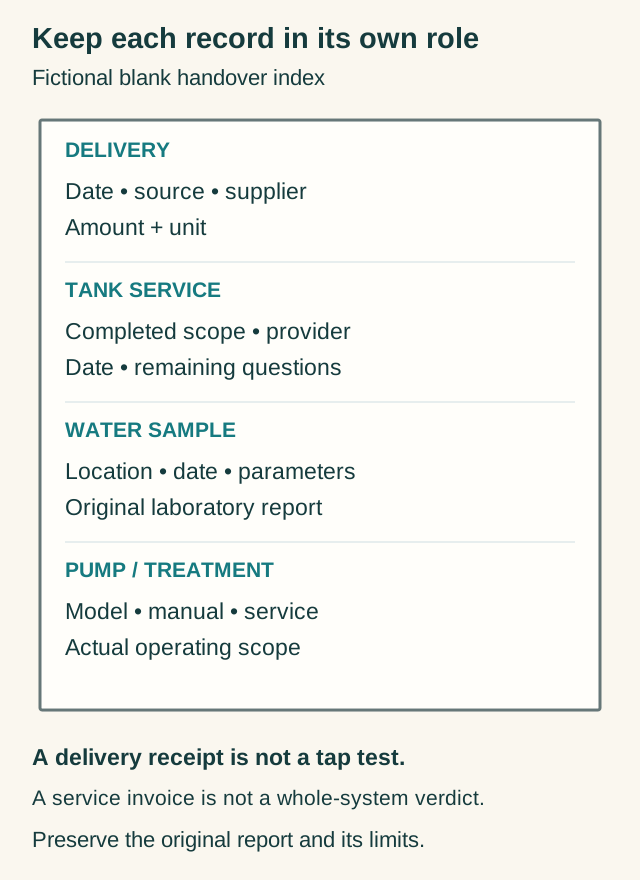
Keep each record in its own role
A clear handover separates the date and purpose of each record. Delivery, tank work, a water sample and equipment service have different scopes.
Fictional blank index; no result, provider credentials or completed work is represented.
Read the picture labels and part explanations
- Keep each record in its own role
- Fictional blank handover index
- DELIVERY
- Date • source • supplier
- Amount + unit
- TANK SERVICE
- Completed scope • provider
- Date • remaining questions
- WATER SAMPLE
- Location • date • parameters
- Original laboratory report
- PUMP / TREATMENT
- Model • manual • service
- Actual operating scope
- A delivery receipt is not a tap test.
- A service invoice is not a whole-system verdict.
- Preserve the original report and its limits.
- DELIVERY
- Date • source • supplier; Amount + unit.
- TANK SERVICE
- Completed scope • provider; Date • remaining questions.
- WATER SAMPLE
- Location • date • parameters; Original laboratory report.
- PUMP / TREATMENT
- Model • manual • service; Actual operating scope.
Conceptual information task; no property measurements or approved arrangement.
Which original report or service record is still missing?
Sources for this lesson: Manitoba Health — Bulk Water Hauling Guidelines, Health Canada — Well water and health: Test your well water, City of Hamilton — Cistern Maintenance & Water Testing
How would I use the guide this week?
Identify the actual supply and locate the records you already have. Match the supplier, tank, pumping arrangement and any treatment equipment without opening equipment or tank access. Write down the normal delivery booking route and the current local public-health contact.
Then resolve the most consequential gap: an unknown water source, damaged external protection, missing laboratory follow-up, an unconfirmed winter delivery arrangement or an unclear service scope. Give that question to the appropriate provider. Mark a task complete when the action or result actually exists, and retain any stated limit.
For the wider acreage, continue to the acreage living guide, the rural-water quantity guide, the septic care guide and the private-road guide. They explain their own systems; this lesson connects the delivered drinking-water chain and its household responsibilities.
Use the blank record below for display meaning and booking instructions, delivery communications, sampling or other events, service scope and handover. Write on your own printed or private copy. The worksheet has no form fields and does not store or send a completed record. Leave an answer blank or explicitly unresolved until the actual response, work or result exists.
Your cistern: booking, sampling, service and handover record
Use a blank printed or private copy. On a narrow screen, scroll each table horizontally to read every column. This worksheet has no form fields and does not store or send a completed record.
Record what the actual source, supplier, installer, laboratory or public-health advice establishes. Retain the date, sample location, version and remaining limits. Leave an answer unresolved until the action or response exists. Keep account passwords, access codes and other secrets out of copies shared for general discussion.
Display meaning and the actual booking instruction
| Question or identity | Your actual record, date and limits |
|---|---|
| Tank/display identity and matching instruction reference | |
| What does the display report? Actual unit or meaning | |
| Provider’s stated basis and limitations of the reading | |
| Actual reading and time/date, if available | |
| Supplier contact and actual request method | |
| Provider-confirmed reorder instruction; who confirmed it and when | |
| Supplier’s actual booking response and relevant delivery arrangement | |
| What follow-up applies if the reading is unavailable or conflicts? | |
| Installer/owner instructions and current version/date |
Keep request, booking and delivery separate
A sent request is not a confirmed booking. A confirmed booking is not a completed delivery. Enter an actual volume only with its unit and record source.
| Request/date and response actually received | Supplier, stated source and vehicle identity if supplied | Actual delivery date/time and amount with unit | Record reference and what the supplier reported | What you observed; observation date/location | Unresolved question, responsible contact and follow-up |
|---|---|---|---|---|---|
Record the event and the actual sampling follow-up
The local plan, a collection, laboratory acceptance, a result and advised action are different records. Follow the laboratory’s actual instructions; this table supplies no sample procedure or testing schedule.
| Event/question and current local advice/reference | Stated sample location and treatment context | Actual collection date and laboratory acceptance/reference | Original result/report date and parameters covered | Responsible advice, restrictions and follow-up | Action actually completed/date; remaining limits |
|---|---|---|---|---|---|
Separate the proposed service from completed work
Identify correction, cleaning, disinfection and return-to-use advice separately. Leave disposal and water-during-work responsibilities with the actual service scope; this sheet gives no chemical, isolation, entry, disposal or restart instructions.
| Concern and actual installation/component identity | Proposed correction/cleaning/disinfection scope; exclusions | Responsible service/advice contact and scope reference | Actual advice for water during work and disposal responsibility | Work actually recorded/date and completion information | Return-to-use advice/reference; follow-up and remaining limits |
|---|---|---|---|---|---|
Leave a usable handover
| Question or identity | Your actual record, date and limits |
|---|---|
| Normal fill connection, secured access and component drawing reference | |
| Supplier/source records and the current delivery-request arrangement | |
| Tank, pump/control and treatment identity/manual references | |
| Actual public-health/laboratory contacts and local sampling plan | |
| Recent result locations/dates, actual advice and unresolved items | |
| Completed service records and outstanding completion information | |
| Actual seasonal approach and equipment-protection instructions | |
| Who requests delivery, receives notices, follows results and updates records? |
A complete record keeps each answer within its scope. This blank sheet supplies no source approval, supplier availability, water-quality finding, usable reserve, technical design or authority to extend the system.
Know what the words mean
- Cistern
- A container used to store water; its source, intended use and suitability must be established separately.
- Potable water
- Water suitable for drinking under the applicable water-quality requirements; a storage-tank label does not establish that its contents are potable.
- Fill port
- The designated connection where water is transferred into the cistern.
- Withdrawal connection
- The connection taking water from storage toward the downstream system.
- Sampling location
- The actual place water was collected for a laboratory test, retained with the date and parameters.
- Usable storage
- The volume available within the documented usable operating range, rather than simply the gross tank capacity.
- Confined-space work
- Work requiring the applicable trained assessment and controls for an enclosed or partly enclosed space; this guide gives no owner entry clearance.
Questions to bring
- Which water source and vehicle supplied the last delivery?
- Which connection is the normal fill port and who maintains its protection?
- Which drawing identifies the actual tank, pump, controls and any treatment?
- What does the level display report, and when is delivery booked?
- Which local sampling plan and laboratory apply to this address?
- What does the hauler require for winter access?
- Which service work and laboratory follow-up are complete, and what remains unresolved?
Sources and further reading
Original HomeAI explanation informed by these references. Sources have not reviewed or endorsed HomeAI. Illustrations are conceptual. The source review date is 2026-10-26.
- Manitoba Conservation and Water Stewardship — Water Storage Tanks (Cisterns)
Manitoba historical general cistern fact sheet
Component mechanism and roles; broad access/quality/delivery/placement questions. Modern provider confirmation required for actual design.
Source date as reported: 2014-03
- City of Hamilton — Cistern Maintenance & Water Testing
Hamilton, Ontario, household private cisterns
Hamilton, Ontario: local cistern maintenance, protection, bacterial-testing example and distinction from roof-water storage. Its local schedule is not a Canadian schedule.
Source date as reported: 2026-09-03
- Manitoba Health — Bulk Water Hauling Guidelines
Manitoba bulk drinking-water haulers
June 2026 Manitoba bulk-water guidance: source, vehicle, transfer equipment and activity records. No hauler, source or vehicle is approved by HomeAI.
Source date as reported: 2026-06
- City of Hamilton — Drinking Water Haulers
Hamilton, Ontario, public-health vehicle inspection context
Hamilton, Ontario: public-health vehicle inspection and protection of tanks, equipment and connections during storage, filling, transport and delivery.
Source date as reported: 2022-06-27
- CCOHS — Confined Space: Introduction
Canada occupational safety introduction; jurisdiction rules differ
Canadian occupational-safety introduction: confined-space hazards, changing conditions and the need for competent assessment. No tank-entry, testing, isolation, ventilation or rescue procedure is supplied here.
Source date as reported: 2025-03-12 fact sheet; page modified 2026-10-20
- Government of Nova Scotia — Water shortages: guidance for private well owners
Nova Scotia, private-well shortage response
Separate storage can supplement low-yield well; never pour other supplies into a well; actual alternative-source and local-response questions.
- Health Canada — Well water and health: Test your well water
Canada, private-well water quality; cistern application only via local public-health/laboratory scope
Different microbial/chemical/general tests; proper sample context; appearance not complete evidence; accredited/local laboratory route.
Source date as reported: 2024-12-12
- Alberta Health Services / MyHealth Alberta — How to clean and disinfect a cistern
Alberta household cistern guidance
Alberta Health Services, current May 2, 2025: correction of contamination problems before cleaning/disinfection, regional bacterial-testing example and service/disposal questions. No owner chemical or tank-entry procedure.
Source date as reported: 2025-05-02
- Health Canada — Well safety during and after emergencies
Canada, private wells; not a universal cistern outage procedure
Powered delivery, well-specific pressure-loss boundary, backup-supply importance and winter dependencies.
Source date as reported: 2024-08-02
- Agriculture and Agri-Food Canada — Ponds and dugouts
Canada, farm-water ecosystem explanation; historical technical page
Agriculture and Agri-Food Canada, modified 2020-01-24: ponds/dugouts and material carried by runoff. Agricultural explanation is not approval of household drinking water.
Source date as reported: 2020-01-24
- Government of Saskatchewan — Dugout Development and Site Selection Tool for Livestock Watering
Saskatchewan agricultural/livestock source planning
Saskatchewan livestock-water planning: source, quality, pumping, power and approvals questions in its agricultural context. No livestock threshold, spacing, programme eligibility or household-water finding.
- HealthLink BC — Maintenance and operation of onsite sewage systems
British Columbia onsite sewage systems
Tank/soil treatment distinction and effects of vehicle routes, drainage, excess water and changed use.
Source date as reported: 2025-03-12
- Province of Manitoba — Constructing or Altering a Drinking Water System (Permits)
Manitoba private/public/semi-public supply classification
Manitoba drinking-water permitting page distinguishes private domestic supplies from public/semi-public systems while retaining other approval questions. No classification is determined for a property.
- Government of Alberta: Pressure Tanks (Agdex 716(C31), revised April 2005)
Alberta; historical farm-water education; component mechanism only
Compressed-air delivery and usable water between pump cycles, including air-water contact and diaphragm separation. Historical component explanation only; no sizing threshold, pressure setting, installation design or maintenance prescription.
Source date as reported: 2005-04
Connected reading
- Rural water: understand replenishment, delivery and usable storage ↗
- Know what your private well is supplying ↗
- Buying a home with a well: quality, quantity and the record ↗
- Care for a septic system without guessing ↗
- Buying with septic: assess the whole treatment system ↗
- Where is the septic bed? Understand the yard before planning changes ↗
- Rainwater collection: follow the roof, the store and the overflow ↗
- A power outage plan for heating, water and communications ↗
- Private roads and shared services: connect access, upkeep and the actual agreement ↗
- Home water filters and UV treatment: understand what each part does ↗
- Water softeners: understand service, regeneration and the limits ↗
- Canadian acreage living: understand the whole property before taking it on ↗
- Buying a Canadian acreage: make the whole property work before you commit ↗
Have a question about your property?
Start with what you know and the decision you need to make. Keep addresses and personal details out.
Ask HomeAI